
Every morning, we see the sun rise in the east, and by evening, it slowly sets in the west; to most people, the sun's daily path appears much the same. However, if you stand in one spot and photograph the sun at the same time every day for a full year—then stack all the images together—you will be amazed to discover that the sun’s trajectory across the sky forms an elegant, asymmetrical figure-eight shape. This fascinating phenomenon is known in astronomy as the *analemma*.
The solar analemma is not only a favorite challenge for astrophotography enthusiasts but also serves as a valuable educational tool for understanding concepts such as Earth's orbital motion, axial tilt, the sun's apparent motion, and the difference between apparent solar time and mean solar time. From North America and Europe to the Southern Hemisphere, many observatories use the analemma to demonstrate the true nature of Earth's motion to the public.
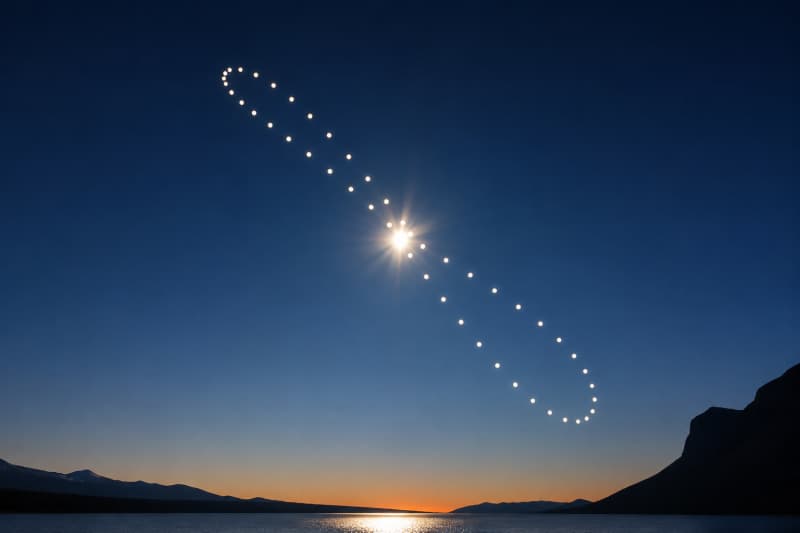
What is a Solar Analemma?
An analemma is a trajectory formed by superimposing the positions of the sun recorded at the exact same time of day over the course of a full year. Because the resulting composite path resembles the figure "8," it is often referred to in Chinese as the "Solar Figure-8 Diagram" (or simply *analemma*).
It is important to note that an analemma does not represent the sun's path over a single day; rather, it tracks the sun's changing position at the same time each day throughout the year. For instance, if you photograph the sun at 3:00 PM daily, the 365 recorded positions will form a complete analemma by the end of the year.
For astronomy enthusiasts in North America—whether in Canada or the United States—capturing a relatively complete analemma is achievable simply by maintaining a consistent time and fixed location for photography. However, the tilt angle, size, and orientation of the resulting analemma will vary depending on the observer's latitude.
Today, the analemma has become a classic subject in international astrophotography competitions. It is highly popular among astronomy enthusiasts not only for its artistic merit but also for its ability to visually demonstrate the patterns of Earth's motion.
Why does the solar analemma form a figure-8 shape?
Upon seeing the solar analemma for the first time, many people cannot help but ask: why isn't it a circle or an ellipse, but rather an irregular figure-8?
In reality, the analemma is the result of the combined effects of the Earth's axial tilt and its elliptical orbit around the Sun. It is the interplay of these two factors that causes the Sun to appear in different positions at the same time each day, ultimately creating this unique solar path.
Axial Tilt Determines the Sun's Vertical Movement
The Earth's axis of rotation maintains a tilt of 23.4° relative to its orbital plane. This angle dictates the continuous variation in the Sun's altitude throughout the year and is the fundamental cause of the four seasons.

Around the summer solstice, solar declination reaches its maximum, and the Sun attains its highest altitude at noon in the Northern Hemisphere; conversely, around the winter solstice, solar declination is at its minimum, and the Sun's altitude at noon drops to its lowest point of the year. The spring and autumn equinoxes fall between these extremes. As solar declination shifts, the Sun's position at a fixed time each day slowly moves northward or southward, creating the upper and lower loops of the solar analemma. If the Earth lacked this axial tilt, the Sun would maintain the same altitude every day, and the analemma would not exhibit this vertical variation.
An Elliptical Orbit Causes Lateral Shifts in the Sun's Position
In addition to the tilt of Earth's axis, the orbit in which Earth revolves around the Sun is not a perfect circle but an ellipse. According to Kepler's Second Law, Earth moves faster when near perihelion and slower when farther from the Sun. Consequently, the Sun's apparent motion across the celestial sphere is non-uniform; its speed varies, sometimes exceeding the average rate and sometimes falling behind it.
The clocks we use daily rely on "mean solar time," which progresses at a constant rate, whereas the Sun's actual movement is irregular. This discrepancy causes the Sun to shift slightly east or west when observed at the same time each day. The combination of these vertical and horizontal shifts ultimately creates the irregular figure-eight pattern—known as an analemma—that we observe today.
What would the solar figure-eight pattern look like if Earth's conditions were different?
To better understand the solar figure-eight pattern, let us consider a few simple hypothetical scenarios. If Earth had no axial tilt and orbited the Sun in a perfectly circular path, the Sun would appear in the exact same position at the same time each day; the resulting record would be a single point rather than a trajectory.
If the orbit remained circular but Earth had an axial tilt of 23.4°, the Sun would move only in a north-south direction, resulting in a figure-eight pattern that is perfectly symmetrical vertically.
If the axial tilt were removed while the elliptical orbit was retained, the Sun would not shift vertically but would oscillate horizontally, creating a horizontally elongated elliptical path.
In reality, Earth possesses both an axial tilt and an elliptical orbit; consequently, the solar figure-eight pattern exhibits both vertical variation and horizontal displacement, with loops of unequal size—resulting in the asymmetrical analemma we observe today.
What is the relationship between true solar time, mean solar time, and the solar *Ba Zi* chart?
To better understand the solar *Ba Zi* chart, one must also grasp another important concept: the distinction between true solar time and mean solar time. True solar time is determined by the sun's actual movement; local "true noon" occurs when the sun reaches its highest point over the local meridian. However, because the Earth's orbital speed varies—due to the nature of its elliptical orbit—true solar time does not progress at a perfectly uniform rate from day to day.
To facilitate the smooth functioning of society, mean solar time was introduced; this is the standard time used by clocks, mobile phones, and computers today. Mean solar time assumes a constant daily solar speed, resulting in the uniform passage of time.
A discrepancy arises daily between these two timekeeping methods, a phenomenon known as the "Equation of Time." Over the course of a year, this discrepancy can reach more than ten minutes, causing the sun to appear slightly shifted to the east or west at the same clock time each day. It is the combination of the Equation of Time and the variation in solar declination that determines the complete shape of the solar *Ba Zi* chart; consequently, the analemma serves as the most intuitive visual representation of the Equation of Time.
How do you capture your own solar analemma?
For an astronomy enthusiast passionate about astrophotography, capturing a complete solar analemma—a figure-eight pattern traced by the sun over the course of a year—is a long-term project that tests patience but offers immense satisfaction.

First, you need to select a fixed observation site that remains unobstructed by buildings or trees throughout the year and ensure the camera's position remains unchanged for the entire duration of the project. Second, you must take the photo at the same time each day—such as noon or 3:00 PM local time—while maintaining consistent focal length, exposure settings, and framing.
Additionally, because the sun is extremely bright, using a professional solar filter is mandatory; never observe the sun directly through a telescope or telephoto lens, as this can damage your equipment or cause serious eye injury.
After a year of shooting, you can use post-processing software to stack all the images and create the complete solar analemma. Since overcast or rainy weather may prevent shooting on certain days, many photographers require two years or even longer to complete a full image.
If you live in a region with frequent sunny weather—such as Arizona, California, or Nevada—your chances of successfully completing a solar analemma project within a year are significantly higher than in the Northeastern United States or coastal Canada.
FAQs: What else you might want to know about solar analemmas
Many beginners new to astrophotography assume that simply photographing the sun continuously will yield the desired "figure-8" solar analemma. In reality, the key lies in maintaining the exact same shooting time and a fixed camera position every day; otherwise, the resulting path will show significant deviation.
Another common question is whether solar analemmas captured in different countries look the same. The answer is no. Because geographic latitudes differ, the sun's altitude in the sky varies; consequently, the analemmas observed in North America, Europe, Asia, and the Southern Hemisphere will exhibit distinct differences.
Additionally, a solar analemma does not necessarily form a perfect "figure-8" shape. Depending on the observation latitude, the time of day, and the orientation relative to the horizon, some analemmas may appear more elongated while others show a distinct tilt—all of which are normal phenomena.