
In the vast Milky Way galaxy, some celestial objects are memorable enough to be remembered simply from photographs, and the Pillars of Creation are undoubtedly one of the most famous cosmic sights. Located within the Eagle Nebula M16, they are composed of massive amounts of gas and dust, resembling fingers, stalagmites, or an elephant's trunk reaching into space. In 1995, the Hubble Space Telescope captured an image of the Pillars of Creation that became one of the most iconic images in modern astronomy, bringing this distant star-forming region into the public eye.
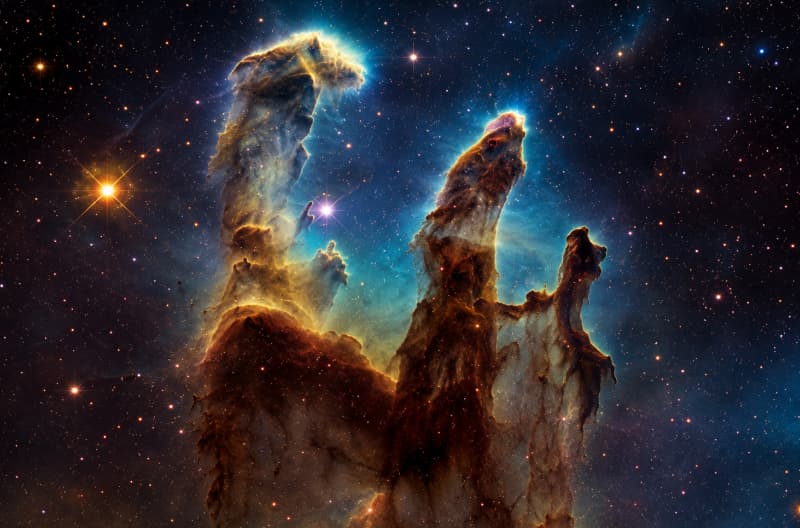
For novice astronomers in North America, the Pillars of Creation are not only a valuable deep-sky object to learn about, but also an excellent case study for understanding nebulae, star formation, and interstellar dust. However, it's important to note that the columnar structure of the Pillars of Creation is not directly visible to the naked eye. Even with better amateur telescopes, what can be observed is primarily the Eagle Nebula and the surrounding stellar region, not the three clearly discernible giant "pillars" in the photograph.
Where are the Pillars of Creation located?
The Pillars of Creation are located within the Eagle Nebula, designated M16 by Messier. M16 is situated in the constellation Serpens, more precisely in the serpent's tail region. Serpens is unique in that it is the only one of the 88 modern constellations to be divided into two discontinuous regions by the constellation Ophiuchus.
The Eagle Nebula is not a small, isolated cloud of gas, but a large star-forming region. NASA data shows that M16 contains emission nebulae and the young open cluster NGC 6611, and the Pillars of Creation are located within this complex star-forming environment. M16 is approximately 7,000 light-years from Earth, and the light visible on its surface has actually traveled through the universe for thousands of years.
Why do the Pillars of Creation look like giant stalagmites?
A closer look at photographs of the Pillars of Creation reveals that they are not solid rock structures, but rather massive interstellar cloud pillars composed of gas and dust. The primary component is cold hydrogen gas, mixed with a large amount of dust. The pillar-like structure has persisted for so long because the denser gas and dust within them are more resistant to the intense radiation and stellar winds emitted by young stars than the surrounding sparser matter.
The Pillars of Creation are surrounded by numerous young, hot, and massive stars. These stars release intense ultraviolet radiation and high-speed stellar winds, constantly eroding the surrounding gas. The less dense material is gradually blown away, while the denser regions are temporarily retained, forming the pillar-like structure we see today.
In other words, the Pillars of Creation are not "rocks floating in space," but a massive cosmic structure shaped by stellar radiation and interstellar matter.
Why are the Pillars of Creation called the "Pillars of Creation"?
The name is related to the star-forming activity in the region where they are located.
Within the Pillars of Creation and at the top of the columnar structures, you can find very dense clumps of gas and dust. These clumps gradually collapse under their own gravity, providing conditions for the formation of new stars. NASA describes these regions as stellar "cradles" where young stars are forming.
Therefore, "creation" doesn't mean that these pillars themselves produce stars, but rather that the gas and dust environment they contain is nurturing a new generation of stars. For novice astronomy enthusiasts, this is also a very intuitive example of understanding the star formation process: stars don't appear out of thin air, but gradually form from dense matter in giant molecular clouds.
How big are the Pillars of Creation?
While the Pillars of Creation in the photos appear to be only a small part of the Eagle Nebula, they actually possess an astonishing scale. Current NASA data indicates that classic Pillars of Creation structures are approximately 4 to 5 light-years high, while in a recently released NASA image of a single pillar, one structure reaches a height of about 9.5 light-years, the exact figure depending on the extent of the structure being referred to.
It's important to correct a common misconception: it's incorrect to say that "each Pillar of Creation is only four or five light-years long." The three main pillars in classic Hubble images are approximately several light-years in size, and the extent of the pillars covered by different observations is not entirely the same.
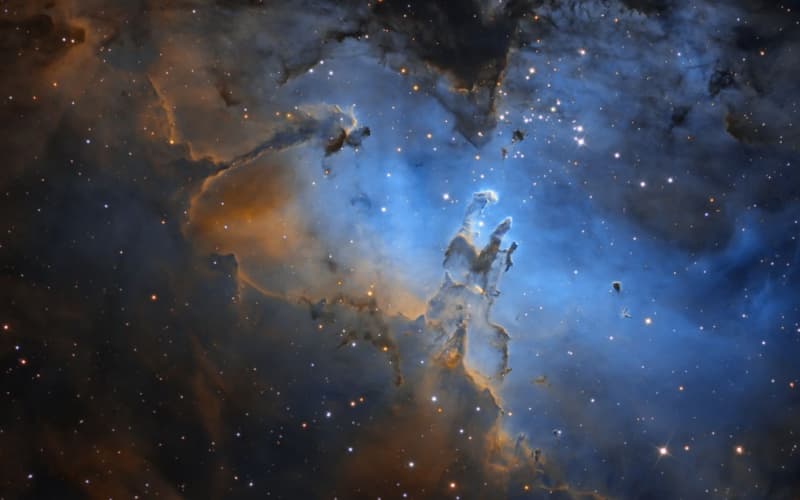
The entire Eagle Nebula is far larger than the Pillars of Creation. NASA data shows that the main body of M16 spans approximately 70 × 55 light-years, therefore the Pillars of Creation are only a relatively small region within the entire Eagle Nebula.
Did Hubble really capture the "birth" of the Pillars of Creation?
No. The 1995 Hubble image simply gave us our first truly stunning view of this region.
The Hubble Space Telescope obtained the original classic image on April 1, 1995, using the second-generation Wide Field Planetary Camera (WFPC2). In September 2014, Hubble observed the region again, using the newer WFC3 instrument to obtain higher-resolution visible and infrared images. These images were subsequently released in 2015.
Infrared observations are particularly important because infrared light penetrates dust more easily, revealing stars obscured in visible light images and more detail within the pillar-like structures. This is why the Pillars of Creation look quite different in images taken by different telescopes.
Was the Pillars of Creation destroyed by a supernova?
This is one of the most interesting and misunderstood questions regarding the Pillars of Creation.
Early infrared observations found evidence of possible massive stellar explosions near the Eagle Nebula, leading to a bold hypothesis: **The Pillars of Creation may have already been destroyed by the shockwave of a supernova explosion, but the light from that explosion hasn't yet reached Earth.** This hypothesis was widely discussed in research around 2007.
However, subsequent Hubble observations in 2014 did not find direct evidence that the Pillars of Creation had been destroyed by a supernova. Therefore, the statement that "the Pillars of Creation have disappeared" cannot be considered a definitive fact. A more rigorous statement is: Speculations about its future or past state existed in the past, but the Pillars of Creation we see today still exist.
This also reflects an important concept in astronomy—due to the finite speed of light, what we see is not the "present" state of a celestial body, but rather the light it emitted thousands of years ago.
Can you see the Pillars of Creation with a telescope?
For novice astronomers in North America, this is the most important thing to know beforehand: seeing the Eagle Nebula does not mean you can see the Pillars of Creation.
NASA data shows that M16 has an apparent magnitude of approximately 6. In sufficiently dark skies and good observing conditions, small telescopes have a chance to detect the Eagle Nebula and its related star clusters.
However, the Pillars of Creation are only a small part of M16 and are low-contrast, diffuse structures of gas and dust. To discern the clear pillar outlines in photographs visually, you need a larger telescope, excellent sky transparency, and low light pollution. Ordinary binoculars are better suited for locating the region of M16 than for directly appreciating the fine structure of the Pillars of Creation.
Therefore, if you're observing the Eagle Nebula in North America during the summer, set your goal as "finding M16" rather than expecting to see the famous three pillars with the naked eye.