
When observing the night sky in the Southern Hemisphere for the first time, one immediately notices distinct differences compared to the Northern Hemisphere. Beyond the spectacular view of the Milky Way, the southern sky features numerous celestial objects that are rarely—or never—visible from the mid-to-high latitudes of the Northern Hemisphere, such as the Southern Cross, Alpha Centauri (Rigil Kentaurus), Canopus, and the Large and Small Magellanic Clouds. These objects serve as prominent landmarks in the southern night sky.
For astronomy enthusiasts traveling to Southern Hemisphere regions—such as Australia, New Zealand, South Africa, Chile, Argentina, and Brazil—it is important to familiarize themselves beforehand with the locations of key celestial objects.
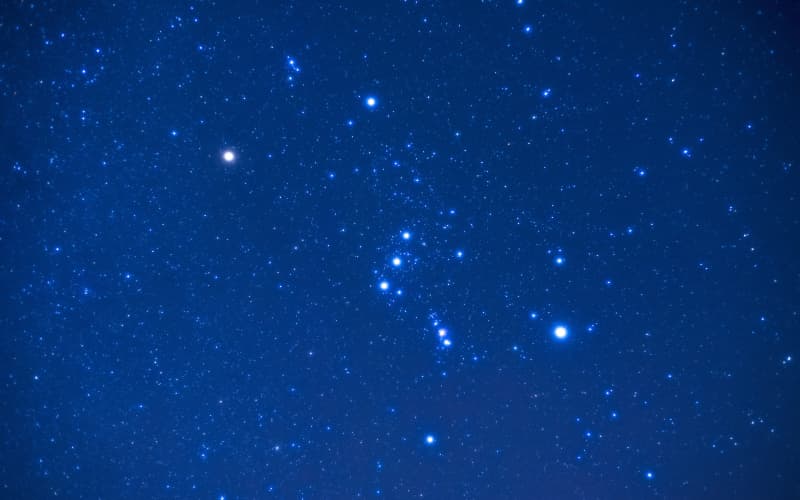
Beginners are advised against trying to locate fainter constellations right away; instead, they should first master a few bright stars and striking deep-sky objects. By using the relative positions of these objects as a guide, they can gradually gain an understanding of the southern sky as a whole.
The greatest advantage of stargazing in the Southern Hemisphere is the opportunity to view celestial features that are invisible from the mid-to-high latitudes of the Northern Hemisphere. Because the Earth's axis of rotation is fixed, the portion of the celestial sphere visible to observers varies depending on their latitude.
Canopus: A Crucial, Second-Brightest Star in the Southern Hemisphere
**Canopus** is one of the most prominent bright stars in the southern night sky and the second-brightest star in the entire sky, surpassed only by Sirius. Located in the constellation Carina, it has an apparent magnitude of approximately -0.7 and lies about 300 light-years from Earth.
It has been noted that at latitudes around 33° South, Canopus sits low in the sky just after nightfall in August, meaning observers may need an unobstructed view of the southern horizon. While this assessment is largely correct, the claim that "Canopus cannot be seen from low-latitude regions of the Southern Hemisphere" requires correction. In reality, the further south one goes, the higher Canopus typically rises; at 33° South, it reaches a clearly visible altitude, even if it appears low in the sky at the onset of darkness in early August. With a declination of approximately -52.7°, Canopus is well-positioned for observation across most of the Southern Hemisphere, whereas in the Northern Hemisphere, it is visible only from lower latitudes.
This presents an interesting latitudinal distinction for observers in North America. While Canopus is invisible from most of the continent, the chances of spotting it increase significantly if one travels to Hawaii, southern Mexico, or regions at even lower latitudes.
The Large and Small Magellanic Clouds: The Southern Sky's Most Distinctive "Clouds"
When gazing at the Milky Way from the Southern Hemisphere, one can spot two unique, hazy patches of light: the Large Magellanic Cloud (LMC) and the Small Magellanic Cloud (SMC). Although they resemble faint clouds, they are not ordinary nebulae within the Milky Way; rather, they are dwarf galaxies located in our galaxy's vicinity.
According to NASA data, the Small Magellanic Cloud is a satellite galaxy of the Milky Way situated approximately 200,000 light-years away, containing a vast number of stars, star clusters, and gas structures. The Large Magellanic Cloud is also a satellite galaxy of the Milky Way, located about 200,000 light-years from Earth, and is home to active star-forming regions such as the famous Tarantula Nebula.
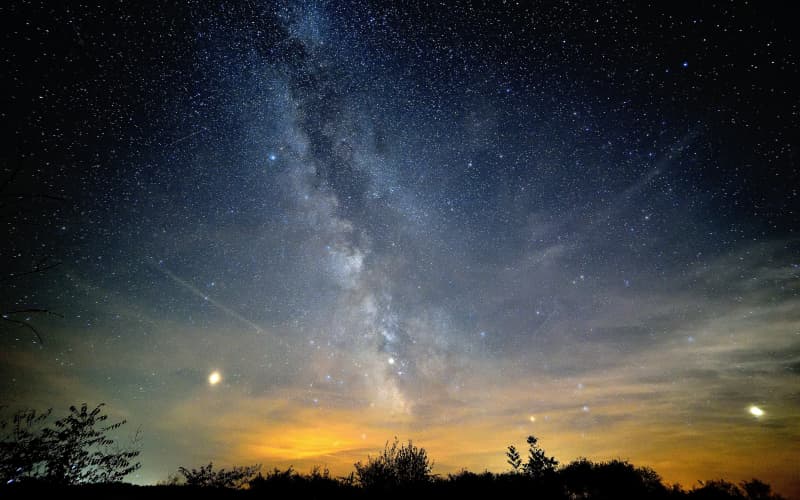
In the dark skies of the Southern Hemisphere, far from city lights, both objects are visible to the naked eye. For novice stargazers, their greatest appeal lies in the realization that what you are seeing is not merely a patch of galactic gas or dust, but an entirely separate galaxy—home to billions of stars—located hundreds of thousands of light-years away.
The Southern Cross: A Key Landmark for Locating the Southern Sky
**The Southern Cross (Crux)** is one of the most iconic constellations in the Southern Hemisphere and a primary target for beginners exploring the southern night sky.
Although the Southern Cross is relatively small in area, its shape is highly distinctive. Once located, its position can be further verified using nearby bright stars such as Alpha Centauri (Rigil Kentaurus) and Beta Centauri (Hadar). These two stars are often referred to as the "Pointers" because, in conjunction with the Southern Cross, they help observers determine the approximate direction of the South Celestial Pole.
It is important to note that the Southern Cross is not the South Celestial Pole itself; rather, it serves as a convenient navigational landmark. By extending the long axis of the cross and using the nearby Pointers, one can more accurately estimate the location of the South Celestial Pole.
For novice stargazers from North America, mastering this method is particularly valuable, as the familiar Big Dipper and Polaris—which serve as navigational guides in the Northern Hemisphere—do not fulfill the same role in the Southern Hemisphere.
Alpha Centauri and Hadar: The Southern Sky's Most Famous Pair of Bright Stars
**Alpha Centauri** is one of the most famous star systems in the southern sky and the closest to our Solar System. According to NASA data, it lies approximately 4.3 light-years from Earth and consists of three stars: Proxima Centauri (the closest of the three), and Alpha Centauri A and B, which form a tight binary system.
A clarification regarding brightness is necessary here: while the combined brightness of Alpha Centauri A and B—if considered as a single unit—ranks among the brightest stellar sources in the night sky, Alpha Centauri A individually is generally ranked as the fourth-brightest star overall, not the third. NASA explicitly lists Alpha Centauri A as the fourth-brightest star in the sky.
Locating this pair of bright stars near the Southern Cross is a highly practical way to familiarize oneself with the southern night sky. Under good seeing conditions, one can even attempt to resolve Alpha Centauri A and B individually using a small telescope.
The Southern Milky Way and the Carina Nebula
Another region of the Southern Hemisphere's Milky Way well worth observing is the area near the constellation Carina. Situated within the Milky Way, this region boasts a high density of stars and is home to the famous Carina Nebula.
The Carina Nebula is a massive emission nebula located approximately 7,500 light-years from Earth; spanning over 300 light-years, it contains numerous massive stars and active star-forming regions. NASA notes that this area hosts many giant stars with masses dozens of times that of the Sun, making it a crucial region for studying star formation.
While comparing it to the Orion Nebula serves as a useful entry point for beginners to understand deep-sky objects in the southern sky, one should not simply assume it is "necessarily brighter" than the Orion Nebula. Factors such as different brightness metrics, apparent size, and observing conditions can influence the comparison. In terms of actual observation, the visual spectacle of the Carina Nebula in the dark skies of the Southern Hemisphere is truly impressive.
How can stargazers from North America plan a trip to the Southern Hemisphere?
When traveling from North America to the Southern Hemisphere for stargazing, it is advisable to first select a dark-sky location far from city lights and to check the local month, moon phase, and the rise and set times of celestial objects in advance. Since the seasons in the Southern Hemisphere are the reverse of those in the North, a trip during the North American summer might coincide with the Southern Hemisphere's winter; furthermore, the visibility of the Milky Way and certain southern celestial targets varies with the season.
During actual observation, you can locate objects in this order: the Milky Way, the Southern Cross, the Pointers (Alpha and Beta Centauri), Alpha Centauri (Rigil Kentaurus), Canopus, and the Magellanic Clouds. This approach helps you quickly orient yourself to the southern sky while gradually learning to distinguish between stars, constellations, and galaxies.
Regarding equipment, the naked eye is sufficient to view Canopus, the Southern Cross, Alpha Centauri, and the Large and Small Magellanic Clouds, while a pair of binoculars will significantly increase the number of visible stars. If using a telescope, you can further observe the Carina Nebula as well as the rich variety of star clusters and nebulae found in the southern sky.
What are the most iconic celestial objects worth seeing in the Southern Hemisphere's night sky?
If you are observing the Southern Hemisphere sky for the first time, a few key names are worth remembering: Canopus, the Southern Cross (Crux), Alpha Centauri (Rigil Kentaurus), the Large and Small Magellanic Clouds, and the Carina Nebula. These represent, respectively, a brilliant southern star, a navigational constellation, the nearest star system, satellite galaxies of the Milky Way, and a spectacular star-forming region.
Among them, Canopus is the second-brightest star in the entire sky; Alpha Centauri is the star system closest to the Sun; and the Magellanic Clouds are satellite galaxies of the Milky Way that can be glimpsed with the naked eye from the Southern Hemisphere. NASA data confirms that the Small Magellanic Cloud is visible to the naked eye under favorable southern sky conditions, while Alpha Centauri lies just 4.3 light-years from Earth.
For amateur astronomers from North America, getting to know the Southern Hemisphere sky is not merely about stargazing from a different location; it is a process of re-establishing one's celestial coordinate system. Once you are actually in the Southern Hemisphere—determining direction via the Southern Cross and tracing the Milky Way to find Alpha Centauri, Canopus, and the Magellanic Clouds—you will discover a southern sky that offers a completely different, yet equally magnificent, celestial panorama.