
In the vast depths of space, some galaxies possess structures far more complex than ordinary spiral galaxies. NGC 7098 is a prime example. Located in the constellation Antarctica in the southern sky, it is a barred spiral galaxy with a distinct double-ring and double-bar structure. Images from the European Southern Observatory (ESO) telescopes reveal two ring structures surrounding a bright galactic core, while the core region also contains two bar structures of different scales. While not visible to the naked eye, NGC 7098 is an excellent case study for novice amateur astronomers in North America, providing valuable insights into galaxy structure, star formation, and the dynamics of barred spiral galaxies.
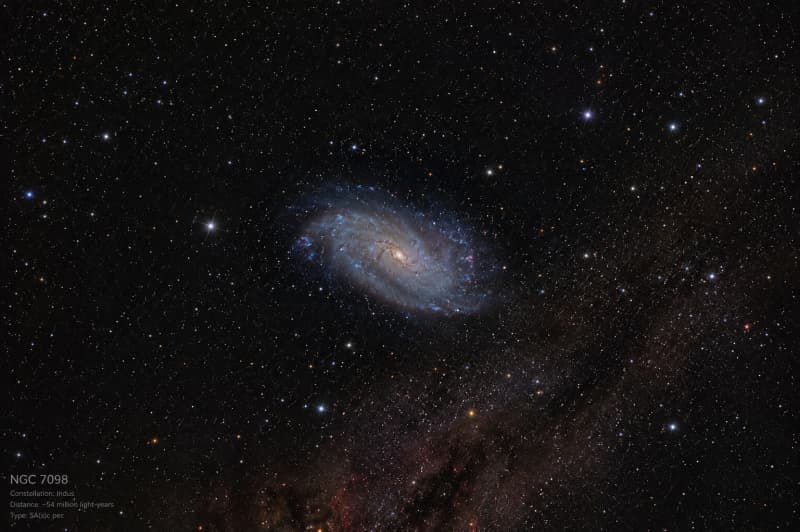
What type of galaxy is NGC 7098?
NGC 7098 is a barred spiral galaxy. A barred spiral galaxy is one whose central core is not a simple spherical bulge, but rather a bar-like structure composed of numerous stars. Our Milky Way galaxy is also considered a barred spiral galaxy, so studying these distant galaxies can help astronomers further understand the structure of the Milky Way itself.
What makes NGC 7098 special is that it doesn't have just one central bar, but rather exhibits a double-barred galaxy structure. From observational images, a smaller bar-like structure is nested within a larger one, forming a complex "bar within a bar" structure. The paper points out that the two bars are not identical in scale and rotational speed, and they interact with each other, thus this structure possesses unique dynamical characteristics worthy of study.
Why does NGC 7098 exhibit a "double-bar" structure?
In typical barred spiral galaxies, the central bar is usually formed by a large number of stars, and its motion is influenced by the galaxy's gravitational field. However, the situation becomes more complex when two bars of different scales exist within a galaxy.
The smaller bar within NGC 7098 is located within the larger bar; they are not simply arranged statically. The different bar structures may have different rotation modes, and their gravitational interactions affect the motion of stars and gas within the galaxy. Therefore, double-barred galaxies are important subjects for studying the internal dynamics of galaxies.
However, it's important to note that the two bars cannot be simply understood as two independent "collections of stars." They belong to the overall structure of the same galaxy, and the formation and maintenance of these bar structures involve complex factors such as stellar orbits, gravitational potential, and the distribution of matter within the galaxy.
What are the characteristics of the double-ring structure of NGC 7098?
Besides the two bar-like structures, one of the most striking features of NGC 7098 is the double-ring structure surrounding its core. The author describes these two ring-like structures as bands related to the galaxy's spiral arms, located in the inner and outer regions of the galaxy's center, respectively, and spreading around the bright core.
Here, the statement that "ring-like structures are spiral arms" needs some caution. For complex barred spiral galaxies, there may be close dynamical connections between rings, spiral arms, and bars, but they are not morphologically identical structures. More accurately, NGC 7098 exhibits a distinct double-ring and double-bar structure, which together constitute its unique appearance.
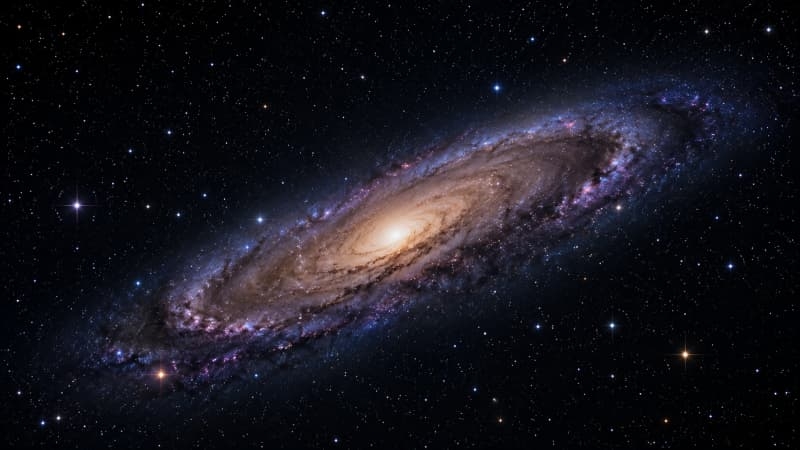
For beginners, it can be understood as follows: the galaxy has two bars at its center, and two distinct ring-like regions on the periphery, forming a very complex "nested structure."
Is star formation occurring in the ring regions of NGC 7098?
Another noteworthy feature of NGC 7098 is the uneven distribution of star formation activity across its different regions.
The paper points out that significant star formation activity is observed in the two ring regions, with a large number of young, hot stars forming there. In contrast, the galactic center is very clean, with almost no noticeable dust lanes and lacking the same level of new star formation as the ring regions.
This difference between regions is crucial for understanding galactic evolution. Star formation typically requires large amounts of cold gas and dust as raw materials, and the distribution, compression, and motion of gas within a galaxy are influenced by its overall gravitational structure. Therefore, it is not uncommon for different regions of a galaxy to exhibit completely different star formation environments.
How far is NGC 7098 from Earth?
According to the data provided in the sample article, NGC 7098 is approximately 95 million light-years from Earth, with a telescopic magnitude of about 11.3 and an estimated diameter of about 152,000 light-years.
Here is a very important observational concept: a telescope with a telescopic magnitude of 11.3 does not mean it is only slightly fainter than the limit of the naked eye. For diffuse objects like galaxies, light is distributed over a large area, and their surface brightness is usually much lower than that of point stars of the same magnitude. Therefore, even if a telescope theoretically has a certain aperture, the actual observational difficulty cannot be simply judged based on the telescope's magnitude.
Why is NGC 7098 difficult to observe in most of North America?
NGC 7098 is located in the constellation Octans and is close to the celestial south pole. Due to varying latitudes, the visible area of the celestial sphere differs from latitude, making this deep-sky object, located very far south, unfriendly to observers in most of North America. The article also points out that the horizon obscures most of the Northern Hemisphere, making it impossible to observe NGC 7098 properly.
This is especially important for novice stargazers in North America. Even with a large-aperture telescope, if the target is not above the horizon, even the best equipment cannot solve the observation problem.
Theoretically, those in the southern United States, Mexico, or lower latitudes could have better opportunities for southern sky observation than those in higher latitudes of North America, but NGC 7098's declination is very far south, and whether it can be seen and its rise altitude still need to be calculated based on local latitude and observation time.
What equipment is needed to observe NGC 7098?
For amateur astronomers who genuinely want to observe NGC 7098, a large-aperture telescope, a stable equatorial mount, and good dark sky conditions are more important.
Because its apparent magnitude is approximately 11.3 and it is a distant diffuse galaxy, it is completely invisible to the naked eye. Even if a small telescope can capture it, it may only appear as a very faint patch of light, making it difficult to directly see the double rings and double bars in photographs.
If using astrophotography equipment, longer exposures can accumulate light, and post-processing can then reveal the galaxy's outer structures. For beginners, a more realistic learning approach is to start with easier-to-observe galaxies such as Andromeda Galaxy M31 and Triangulum Galaxy M33, and gradually challenge faint, deep-sky targets like NGC 7098.
What astronomical knowledge can we gain from NGC 7098?
The value of NGC 7098 lies not only in its unusual appearance. Through this galaxy, we can learn about several important astronomical concepts at once, including barred spiral galaxies, double-barred galaxies, galactic rings, spiral arms, star formation, galactic dynamics, and surface brightness.
Of particular interest is that galaxies are not merely static, giant collections of stars. The stars, gas, and dust within them are all in motion under the influence of gravity, and the overall structure of a galaxy changes over vast periods of cosmic time. NGC 7098's complex double-barred and double-ringed structure perfectly demonstrates the richness of galactic internal dynamics.