
When it comes to nebulae visible to the naked eye, many beginner astronomy enthusiasts find it strange: nebulae are often hundreds or thousands of light-years away from us and look so dim—can you really see them directly without a telescope? The answer is yes, but good observation conditions are required. For Northern Hemisphere observers, the most classic target is the Orion Nebula (M42); if you travel to the Southern Hemisphere, you can also challenge the even more spectacular Carina Nebula. In addition, the Lagoon Nebula (M8), located in Sagittarius, also has a chance of being seen with the naked eye in a dark night sky without obvious light pollution. NASA data confirms that M42 can be spotted with the naked eye in dark locations, while M8 can also appear as a very faint spot of light under dark skies.
However, a point prone to misunderstanding needs to be clarified first: being able to see a nebula with the naked eye does not mean being able to see the colorful structures found in astronomical photos. What the naked eye sees is usually just a very faint grayish-white or hazy patch of light; rich gas structures and colors can only be revealed through telescopes, long-exposure photography, or modern astronomical cameras. Therefore, true naked-eye nebula observation tests not telescope aperture, but sky quality, light pollution, moonlight, and the observer's night-vision ability.
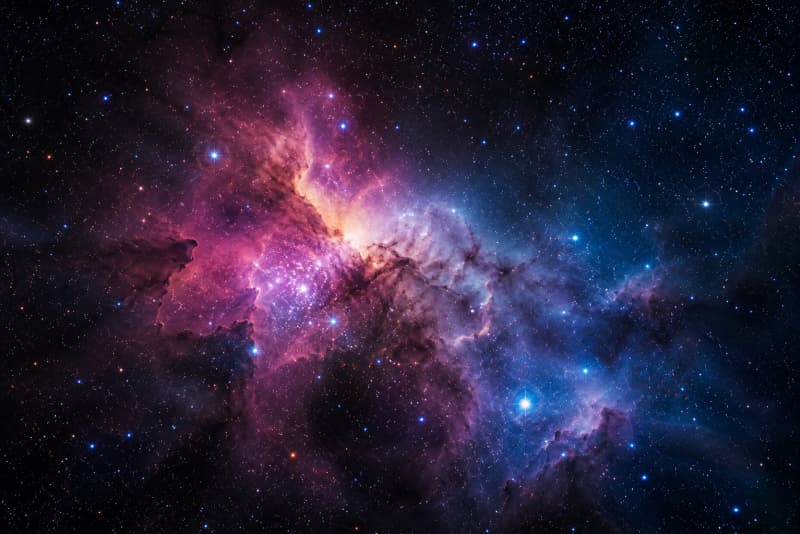
What are nebulae visible to the naked eye?
Nebulae are not a single type of celestial object. In a broad sense, they are massive astronomical structures composed of gas, dust, and stars—some are nurseries where new stars are born, while others are the remnants left behind by dying stars. For naked-eye observation, the easiest ones to spot are primarily emission nebulae that possess high brightness and a large angular diameter.
Taking the Orion Nebula as an example, it is essentially a vast star-forming region. Ultraviolet light emitted by young, hot stars ionizes the surrounding hydrogen gas, causing it to radiate, which is why we can see the light it emits. NASA currently places M42 at a distance of about 1,500 light-years with an apparent magnitude of around 4.0, making it one of the closest large star-forming regions to Earth.
Dark nebulae, on the other hand, are completely different. Unlike emission nebulae, they usually do not glow brightly on their own; instead, their dense dust blocks the light from stars behind them, making them look like missing patches of starlight in the sky. As a result, dark nebulae can also be observed with the naked eye, but what you observe is a "dark silhouette" rather than a glowing cloud of gas.
Orion Nebula M42: The Easiest Naked-Eye Nebula to Spot in the Northern Hemisphere
If you want to look for a nebula visible to the naked eye, the Orion Nebula should be the first target North American beginners try. It is located in the "Sword of Orion" region below Orion's Belt, making its position very easy to identify. Orion itself features striking landmarks such as Betelgeuse, Rigel, and the three stars of the Belt, so even without much constellation experience, it is easy to find the general area.
After locating Orion's Belt, move your gaze downward to see a few stars lined up together; the central region among them is where the Orion Nebula is located. Note that when observing with the naked eye, M42 usually does not display obvious red or blue colors like in photos, but rather appears as a faint, hazy patch of light. NASA also explicitly points out that M42 can be seen directly with the naked eye in dark locations, with the best viewing season generally being Northern Hemisphere winter.
For North America, December through February is a great period to observe the Orion Nebula. After heading away from the city, you can first try to find it with the naked eye, then observe it using binoculars. Binoculars can significantly enhance M42's brightness and extent, while also revealing more surrounding stars.
Carina Nebula: One of the Most Spectacular Naked-Eye Nebulae in the Southern Hemisphere
If the Orion Nebula is the classic target for Northern Hemisphere beginners, then the **Carina Nebula (NGC 3372)** is a target that Southern Hemisphere stargazers should not miss.
The Carina Nebula is located in the constellation Carina, with a declination close to -60°, making it unfriendly to observers at middle to high northern latitudes. Whether a celestial object can rise above the horizon depends on the observer's latitude and the object's declination. Taking the Carina Nebula's declination of approximately -59°52′ as an example, locations around 30° North latitude can theoretically only see it extremely close to the horizon; further north, it remains entirely below the horizon.
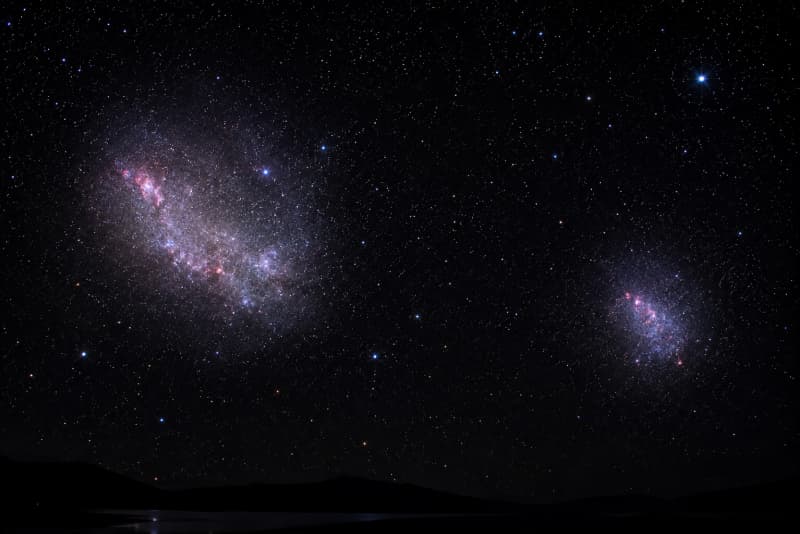
Therefore, the statement in the reference text that "there is only a chance to see it south of 30° North latitude" can be kept as a general guideline to help beginners understand, but actual observations must still account for elevation above the horizon. Even if it can be seen around 20° North latitude, the target may only rise very low, where atmospheric extinction and ground obstructions will severely degrade the view.
The Carina Nebula is located about 7,500 light-years from Earth. NASA data shows that it is a vast star-forming region spanning hundreds of light-years across and containing a large number of massive stars. Under dark Southern Hemisphere skies, it can be a magnificent target for naked-eye observation.
Lagoon Nebula M8: A Naked-Eye Nebula in the Summer Milky Way
Besides M42 and the Carina Nebula, the **Lagoon Nebula (M8)** is another naked-eye nebula worth getting to know for beginner astronomy enthusiasts.
The Lagoon Nebula is located in the constellation Sagittarius, situated within a highly dense star region near the Galactic Center. NASA puts M8 at a distance of about 5,200 light-years with an apparent magnitude of around 6.0; it is an emission nebula and an active star-forming region.
M8's brightness is right at the limit of human naked-eye observation, so "visible to the naked eye" comes with very important prerequisites: it requires dark skies, good eyesight, and excellent atmospheric transparency. NASA also explicitly notes that while M8 can barely be seen with the naked eye under dark skies, it is much easier to spot using binoculars or a small telescope.
For North American observers, once the summer Milky Way rises, the Sagittarius region is one of the best directions to look for M8. First locate the famous "Teapot" asterism in Sagittarius, then search along the Milky Way to have a chance of spotting the Lagoon Nebula.
Why are nebulae in astrophotography so much more beautiful than what the naked eye sees?
Many beginners, after seeing photos of nebulae for the first time, are left with a question: Why is the Orion Nebula online a vibrant mix of reds and blues with complex structure, while what the naked eye sees is just a faint smudge?
The main reason lies in the different ways the human eye and a camera perceive light. Nebulae emit very faint light, with much of it concentrated in specific wavelengths. Long-exposure photography allows a camera to continuously gather photons, and post-processing can then enhance details across different spectral bands, revealing colors that the naked eye cannot directly resolve.
Additionally, under low-light conditions, the human eye relies primarily on rod cells, which drastically decreases color sensitivity. As a result, during actual dark-sky observations, even a stunning emission nebula usually appears to the naked eye as a grayish-white, faint greenish, or very subtle misty structure, rather than the vivid colors seen in photographs. This is why naked-eye nebula observation and astrophotography are actually two entirely different experiences.
How can North American beginners improve their success rate when observing nebulae with the naked eye?
To see nebulae visible to the naked eye, the first thing to address is light pollution. Even if you can see Orion from a city center, it is very difficult to make out the faintest structures surrounding M42, let alone challenge M8. When conditions allow, you should head to rural areas, mountain regions, national parks, or other dark-sky sites.
Second, avoid bright moonlight. The Moon significantly increases background sky brightness, making faint nebulae even harder to distinguish. Periods around the new moon are generally better suited for naked-eye deep-sky observation.
Third, allow your eyes to fully adapt to the dark. After arriving at your observing site, do not check your phone frequently, and avoid using white flashlights directly. After a period of dark adaptation, your eyes' ability to perceive faint light will improve noticeably.
Finally, use averted vision. When a target is extremely faint, do not stare directly at its center; instead, look slightly to the side so the target falls on the area of the retina that is more sensitive to low light. This technique is especially helpful when searching for faint targets like M8.
Which other nebulae can you try to observe with the naked eye?
Besides the targets mentioned above, there are other nebulae and dark nebulae in both the Northern and Southern night skies worth challenging. For instance, during North American summers, you can try searching for dark nebula regions within the Milky Way; the Southern Hemisphere boasts even richer fields around the Galactic Center and the Carina region.
However, for beginners, there is no need to tackle too many targets at once. The Orion Nebula (M42) should be your first stop, followed by attempts at the Lagoon Nebula (M8). If you ever have the chance to visit the Southern Hemisphere in the future, you can then add the Carina Nebula to your observing list.
It is worth noting that dark nebulae like the "Horsehead Nebula"—while famous in astrophotography—are extremely difficult to observe directly with the naked eye and should not be lumped into the same category of naked-eye targets as bright emission nebulae like M42. Dark nebulae rely primarily on silhouetting against background starlight to form an outline, which places far greater demands on sky quality and observer experience.