
Every year on the seventh day of the seventh lunar month, the Qixi Festival evokes the legend of the Cowherd and the Weaver Girl, separated by the Milky Way. Indeed, in the actual summer night sky, Altair and Vega are among the brightest stars easily identifiable in the Northern Hemisphere. Vega is located in Lyra, and Altair in Aquila; these two bright stars, along with Deneb in Cygnus, form the famous Summer Triangle. For novice astronomers in North America, the summer nights around Qixi are an excellent time to observe Altair, Vega, the Milky Way, and the summer constellations, and the entire observation process does not require an expensive telescope.
What are Altair and Vega?
Altair, located in the constellation Aquila, is the brightest star in Aquila and a key component of the Summer Triangle. It is approximately 17 light-years from Earth and has an apparent magnitude of about 0.8, making it very easy to spot with the naked eye on a clear summer night. Altair is an A-type main-sequence star, significantly more massive and hotter than the Sun, and rotates very rapidly. This rapid rotation causes it to not be nearly spherical like the Sun, but rather exhibits a more pronounced equatorial bulge.
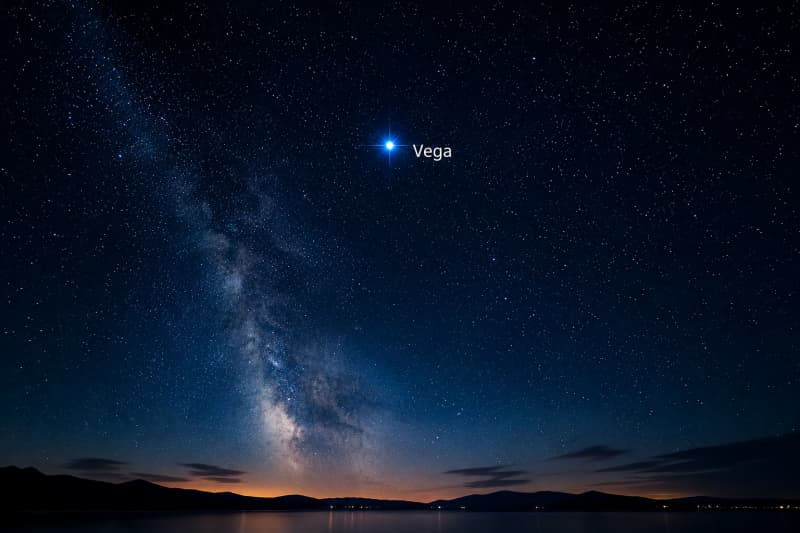
Vega, located in the constellation Lyra, is one of the most prominent bright stars in the Northern Hemisphere night sky. It is approximately 25 light-years from Earth and has an apparent magnitude close to 0, making it usually appear brighter than Altair. Vega is also an A-type star and is the most easily recognizable constellation in Lyra. For beginners learning about constellations, locating Vega first and then using the Summer Triangle to confirm Altair is a very simple and effective method for star identification.
The Summer Triangle is key to finding Altair and Vega.
If you don't know where Altair and Vega are, finding them directly in the sky can be difficult. A simpler method is to first learn about the Summer Triangle. It's not an official constellation, but a famous cluster of three bright stars from different constellations: Vega in Lyra, Altair in Aquila, and Deneb in Cygnus.
In North America, the Summer Triangle can be found in the eastern and southeastern sky shortly after dark during summer. Vega is usually one of the brightest stars in the triangle; looking south from Vega, you'll find Altair. Deneb is located on the other side of the triangle. Once you understand these three vertices, the surrounding constellations Lyra, Aquila, and Cygnus will become easier to identify. For beginners, instead of memorizing constellation charts, it's better to first find the three bright stars of the triangle and then gradually learn about the surrounding fainter stars.
How to find Altair and Vega on Qixi Festival (Chinese Valentine's Day)?
The easiest way to observe Altair and Vega in North America is to choose a clear, unobstructed summer night. Don't rush to look for them after sunset, as the fainter stars haven't fully appeared yet when the sky is just darkening. Wait until it's fully dark, then look for the very bright Vega, and use the Summer Triangle to locate Altair.
It's important to note that the positions of stars in the sky are not fixed. Due to the Earth's rotation, the same star will be at different altitudes and positions at different times; and the night sky will also differ depending on the latitude of North America. Therefore, the statement that "Altair will always be in a fixed direction on Qixi Festival" is not entirely accurate. A more precise approach is to use star chart software to determine their positions based on the local date, time, and latitude.
If observing from a city, Altair and Vega are usually still relatively easy to see, but the Milky Way may be very faint or even completely invisible. Going to the suburbs or to a darker location away from city lights will provide a more complete summer stargazing experience.
Are Altair and Vega really separated by the Milky Way?
In the Qixi Festival (Chinese Valentine's Day) legend, the Milky Way is the "Celestial River" that separates the Cowherd and the Weaver Girl. From Earth, this description is indeed very vivid, as the Milky Way stretches across the sky near Altair and Vega in summer.
However, from an astronomical perspective, the Milky Way is not actually a "river" between two stars. What we see as the **Milky Way** is actually a projection of the Milky Way's disk onto the sky. Our solar system is located within the Milky Way, and when we look along the direction of the Milky Way's disk, we see a large number of stars, nebulae, and dust clustered together, forming a hazy white band of light.

Therefore, in areas with less light pollution, Altair, Vega, and the Milky Way can create a very beautiful summer night sky spectacle. However, near major North American cities, artificial lighting significantly increases the brightness of the sky background, and the Milky Way is often one of the first celestial objects to disappear from view.
How far apart are Altair and Vega?
Altair is about 17 light-years from Earth, and Vega is about 25 light-years away. However, this doesn't mean they are only 8 light-years apart. Because they face different directions from the Sun, the actual distance cannot be calculated simply by subtracting the two distances.
Based on three-dimensional spatial estimation, the actual distance between Altair and Vega is approximately 15 light-years. This illustrates a crucial astronomical concept: angular distance in the sky does not equal the actual distance between celestial bodies. The fact that two stars appear close together from Earth only indicates that their projected positions in the sky are relatively close; it doesn't mean they are actually close to each other in space.
Therefore, from a scientific perspective, Altair and Vega are not a true "binary star" pair, nor are they a stellar system orbiting a common center of mass. The "meeting" in the Qixi Festival story is a romantic imagination that human culture has bestowed upon the starry sky.
Will Altair and Vega remain in their current positions forever?
No. Stars are not fixed "light bulbs" in the universe; they all move within the Milky Way galaxy. Altair and Vega also have their own spatial motion, so their positions in the sky change over time.
It's important to avoid a common mistake: you can't simply say that Altair and Vega are "moving away from each other" at a fixed speed. Stellar motion includes radial motion along the line of sight and lateral motion perpendicular to the line of sight, also known as proper motion. Only by combining these information can you calculate the true spatial motion of the two stars.
For the average stargazer, on a timescale of decades or even centuries, Altair and Vega will still maintain their familiar bright summer star positions. But if you extend the timescale to tens of thousands of years or even longer, their positions in the sky will change significantly, and the constellation shapes we see today will not remain unchanged forever.
Can you see the surfaces of Altair and Vega with a telescope?
Actually, ordinary amateur telescopes cannot directly see the surfaces of Altair and Vega like they do when observing the Moon. Although they are very bright stars, they are still too far away to be seen as point sources in ordinary telescopes.
Therefore, a large telescope is not necessary to observe Altair and Vega. The naked eye is actually the most suitable observation tool. The significance of binoculars lies more in expanding the field of view and increasing the number of faint stars in the surrounding area, allowing the observer to further understand the constellations and regions of the Milky Way in which they are located.
For example, after finding Vega, one can continue to observe the nearby constellation Lyra and try to find the famous Ring Nebula M57; after finding Altair, one can continue to explore along the constellation Aquila and the Milky Way region. In this way, stargazing on Qixi Festival is no longer just about finding two bright stars, but a complete introductory exercise in the summer night sky.
What else can you see while observing the Cowherd and Weaver Girl constellations in North America?
The region where Altair and Vega are located is itself a very worthwhile area of the sky to observe in the Northern Hemisphere summer. Starting with Vega, you can learn about the major stars of Lyra; starting with Altair, you can find Aquila; and continuing along the Summer Triangle formed by Deneb, Altair, and Vega, you can also discover the spectacular region of the Milky Way passing through Cygnus.
If the observation location is dark enough, you can also try to observe dark nebulae, star clusters, and other deep-sky objects in the Milky Way. Compared to city skies, dark locations allow more visible stars to emerge, and make it easier to experience the true visual effect of the Milky Way "stretching across the sky" in the Qixi Festival legend.
For novice stargazers in North America, Qixi Festival is not just a traditional festival, but also a great opportunity to learn about the summer night sky, the Summer Triangle, and the Milky Way.