
As a key member of the famous Summer Triangle in the Northern Hemisphere's night sky, Altair is not only strikingly bright but also one of the first bright stars that novice astronomers encounter when learning to identify constellations. For beginners, however, simply locating Altair is merely the first step; it is also well worth exploring the star's physical characteristics, origins, and observational significance.
Located approximately 16.7 light-years from Earth, Altair is an A-type main-sequence star relatively close to the Sun and serves as the brightest star in the constellation Aquila. Observers in the Northern Hemisphere can relatively easily locate this famous star by choosing a clear night with minimal atmospheric turbulence and light pollution, and by following the basic observation methods outlined in this article.
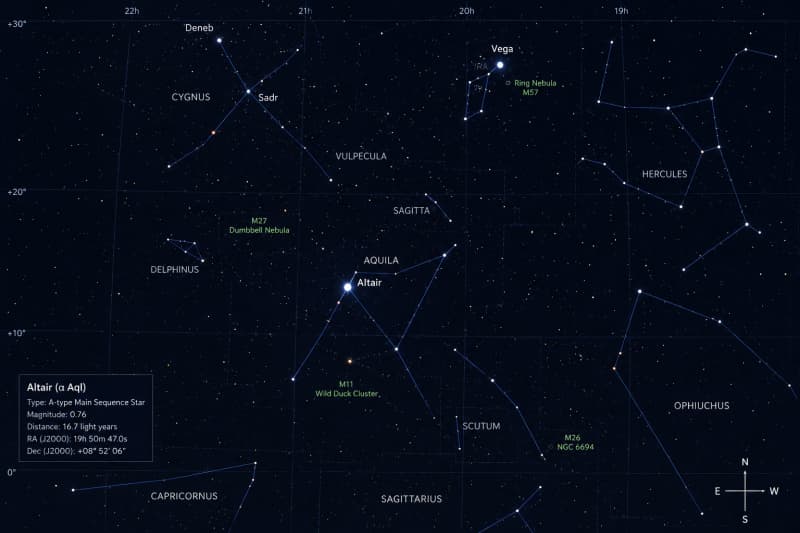
What is Altair, and why is it so famous?
Altair is a star in the constellation Aquila and one of the brightest stars in the entire sky, with an apparent magnitude of approximately 0.76. It ranks among the most luminous stars visible from Earth. Not only is it one of the three vertices of the Summer Triangle, but it is also one of the most iconic bright stars in the Northern Hemisphere's summer night sky.
In China, there is a widely known story about Altair: Legend has it that the hardworking and kind-hearted Cowherd (represented by Altair) fell in love with and married the Weaver Girl (represented by Vega) from the heavens. However, because they violated celestial laws, they were separated by the Milky Way and could only meet once a year—on the seventh day of the seventh lunar month—when magpies formed a bridge for them to cross. This story is popular throughout East Asia, including China, Japan, and Korea, making Altair and Vega two of the most culturally significant stars in the region.
From the perspective of modern astronomy, Altair and Vega are separated by approximately 15 light-years and share no actual physical connection; they merely appear to gaze at each other across the Milky Way when viewed from Earth. The legend of the Cowherd and the Weaver Girl thus represents an ancient romantic fantasy inspired by the starry sky. How can novice astronomers observe Altair?
For those new to astronomy, Altair is an excellent target for beginners. Due to its high luminosity, it can be easily identified with the naked eye—even in suburban areas—provided the sky is clear. Unlike many fainter deep-sky objects, observing Altair requires no specialized equipment.
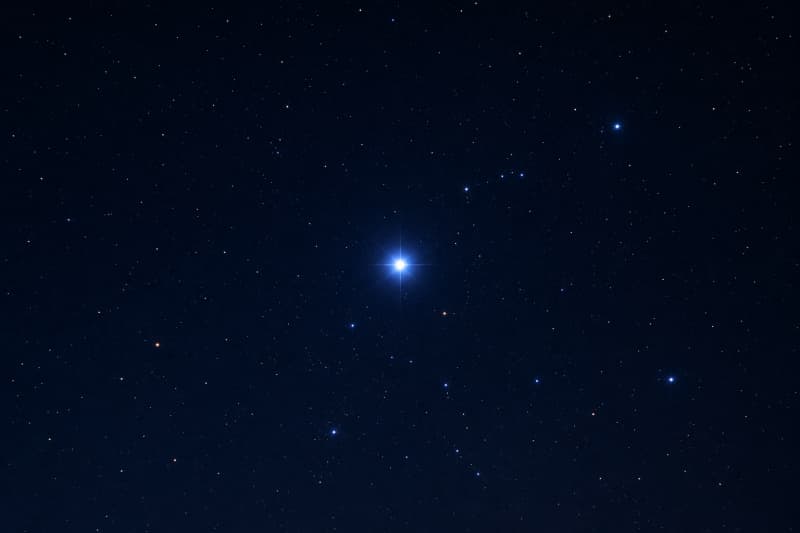
Using 7×50 or 10×50 binoculars allows for a clearer view of the stars surrounding Altair and reveals the rich stellar background of the Milky Way region in which it resides. While binoculars will not resolve Altair into a visible disk, they enhance the depth and detail of the surrounding starfield, helping observers better familiarize themselves with the constellation Aquila and the adjacent sky.
To optimize the viewing experience, observers are encouraged to choose locations free from light pollution. Although light pollution does not completely obscure Altair, it significantly reduces the visibility of the Milky Way background and detracts from the overall stargazing experience. In North America, many national parks, International Dark Sky Parks, and suburban observation sites offer ideal conditions for viewing the night sky.
Observational Significance of Altair in the Summer Sky
Altair is not only a bright star worthy of individual observation but also a key reference point for exploring the summer sky in the Northern Hemisphere. Together with Vega and Deneb, it forms the famous Summer Triangle—a vast asterism that spans much of the summer night sky and serves as a vital guide for locating the Milky Way.
For beginners, once Altair has been identified, the next step is to learn to recognize prominent constellations such as Aquila, Lyra, and Cygnus. These constellations can then serve as guides for locating various deep-sky objects, including open clusters, planetary nebulae, and the star clouds of the Milky Way.