
The Spindle Galaxy (NGC 5866) is a fascinating object for deep-sky enthusiasts; not only does it possess an elegant appearance, but its distinctive dust lane has also made it a subject of long-standing study by astronomers worldwide. As a classic lenticular galaxy, it blends characteristics of both elliptical and spiral galaxies, and because it appears as an elongated, spindle-like shape when viewed through small telescopes, it earned the name "Spindle Galaxy."
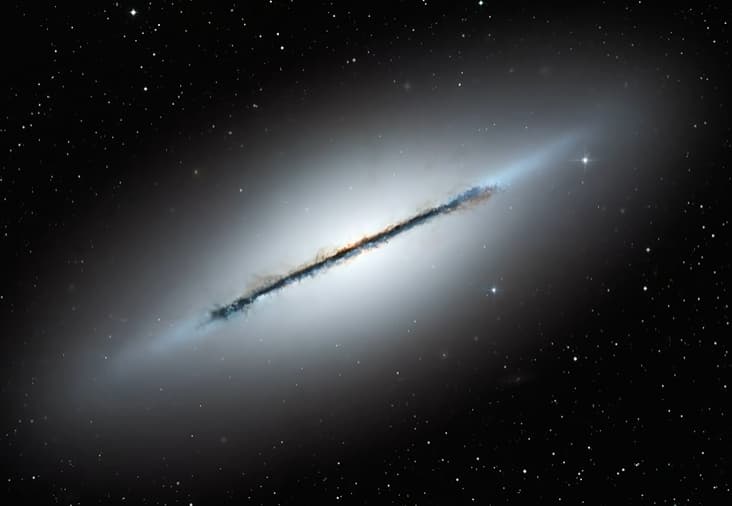
What is the Spindle Galaxy (NGC 5866)?
Located in the northern constellation Draco, the Spindle Galaxy (NGC 5866) is a highly popular NGC deep-sky object that lies outside the Messier catalog. Situated approximately 44 million light-years from Earth with a diameter of about 60,000 light-years and an apparent magnitude of roughly 9.9, it is a moderately bright galaxy, making it an excellent target for those advancing in their deep-sky observation skills.
Unlike the familiar Andromeda Galaxy, NGC 5866 is classified as a lenticular galaxy. This type of galaxy falls between elliptical and spiral galaxies; it possesses a distinct central bulge and a flat galactic disk but lacks clearly defined spiral arms, leading astronomers to view it as a unique transitional form in galactic evolution.
What truly makes the Spindle Galaxy famous is the dark dust lane running across its center. This feature stands out strikingly in images captured by professional telescopes and the Hubble Space Telescope, serving as the most important characteristic for identifying NGC 5866.
Why is NGC 5866 classified as a lenticular galaxy?
In the astronomical classification of galaxies, lenticular galaxies represent a unique category. If elliptical galaxies are viewed as smooth collections of stars and spiral galaxies are characterized by spectacular spiral arm structures, then lenticular galaxies appear to be a hybrid of the two.
The Spindle Galaxy (NGC 5866) exhibits the following characteristics:
A bright, concentrated central bulge;
A flat, extended galactic disk;
An absence of distinct spiral arm structures;
An abundant distribution of dust.
Because NGC 5866 is oriented almost edge-on relative to Earth, we do not see a disk but rather a slender band of light. A dark dust lane running through the center bisects the galaxy, giving it the appearance of a spindle—hence its descriptive Chinese name, the "Spindle Galaxy."

Many astronomers believe that this dust lane may actually be a ring of dust encircling the galactic center; we simply see it as an edge-on projection due to our viewing angle from Earth.
When is the best time to observe the Spindle Galaxy from North America?
For astronomy enthusiasts in North America, the period from spring to early summer (April through July) is the prime time to observe the Spindle Galaxy. As Draco is a northern constellation, the galaxy reaches a favorable altitude for viewing across most of the United States and Canada.
Additionally, for the best viewing experience, consider the following conditions:
No moonlight or near the time of the new moon;
A dark-sky environment rated Bortle Class 4 or better;
Viewing after 10:00 PM, when the galaxy has risen to a higher position in the sky;
Good atmospheric transparency.
While it is possible to spot the Spindle Galaxy from urban areas, light pollution usually limits the view to a faint, elongated, grayish-white smudge.
However, the western United States and Canada boast numerous dark-sky areas certified by the International Dark-Sky Association, making them excellent locations for deep-sky observation.
How can you locate NGC 5866 in the night sky?
Locating deep-sky galaxies is not difficult; using a star chart app can significantly simplify the process. First, locate the Big Dipper in the night sky, then follow the direction of its handle to find the constellation Draco.
Popular star chart apps include:
SkySafari
Stellarium
Sky Guide
Simply enter "NGC 5866" to find its real-time position.
Since the Spindle Galaxy (NGC 5866) has an apparent magnitude of approximately 10, it is usually difficult to identify with binoculars. It is recommended to use a refractor with an aperture of at least 80mm or a reflector with an aperture of at least 150mm for observation.
What kind of telescope is needed to view the Spindle Galaxy?
The level of detail visible varies significantly depending on the telescope's aperture.
70mm–80mm Refractors
You can see an elongated, oval-shaped patch of nebulosity, but the dust lane is generally indiscernible.
130mm–150mm Newtonian Reflectors
The galaxy's elongated profile is clearly visible, and under excellent viewing conditions, subtle variations in central brightness can be detected.
Telescopes with apertures of 200mm or larger
Under dark-sky conditions, it is possible to observe the boundary between light and dark areas created by the central dust lane; this aperture range is also the standard choice for most deep-sky astrophotography enthusiasts.
If paired with a computerized equatorial mount, you can also attempt long-exposure photography of the Spindle Galaxy to capture a wealth of detail far beyond what is visible to the naked eye.
What are some tips for observing the Spindle Galaxy?
Even with decent astronomical equipment, employing specific observation techniques can improve your chances of success. First, try to avoid urban light pollution by choosing a dark-sky location away from the city. Second, allow your eyes to fully adapt to the darkness—a process that typically takes 20 to 30 minutes—and avoid exposure to bright light (such as from a mobile phone) during this time; if you need a flashlight, use a red-light version or cover a standard flashlight with red plastic film or cloth. Additionally, you might try the "averted vision" technique, as the peripheral retina is more sensitive to faint light, making it easier to discern the galaxy's outline.

If you plan to photograph NGC 5866, it is recommended to use a high ISO setting with exposure times ranging from tens of seconds to several minutes, followed by post-processing image stacking to enhance details in the dust lane and the outer halo.
Why is the Spindle Galaxy a must-observe target for every beginner?
Compared to many distant and faint NGC objects, the Spindle Galaxy—with its relatively high brightness, distinctive shape, and rich scientific significance—represents a rewarding milestone in the journey of learning deep-sky observation.
It offers observers a genuine first glimpse of the magnificent spectacle of a galaxy located tens of millions of light-years away. From the faint, hazy patch visible in a small telescope to the exquisite dust lanes revealed by the Hubble Space Telescope, NGC 5866 showcases both the grandeur and the intricate detail of the cosmos.
If you are seeking a deep-sky target that is both beginner-friendly and rewarding to explore, the Spindle Galaxy undoubtedly deserves a place on your observing list. As your experience and equipment improve, you will gradually discover even more breathtaking details within this classic lenticular galaxy.
FAQ: Frequently Asked Questions About the Spindle Galaxy (NGC 5866)
1. Can the Spindle Galaxy be seen with the naked eye?
No. With an apparent magnitude of approximately 9.9, NGC 5866 requires an astronomical telescope for observation.
2. Can the Spindle Galaxy be seen with a small telescope?
Yes. A telescope with an aperture of 80mm or larger reveals an elongated, hazy outline, though the central dust lane is difficult to discern.
3. When is the best time to observe NGC 5866 from North America?
The best viewing season is from April to July; during this time, the constellation Draco is positioned high in the night sky, making observation more favorable.
4. Why is NGC 5866 classified as a lenticular galaxy?
It is classified as a lenticular galaxy because it possesses both the central bulge characteristic of elliptical galaxies and the disk structure of spiral galaxies, yet lacks distinct spiral arms.