
The arrival of summer marks the prime season for stargazing in the Northern Hemisphere, a time when many astronomy enthusiasts turn their eyes toward the heavens. Yet, beginners often wonder: amidst the myriad stars, which is the brightest one in the summer night sky?
The answer is straightforward: for observers in North America, the brightest star in the summer night sky is typically Vega. Not only is it the most luminous, but it is also a key member of the famous "Summer Triangle" asterism, making it easily recognizable on a clear night.

Other bright stars visible in the night sky include Altair, Deneb, and—occasionally visible low in the southern sky—Arcturus; together, they form the most iconic targets for stargazing during the Northern Hemisphere's summer.
Why is Vega considered the brightest star in the summer night sky?
Before answering the question of which star is the brightest in the summer night sky, a distinction must be made: the discussion here focuses on stars, not planets. While Venus is the brightest object in the summer night sky—outshining any star—it is a solar system body and does not remain visible in the sky throughout the night.
Located in the constellation Lyra, Vega is approximately 25 light-years from Earth and has an apparent magnitude of about 0.03. It is the fifth-brightest star in the entire sky and the brightest star visible in the Northern Hemisphere during summer. Because it passes nearly overhead, observing conditions are excellent at mid-latitudes in North America; consequently, many stargazing guides use it as a starting point for navigating the summer sky.
In terms of physical properties, Vega is an A0V-type main-sequence star. Its surface temperature is around 9,600 K—significantly hotter than the Sun—giving it a brilliant blue-white glow. Its mass is roughly twice that of the Sun, and its luminosity is nearly 40 times greater. Thanks to its high intrinsic luminosity and relatively close proximity, it appears exceptionally dazzling to the human eye.
The Summer Triangle: The Best Way to Find the Brightest Stars in the Summer Night Sky
For those just beginning to learn stargazing, rather than rote-memorizing the positions of constellations, a better starting point is to learn how to locate the famous Summer Triangle. This asterism is formed by three exceptionally bright stars:
Vega
Altair
Deneb
Of the three, Vega is the brightest. From July through September, about an hour after nightfall in North America, simply look toward the east or near the zenith (directly overhead); you will spot a blue-white star that is noticeably brighter than the surrounding stars—that is Vega.
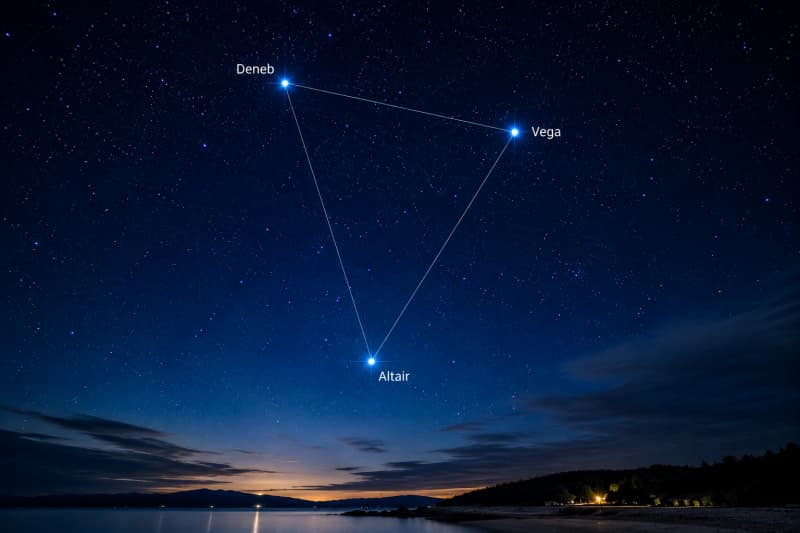
From Vega, look toward the east-southeast to find Altair, or toward the east-northeast to find Deneb. These three stars form a massive triangle that is easily recognizable even in urban environments, making it a key navigational landmark often introduced in introductory astronomy courses.
What other exceptionally bright stars are worth observing in the summer?
While many people focus on Vega when searching for the brightest star in the summer night sky, there are actually several other bright stars worth getting to know.
First is Altair; located about 17 light-years from Earth, it is an A-type star relatively close to the Sun. It rotates extremely rapidly—with an equatorial speed exceeding 200 kilometers per second—giving it a slightly oblate (flattened) shape.
Deneb is a supergiant; despite being over 2,600 light-years away, it remains a bright star in the night sky. This indicates immense intrinsic luminosity, with a light output far exceeding that of the Sun.
Additionally, low in the western sky during summer evenings, one might spot the orange-red star Arcturus. As a K-type red giant, its color contrasts sharply with that of Vega, making it an excellent subject for observing differences in stellar color.
In lower-latitude regions—such as the southern United States or northern Mexico—observers with clear skies may also catch a glimpse of Antares low in the southern sky. This famous red star belongs to the constellation Scorpius and is one of the most iconic red supergiants of the summer sky.
How do light pollution, telescopes, and binoculars affect the viewing experience?
If you are simply looking for the brightest star in the summer night sky, Vega is usually easy to spot—even from the city center—thanks to its high luminosity.
However, if you wish to fully appreciate stellar colors, details of the Milky Way, and the structure of surrounding constellations, the observing environment becomes crucial.
The more severe the light pollution and the brighter the sky background, the sooner faint stars vanish from view, and the harder it becomes to discern the Milky Way. Therefore, it is recommended to head to the suburbs, a park, or an International Dark Sky Reserve for your observations.
Regarding equipment, you do not actually need a large astronomical telescope to view bright stars.
For beginners, a pair of 7×50 or 10×50 binoculars can significantly enhance the experience; they not only provide a steadier view of stellar colors but also make it easy to locate the numerous star clusters and Milky Way star fields near the Summer Triangle.

Using a small-to-medium aperture refracting telescope allows for a clearer view of stellar colors. However, because stars are incredibly distant, they remain mere points of bright light even at high magnifications—unlike planets, they do not reveal surface details. Consequently, observing stars is less about examining their physical shape and more about appreciating their brightness, color, and position within a constellation.
How can you quickly find the brightest star in the summer night sky?
First, choose a clear night with minimal moonlight; it is best to avoid overcast skies and the period around a full moon. About an hour after dark, look toward the eastern or southeastern sky for a blue-white point of light that is noticeably brighter than the surrounding stars. If you are located at mid-latitudes in North America, this star is almost certainly Vega.
Next, use a mobile stargazing app to confirm your sighting, then look for Altair and Deneb; this will quickly help you build a spatial understanding of the summer sky. With repeated observation, you will soon be able to instantly identify the positions of these famous bright stars without the aid of any equipment.
The brightest star in the summer night sky is one that every stargazing enthusiast should know.
For stargazing enthusiasts in North America, Vega is the key star to know when asked about the brightest star in the summer night sky. Not only is it exceptionally bright, but it is also a crucial component of the Summer Triangle and serves as an excellent starting point for learning to locate constellations, understanding stellar spectra, and grasping the concepts of stellar evolution. Once you have mastered the location of Vega, observing it alongside other prominent stars—such as Altair, Deneb, Arcturus, and Antares—will allow for a more systematic understanding of the entire summer sky.