
For astronomy enthusiasts in North America, Sirius is one of the most easily recognizable stars in the winter night sky. Not only is it the brightest star in the entire sky, but it is also a crucial object for studying binary star systems, stellar evolution, and white dwarfs. While many people perceive Sirius simply as an exceptionally bright star, it actually consists of two components—Sirius A and Sirius B—orbiting a common center of mass to form a classic binary star system.

Why is Sirius the brightest star in the night sky?
Sirius holds the title of the brightest star in the sky not merely because of its intrinsic luminosity, but—more importantly—because of its proximity to Earth. Located approximately 8.6 light-years from the Solar System, Sirius is a close neighbor among the stars of the Milky Way. Considering the individual stars within the system, both Sirius A and Sirius B rank among the stars closest to the Sun; consequently, even though Sirius is neither the most massive nor the intrinsically brightest star in the galaxy, it tops the list of stellar brightnesses with an apparent magnitude of -1.46.
Sirius A is a typical A-type main-sequence star. Its surface temperature approaches 10,000 Kelvin—far hotter than the Sun's ~5,800 Kelvin—giving it a brilliant white glow with a slight blue tint. Furthermore, while its mass is roughly twice that of the Sun, its luminosity is more than twenty times greater, meaning it releases far more energy per unit of time than the Sun does. Its proximity and high luminosity, combined with the superior atmospheric clarity often found in winter, make this dazzling star easily visible from most parts of North America.
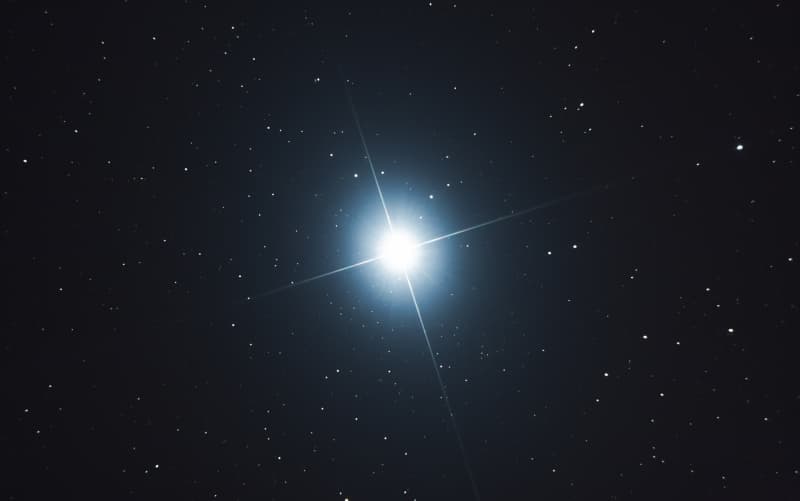
A Binary System: Sirius Is Actually Two Stars
Although only one dazzlingly bright star is visible to the naked eye, Sirius is actually a famous binary star system. The brighter of the two is Sirius A, while the other is the well-known Sirius B. These two stars orbit a common center of mass, completing one revolution approximately every 50 years; consequently, the angular separation between them constantly changes as they move along their orbits.
What truly intrigues astronomers is not the brilliant Sirius A, but rather Sirius B, which is hidden beside its dazzling glare. Because there is a nearly ten-thousand-fold difference in brightness between the two, Sirius B is easily overwhelmed by the primary star's intense light, making it difficult to resolve even with a standard telescope.
In recent years, the angular separation between the two stars has been relatively wide, making this an ideal time for observers—equipped with telescopes having apertures of 150mm or larger and enjoying good seeing conditions—to attempt to spot Sirius B. However, this observation tests optical quality, magnification, and atmospheric stability, rather than relying solely on telescope aperture.
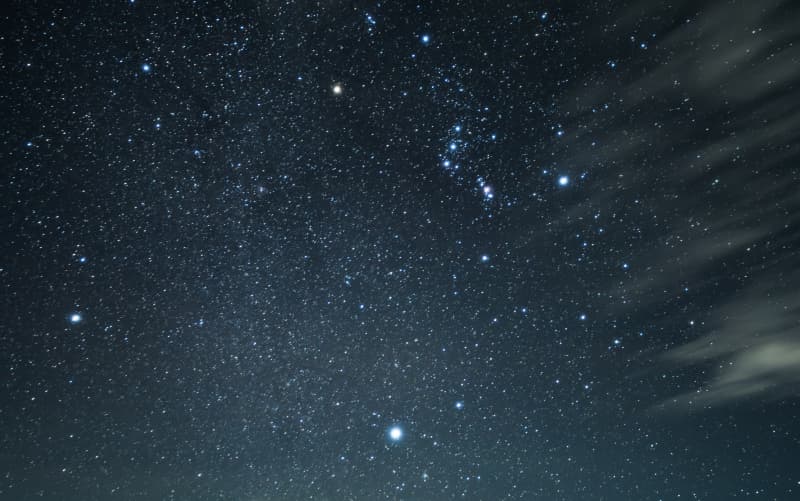
For many binary star enthusiasts, successfully resolving Sirius A and Sirius B has long been a significant challenge for testing both equipment performance and observational skills. This is a key reason why Sirius consistently appears on recommended lists for binary star observation.
Why will Sirius become even brighter in the future? It is still slowly approaching the Solar System.
Sirius is not only one of the star systems closest to the Sun, but the distance between it and the Solar System is also not static. Astrometric data indicate that Sirius is currently still slowly approaching the Sun; consequently, its apparent brightness will increase slightly over the next tens of thousands of years. Astronomers predict that in approximately 60,000 years, the star's apparent magnitude will reach about -1.68—making it brighter than it is today—thereby firmly maintaining its status as the brightest star in the night sky.