
The number of confirmed impact craters on Earth is very small, and those exceeding 100 kilometers in diameter are particularly rare. This scarcity is primarily due to several factors:
First, Earth possesses a thick atmosphere. The vast majority of small meteoroids burn up completely due to intense friction upon entering the atmosphere; only a very small number of large celestial bodies actually strike the surface.
Second, approximately 71% of Earth's surface is covered by vast oceans, making it difficult to detect traces of impacts even when they occur.
Additionally, Earth experiences frequent geological activity. Processes such as plate tectonics, volcanism, weathering, erosion, and glacial movement constantly reshape the surface, causing many ancient craters to disappear entirely over tens or even hundreds of millions of years. Consequently, scientists have confirmed only about 200 impact craters on Earth to date, with large impact structures exceeding 100 kilometers in diameter being exceptionally rare.
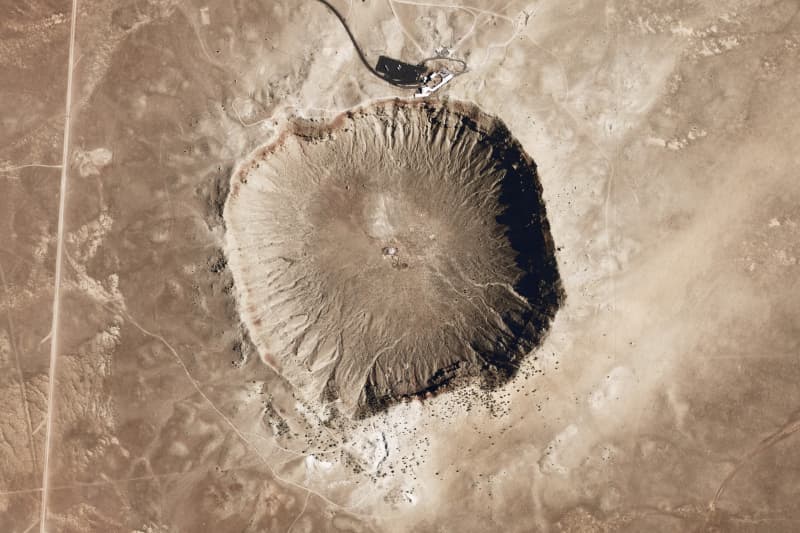
Barringer Crater: One of the World's Most Famous Meteorite Craters
Barringer Crater is arguably the most famous meteorite crater on Earth. Located on the high plateau of Arizona, USA, it was formed approximately 50,000 years ago. Scientific estimates suggest that an iron meteorite—roughly 50 meters in diameter—struck the Earth at high speed, instantly releasing energy equivalent to millions of tons of TNT and creating a massive, circular crater about 1,200 meters wide and 170 meters deep.
In the early 20th century, American mining engineer Daniel Barringer, convinced that a massive iron meteorite lay buried beneath the crater, invested heavily in exploration with the hope of mining this valuable object. However, despite decades of effort, he never discovered an intact meteorite; he found only a vast number of tiny fragments.
Although Daniel Barringer’s commercial mining venture ended in failure, his efforts played a pivotal role in the scientific confirmation of the formation mechanisms behind large impact craters. Consequently, Barringer Crater became the first crater in the world to be scientifically proven to have originated from a meteorite impact.
Today, Barringer Crater is a renowned astronomical education and tourist attraction in North America, drawing numerous astronomy enthusiasts who visit to experience the site firsthand.
Manicouagan Crater: Canada’s Famous "Eye of Quebec"
Located in Quebec, Canada, the Manicouagan Crater is one of the best-preserved large impact structures in the world. Formed approximately 214 million years ago, it originated when an asteroid—estimated to be about 5 kilometers in diameter—struck the Earth; the immense energy of the impact created a massive basin spanning over 100 kilometers.
Over the course of extensive geological evolution, the site has transformed into a ring-shaped lake with a diameter of roughly 70 kilometers, featuring a central uplifted island; consequently, it is also known as the "Eye of Quebec."
Vredefort Crater: The Largest Confirmed Impact Structure
Based on scientifically confirmed data, the Vredefort Crater in South Africa is currently the largest confirmed impact structure on Earth.
It formed approximately two billion years ago when a massive asteroid struck the planet, creating an impact zone with a diameter of roughly 250 to 300 kilometers. However, due to the immense passage of time and two billion years of geological evolution, the original, intact crater has long since eroded away; today, the scale of the ancient impact can only be reconstructed through the study of rock formations, mineralogical changes, and geophysical surveys.
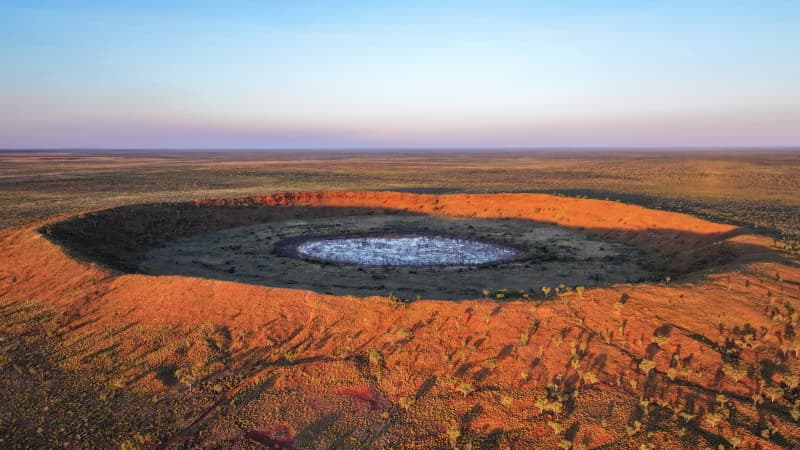
In 2005, this unique geological site was inscribed on the UNESCO World Heritage List, becoming a vital global hub for the study of large-scale celestial impact events.
The Chicxulub Crater: Key Evidence of Dinosaur Extinction
If one were to ask for the most famous impact crater without explicitly naming it, the answer would almost certainly be the Chicxulub Crater. Located near Mexico's Yucatán Peninsula, it lies mostly buried underground with a portion extending into the Gulf of Mexico, making it nearly impossible to observe directly with the naked eye.
The Chicxulub Crater owes its renown to the scientific theory that the impact responsible for its formation also caused the extinction of the dinosaurs.
Scientists believe that approximately 66 million years ago, an asteroid with a diameter of about 10 kilometers struck Earth. This impact released an unprecedented amount of energy, triggering global climate change, massive wildfires, and tsunamis, ultimately leading to the extinction of a vast number of species, including the dinosaurs.
Although there is no definitive consensus within the scientific community regarding the exact cause of the dinosaur extinction—with competing theories such as volcanic activity—the asteroid impact hypothesis remains the most widely accepted explanation in international academia. The Chicxulub Crater stands as one of the most critical pieces of geological evidence supporting this theory.
Why are impact craters so important to astronomical research?
For astronomy enthusiasts, studying impact craters offers not only a better understanding of Earth's history but also deeper insight into the solar system.
Beyond Earth, the Moon, Mercury, and Mars—lacking the protection of an atmosphere—feature surfaces covered in numerous, well-preserved impact craters. For astronomy enthusiasts in North America, familiarity with these famous craters also helps in understanding many hot topics related to NASA, asteroid exploration missions, and planetary science research.