
Summer has arrived, marking the best time of year for stargazing in the Northern Hemisphere. On clear nights, shortly after dusk, one can easily spot a bright star glowing with an orange-red hue in the southern sky; this is the famous "Dahuo" star—known in modern astronomy as Antares.
Thanks to its striking color and brilliance, Antares has long been one of the most recognizable stars in the summer sky and a favorite target for astronomy enthusiasts.

What kind of star is Antares, and why does it appear a vivid red?
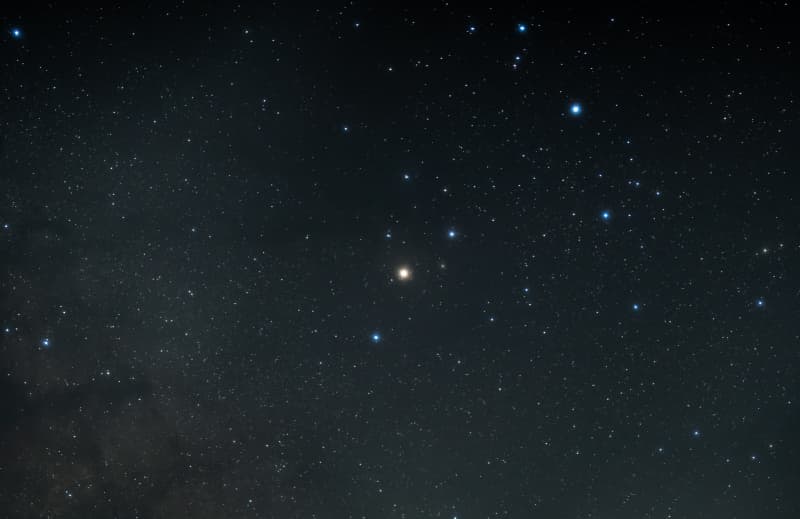
Located in the constellation Scorpius, Antares is a classic red supergiant and one of the largest known stars in the Milky Way. Although it lies approximately 550 light-years from Earth, its immense size makes it one of the brightest stars in the night sky.
Compared to the Sun, Antares has a surface temperature of only about 3,400 to 3,600 Kelvin—significantly cooler than the Sun's surface temperature of roughly 5,800 Kelvin. According to the principles of stellar radiation, the lower the temperature, the more the peak radiation shifts toward the red end of the spectrum; consequently, Antares displays a distinct orange-red hue. This characteristic makes it easily recognizable in the summer night sky.
In terms of stellar spectral classification, Antares is an M-type red supergiant. M-type stars generally possess low surface temperatures and exhibit prominent titanium oxide absorption bands in their spectra, giving them a richer, more intense color when viewed through a telescope. As it consumes its internal fuel, Antares has entered the late stages of its life cycle and may eventually end its evolution in a supernova explosion; it is, therefore, a key subject of study in modern stellar evolution research.
Why Did Ancient People Place Such Great Importance on the Star "Dahuo"?
Before the advent of modern astronomy, humans relied primarily on the positions of stars to track seasonal changes and agricultural schedules. Due to its high luminosity and distinctive color, the star "Dahuo" (Antares) stood out prominently among the stars; consequently, it became a crucial star for timekeeping in social life from very early on.
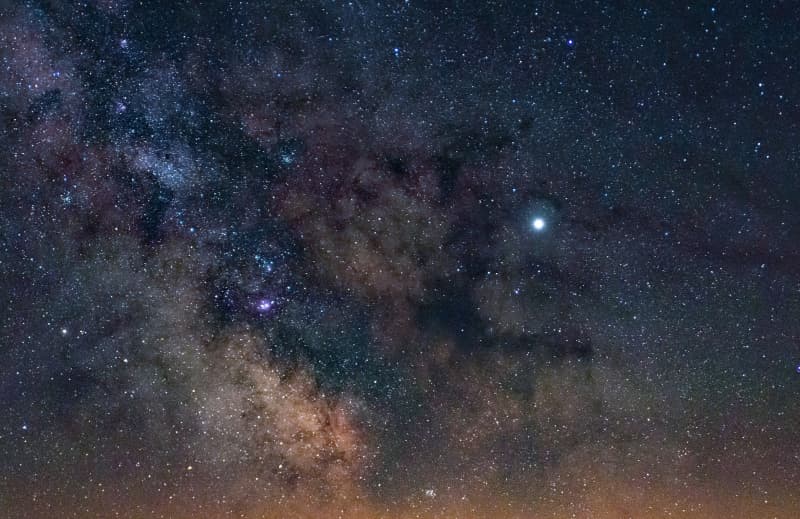
Over millennia of observation, people discovered that "Dahuo" appeared in a relatively fixed position in the night sky at the onset of summer, making it a reliable marker for determining the changing seasons. As the Earth orbits the Sun and stars rise in the east and set in the west each day, the time of "Dahuo's" appearance shifts with the seasons, establishing a consistent celestial pattern.
How to Quickly Locate Antares in North America
For stargazers in North America, Antares is one of the easiest bright stars to spot in the summer night sky. From June through September, provided you are away from urban light pollution, you can usually find it by looking toward the southern sky about an hour after nightfall.
The simplest way to find Antares is to first locate the famous Summer Milky Way. On a clear night, the Milky Way stretches across the sky; Antares sits just to the south of it. Its reddish hue contrasts sharply with the surrounding white or blue-white stars, making it easy to identify.
If you are already familiar with the Summer Triangle, you can look south from there to find the constellation Scorpius. Scorpius has a distinctive curved "S" shape, and Antares lies at the constellation's heart—which is why its name, Antares, is often referred to as the "Scorpion's Heart." You can also quickly pinpoint Antares using mobile stargazing apps like Sky Guide, SkySafari, or Stellarium; these are especially helpful for beginners just learning to identify constellations.
What can be seen when observing Antares with different equipment?
When viewed with the naked eye, Antares’ most striking feature is its vivid color; in a clear night sky, it is virtually unmistakable among other stars.
Using 7×50 or 10×50 binoculars allows you to appreciate its rich orange-red hue more distinctly while also enjoying the dense background of Milky Way stars nearby. Using a stable tripod makes the viewing experience much more comfortable.
With a refracting or reflecting telescope having an aperture of 80mm or larger, Antares does not reveal the intricate details seen on planets; however, the star's color becomes more pronounced, and there is a chance to resolve its fainter companion star. Because the companion is close to the primary star and there is a significant difference in brightness, successful separation requires good atmospheric seeing and high magnification.
Since stars are essentially point sources, astronomical filters offer limited benefit when observing Antares. Instead, good atmospheric transparency and stable seeing conditions are the key factors determining the quality of the view.
Does light pollution affect observations of Antares?
Compared to nebulae and galaxies, Antares is a bright star and is therefore relatively less affected by light pollution. In most North American suburbs—even where sky brightness reaches Bortle Class 5 or 6—there is a high probability of successfully locating Antares.
However, if you wish to appreciate the rich backdrop of the Milky Way while also observing deep-sky objects near Scorpius—such as globular and open clusters—it is advisable to seek out a dark-sky location rated Bortle Class 3 or lower. In such conditions, not only will the Milky Way appear more spectacular, but Antares can also serve as a key reference point for locating nearby deep-sky targets.
Additionally, since summer air tends to be humid and low-altitude viewing is susceptible to atmospheric turbulence, it is best to choose a night with stable air and good transparency; this will make the color and brightness of Antares stand out more clearly.
Why Every Stargazer Should Know Antares
As the most iconic red star in the summer sky, Antares is notable not only for its striking color and exceptional brightness but also as a key example for understanding stellar evolution, spectral classification, and the phenomenon of Earth's axial precession. For stargazers in North America, Antares is a top-priority target for summer observation—whether viewed with the naked eye, binoculars, or a small telescope.