
The summer night sky in the Northern Hemisphere offers the most anticipated stargazing season of the year. From June through September, as night falls, the Milky Way rises to span the heavens; its most spectacular section lies in the direction of the galactic center. This region is rich in bright stars, star clusters, nebulae, and famous constellations—all of which are prime targets for summer stargazing.
The summer Milky Way appears far brighter than its winter counterpart because, during summer, Earth faces the core of the galaxy, where stars are more numerous and densely packed. In contrast, during winter, we face the galactic outskirts—where stellar numbers and density are far lower—resulting in a significantly dimmer appearance compared to the summer sky.
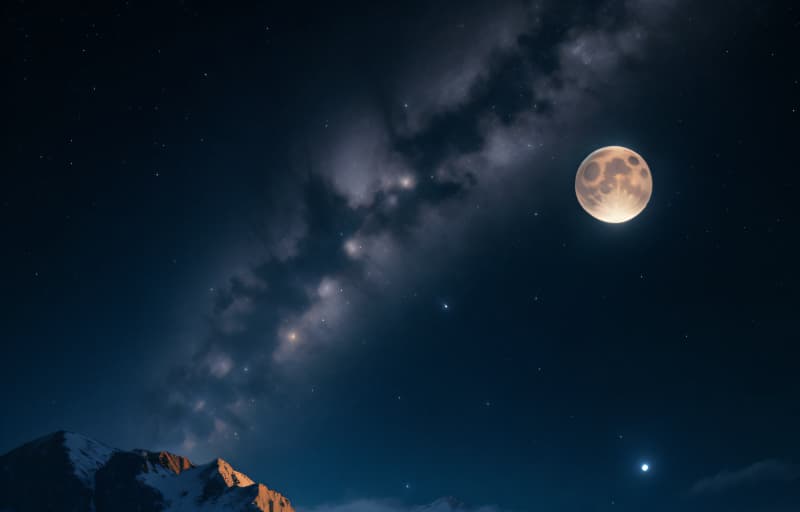
Why the Direction of the Galactic Center Offers the Most Spectacular View of the Summer Night Sky
The Milky Way as seen in the night sky is not a literal "band of light," but rather a visual effect created by hundreds of billions of stars. When we gaze toward the core of the galactic disk, we see a bright, intricate band of stars.
The Galactic Center lies in the direction of the constellation Sagittarius—one of the 88 recognized constellations—at a distance of approximately 26,000 light-years from Earth. Because this region is densely packed with stars, interstellar dust, and gas, it appears significantly brighter than other parts of the Milky Way. On summer nights in North America, the Galactic Center appears in the southern sky; away from urban light pollution, one can clearly discern the varying light and dark structures within the galaxy.
For astrophotography enthusiasts, this is the prime season for capturing images of the Milky Way's "galactic arch" and its core. Many iconic Milky Way photographs feature the Galactic Center region as seen from the Northern Hemisphere during the summer.
Scorpius: One of the Most Striking Constellations in the Summer Night Sky
In the summer skies of the Northern Hemisphere, Scorpius is undoubtedly one of the easiest constellations to recognize. Situated near the center of the Milky Way, it is formed by a string of bright stars tracing a curved "S" shape, resembling a giant scorpion lying alongside the galaxy.
The most famous star in Scorpius is Antares. Displaying a distinct reddish-orange hue, it is one of the most recognizable red stars in the night sky. Antares is a red supergiant with a diameter more than 700 times that of the Sun; if placed at the Sun's position, its outer layers would extend nearly to the orbit of Mars.
In terms of stellar evolution, Antares is in the late stages of its life. As the hydrogen in its core becomes depleted, the star has expanded to form a massive outer atmosphere. Its surface temperature is approximately 3,500 degrees Celsius—far cooler than the Sun's 5,500 degrees—giving it a vivid red appearance.

Across most of North America, Antares is easily visible on summer nights. Simply look for a bright red star in the southern sky, and you can quickly pinpoint the location of Scorpius.
Locating the Sagittarius "Teapot" Asterism and the Galactic Center
If Scorpius is a prominent landmark of the summer night sky, then Sagittarius serves as a key coordinate for locating the center of the Milky Way.
The most famous feature of Sagittarius is an arrangement of stars known as the "Teapot Asterism." These stars form the shapes of a teapot's body, spout, and handle, making the pattern highly recognizable.
In the summer sky of the Northern Hemisphere, the brightest section of the Milky Way extends upward from the direction of the Teapot's spout. Astronomy enthusiasts often vividly describe this feature as "steam rising from the teapot." In reality, this region corresponds to the area of the highest stellar density near the center of the Milky Way galaxy.
A simple way to locate the center of the Milky Way is to:
1. First, find Antares, the red star in the constellation Scorpius;
2. Move eastward toward the head of Scorpius;
3. Look for a grouping of stars that resembles a teapot;
4. Look upward along the "spout" to see the brightest region of the Milky Way.
This method is particularly effective for observers at mid-latitudes in North America, and even beginners new to stargazing can quickly master it.
M7 Open Cluster: A Deep-Sky Object Visible to the Naked Eye
Near the tail of the constellation Scorpius lies a deep-sky object that is ideal for beginners to observe: the M7 open cluster.
Also known as the Ptolemy Cluster, M7 is a large open cluster located approximately 980 light-years from Earth. With an apparent magnitude of about 3.3, it can even be seen with the naked eye under excellent observing conditions.
Unlike globular clusters, the stars in an open cluster are spaced relatively far apart, resulting in a loose structure. These stars typically originate from the same molecular cloud, meaning they share similar ages and chemical compositions.
When observing M7 with binoculars, one can see dozens of stars gathered together, forming a glittering sea of starlight. Binoculars are often better suited than large telescopes for appreciating the cluster's overall structure, making M7 a popular target for stargazing in the Northern Hemisphere during the summer.
The Impact of Light Pollution on Summer Milky Way Observation
The Milky Way has low surface brightness, making it difficult to spot in urban environments. Even when Scorpius and Sagittarius are visible, the details of the Milky Way are often obscured by urban background light. According to International Dark-Sky Association standards, a lower Bortle scale rating corresponds to richer visible detail in the Milky Way.

For observers in North America, excellent dark-sky conditions can be found in the mountainous regions of the western United States, the Canadian Prairies, and certain national parks. In these areas, the Milky Way's dust lanes, dark nebulae, and galactic center structures are clearly visible.
If traveling to a dark-sky location is not feasible, consider using narrowband filters for astrophotography or observing around the time of the new moon—when moonlight is minimal—to achieve better viewing results.
Recommendations for Summer Stargazing Equipment
Observing the summer night sky in the Northern Hemisphere does not necessarily require expensive equipment. For beginners, a pair of 7×50 or 10×50 binoculars is sufficient to view Milky Way nebulae, open clusters, and numerous star fields.
If you wish to explore the central region of the Milky Way in greater detail, consider a refracting or reflecting telescope with an aperture of 100mm or larger. The increased light-gathering capability reveals finer details of deep-sky objects, such as the famous Lagoon Nebula (M8), the Trifid Nebula (M20), and the globular cluster M22.
For photography enthusiasts, a wide-angle lens paired with an equatorial tracking mount makes for an ideal setup to capture the Milky Way core and panoramic views of the summer Milky Way.
The summer night sky in the Northern Hemisphere offers one of the best times of the year for stargazing. From the spectacular galactic center and the dazzling Antares to the distinctive "Teapot" asterism in Sagittarius and the M7 open cluster—ideal for beginners—these features create some of the most captivating scenery in the summer night sky.