
If you're new to astronomy or stargazing, you'll inevitably encounter the name "M51 Whirlpool Galaxy," commonly known as the Whirlpool Galaxy. Its official designations are:
Messier 51
M51
NGC 5194
It also has a smaller companion galaxy, designated NGC 5195.
The Whirlpool Galaxy almost always appears on lists of recommended Deep Sky Objects. The reason is simple: it's not just beautiful. More importantly, it was the first galaxy in human history to be confirmed as having a spiral structure.
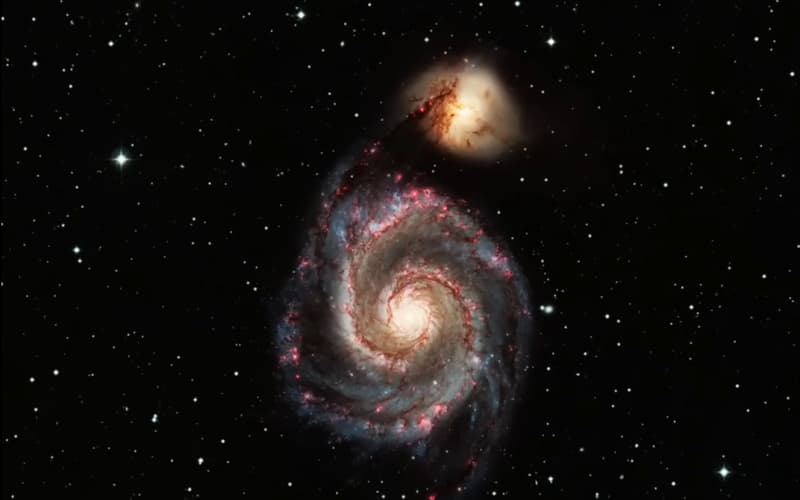
What is a Whirlpool Galaxy?
The Whirlpool Galaxy belongs to the category of Spiral Galaxy; it is also one of the most typical examples of a Grand-design Spiral Galaxy known to humankind.
A "spiral galaxy" refers to a large galaxy with a structure including a galactic bulge, spiral arms, a galactic disk, and a dark matter halo. A "grand-design spiral galaxy," specifically, refers to a galaxy with very clear, regular, and symmetrical spiral arms.
Compared to many fuzzy spiral galaxies, M51's spiral arms are exceptionally clear, making it widely used in Astronomy textbooks, NASA images, Hubble Space Telescope demonstrations, and Galaxy Formation model research.
It could even be said that M51 is a "textbook example of a spiral galaxy." For many amateur astronomers just starting out with galaxy observation, the Whirlpool Galaxy is one of the easiest targets in the "extragalactic universe" to observe.
Because its appearance closely resembles our imagination of galaxies: massive spiral arms revolving around the galactic center, interspersed with young, blue stars, and pinkish regions of ionized hydrogen dotting the spiral arms, it looks like a giant vortex in the universe. This is why it's named the Whirlpool Galaxy.
Where is M51 located? Why do North American stargazers use the Big Dipper to find it?
To quickly locate M51, you can use the Big Dipper. M51 is located near Alkaid, the end of the handle of the Big Dipper, leading many astronomy beginners to believe it's in Ursa Major. In reality, it's in the Canes Venatici constellation. However, because M51 is so close to the handle of the Big Dipper, amateur astronomers often use it for star homing. For observers in the Northern Hemisphere, this is a very easy-to-find Deep Sky Object.

Especially in the mid-to-high latitude regions of the Northern Hemisphere, such as the United States, Canada, and Northern Europe, the observation conditions for M51 are generally ideal, particularly during spring and early summer, known in North American stargazing circles as the Galaxy Season. During this period, many exogalaxies appear in the night sky, making them ideal for observation. M51 is one of the most classic targets during the Galaxy Season, especially in April, May, and June, when the Whirlpool Galaxy rises to a very ideal altitude at night, providing the best observation window for North American astronomy enthusiasts.
Why are the spiral arms of M51 so prominent?
M51 is most famous for its extremely clear spiral arms. Many exogalaxies don't have very prominent spiral arms due to the viewing angle, interstellar dust obscuring them, or the galactic structure itself. However, the Whirlpool Galaxy is different because it faces Earth almost directly. Therefore, from Earth, the entire Spiral Disk can be directly viewed from above, allowing for direct observation of symmetrical spiral arms, star-forming regions, dust lanes, and the galactic core. Because most Spiral Galaxyes don't face Earth at such a perfect angle, M51's observation angle is even more valuable.
Modern astronomical research suggests that M51's remarkably clear Spiral Arms are likely due to the gravitational influence of its neighbor, NGC 5195.
Why do M51 and NGC 5195 interact?
The most interesting aspect of the Whirlpool Galaxy isn't just its structure and observation angle, but its actual gravitational interaction with another galaxy, NGC 5195.
M51's host galaxy is NGC 5194 (also called M51A), and it has a small companion galaxy (also called M51B), forming a well-known Interacting Galaxy System.
Modern astronomy suggests that NGC 5195 passed behind NGC 5194. During this process, the immense gravitational pull between the two galaxies created what we see today: tidal structures, twisted spiral arms, regions of compressed interstellar gas, and bursts of star formation. In fact, the formation of spiral arms in many spiral galaxies is related to galactic interaction.
Therefore, M51 is not just a beautiful, easily observable spiral galaxy; it is also an important case study for understanding galactic evolution, star formation, and gravitational interaction. This is why astronomical institutions worldwide have studied M51 extensively.
How far is M51 from Earth?
According to current astronomical observations, the Whirlpool Galaxy is approximately 23 million light-years away from Earth. This means that what we see of M51 today is actually its appearance 23 million years ago; in other words, the light from M51 that we see today didn't even exist on Earth when it left M51. After traveling through the universe for an immense amount of time, the light eventually reached the field of view of today's telescopes.
How big is M51?
Based on current observations, NGC 5194 (M51A) has a diameter of approximately 76,000 light-years, while its companion galaxy, NGC 5195 (M51B), has a diameter of approximately 59,000 light-years. Although smaller than the Milky Way, they are still considered relatively large spiral galaxies. Their apparent smaller size is primarily due to the low brightness of their outer regions; ordinary photographs only show the galaxy's core, creating an illusion of smaller size.
Why is M51 one of the most popular Deep Sky Objects?
For astronomical observers, the Whirlpool Galaxy is almost a must-see Deep Sky Object, primarily for the following reasons:
First: It can be seen with basic telescopes.
Whirlpool Galaxy, while not particularly bright, is not difficult to observe. Its apparent magnitudes are M51A: 8.4 and M51B: 9.6. On a clear night, even with a 10x50 bispherical telescope, one can see a faint patch of light. With a 6-inch Dobsonian telescope, an 8-inch SCT, or a medium-sized Refractor Telescope, the galactic core, cloud structures, and some spiral arms can be clearly seen.
Second: M51 possesses an extremely strong sense of cosmic awe.
Compared to many star clusters, planetary nebulae, and emission nebulae, the Whirlpool Galaxy's biggest advantage is that the average person can immediately recognize it as "another Milky Way." The universe contains countless stellar systems as massive as the Milky Way. This psychological impact is irreplaceable by many other Deep Sky Objects.