
As stars continue to move through space, some do indeed "cross stellar boundaries," moving from one constellation to another over time. There are two main reasons for this phenomenon:
The star itself is in continuous motion in space (called proper motion).
Modern constellations have precisely defined boundaries.
When the trajectory of a star in the sky crosses these pre-defined constellation boundaries, its "constellation affiliation" changes.
What is proper motion?
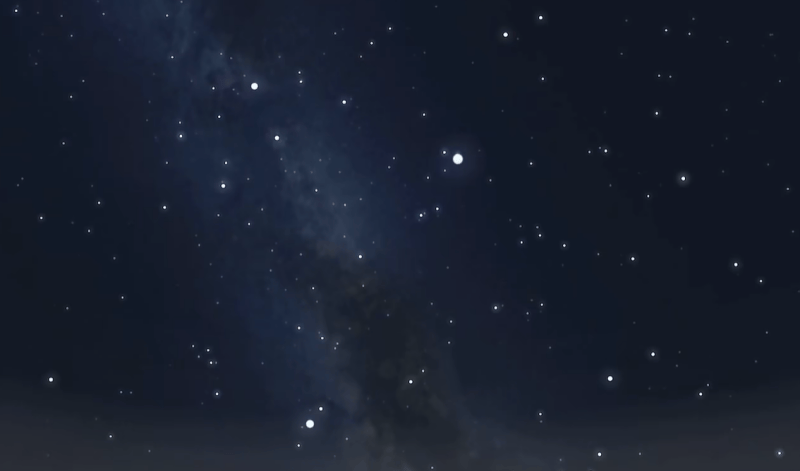
Stars are not stationary in the night sky. They move at different speeds around the core of the Milky Way galaxy in periodic motions. Although this motion is difficult to detect with our observations, on timescales of decades or even centuries, the position of a star on the celestial sphere shows significant changes.
In astronomy, this movement of a star relative to the background in the sky is called proper motion. It describes the change in the star's angle on the celestial sphere, not the change in actual spatial distance.
A classic example is Barnard's Star, one of the fastest known stars in proper motion, whose displacement can be observed within decades.
How Constellation Boundaries Work
In modern astronomy, constellations are no longer simply "patterns composed of linked stars," but rather precisely defined regions of the sky. In the 1920s, the International Astronomical Union divided the sky into 88 constellations, defining the clear boundaries of each. These boundaries were not arbitrarily drawn, but rather based on a celestial coordinate system (similar to latitude and longitude), divided along right ascension and declination.
This means that any point in the entire celestial sphere has been precisely assigned to a particular constellation.
Why Stars Can Change Constellations
Once a star accumulates a sufficiently large proper distance, its position in the celestial sphere will gradually change. If it happens to be located near the boundary of two constellations, it may cross that boundary over time.
It is important to emphasize that constellation boundaries are artificially defined; stellar motion is a natural phenomenon. The superposition of these two factors results in the phenomenon of "stars changing constellations."
Real-world example: ρ Aquilegii
A famous example in astronomy is ρ Aquilegii. Originally located in the constellation Aquila, this star, due to its own motion, crossed the constellation boundary at the end of the 20th century and entered the constellation Delphinus.
Interestingly, this star still retains its original Bayer name, "ρ Aquilegii," even though it is no longer in Aquila. This makes it one of the few stars whose name and actual celestial location are inconsistent.
What is the Bayer Nomenclature?
Names like "Alpha Orionis" and "Beta Tauri" come from the Bayer nomenclature. This is a system that uses Greek letters to name stars according to their brightness order within a constellation.
Generally, a star's name directly indicates which constellation it belongs to. However, because constellation boundaries are drawn later by humans, stars like ρ Aquilegii do not change their names even if they move to a different constellation.
Why Boundaries Look Irregular
If you look at modern constellation maps, you'll find that many constellation boundaries are irregular, even appearing somewhat jagged. This is because the astronomical community needs to meet several conditions when defining celestial boundaries:
Use a unified coordinate system (right ascension/declination)
Retain historically assigned stars
Avoid "cutting" important celestial bodies
Therefore, the final boundary is a compromise that balances historical accuracy and scientific accuracy.
Stars "crossing constellations" is not an unusual astronomical phenomenon, but rather the result of the combined effect of stellar motion and the perceived celestial boundaries. Constellations are essentially observational coordinate systems, not physical structures in the universe; therefore, changes in stellar positions naturally affect their assigned status.