
The answer is yes. Not only can you see stars in space, but you can see more and more clearly than on Earth. The reason many space photos don't show other stars isn't because they're invisible, but because cameras prioritize exposing bright subjects, causing faint starlight to be inaccurately recorded.
To better understand this, we can explain this seemingly paradoxical phenomenon from two perspectives: "human observation" and "camera imaging."
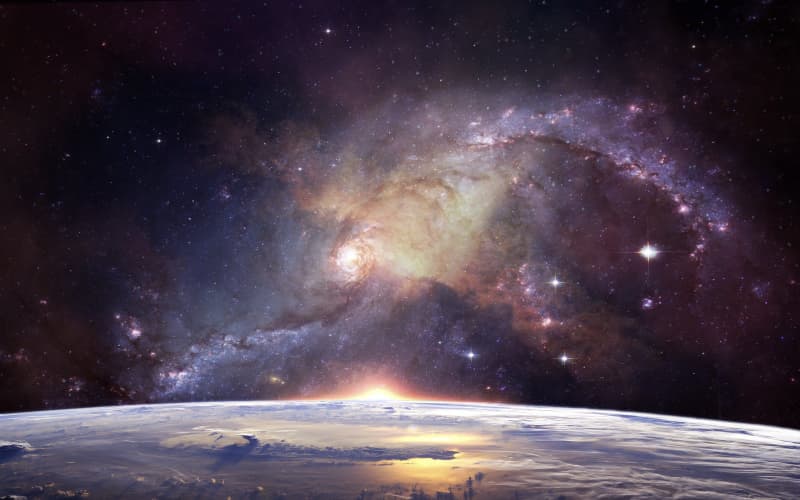
Can you really see stars in space?
From an observational standpoint, space is the ideal environment for stargazing. On Earth, visibility is affected by the atmosphere; for example, atmospheric scattering brightens the sky, and urban light pollution reduces star visibility.
In space, these interferences are virtually nonexistent. Without an atmosphere, there's no scattering effect; without artificial light sources, there's no light pollution. Therefore, in the complete darkness of space, the human eye can see more stars, albeit at lower brightness, and their brightness is more stable, without the flickering phenomenon seen from Earth.
Why can't we see stars in space photos?
Because we rarely see stars in the space photos we usually see. For example, in photos of astronauts spacewalking, the lunar surface, or space stations, the background is usually completely black.
The key to this is that the subject of these photos is a "bright subject," not the starry sky itself. In space, things like spacesuits, the metal structures of space stations or satellites, and the lunar surface are all illuminated by sunlight, making them much brighter than the stars in the background. To ensure these subjects are sharp, the camera must reduce the exposure during shooting; otherwise, the image will be severely overexposed. Under such exposure conditions, the light from the stars is too weak to be effectively recorded, so they appear to "disappear."
How Camera Exposure "Hides Stars"
This phenomenon can be understood through a simple photographic perspective: cameras cannot simultaneously capture extremely bright and extremely dark objects in a single image.
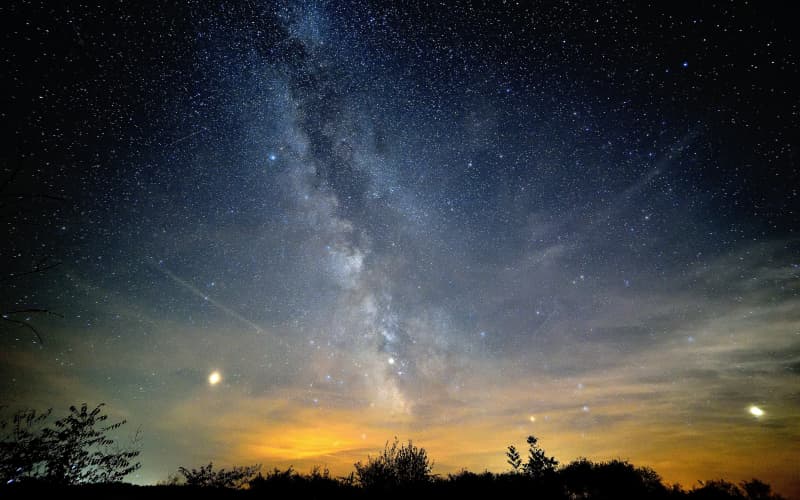
When a bright target is present in the frame, the camera uses a shorter exposure time and a lower ISO to prevent the subject from being overexposed. This setting is suitable for photographing astronauts or spacecraft, but for faint light sources like stars in the background, the accumulated light is insufficient, and therefore they won't appear in the final image.
What Happens If You Specifically Photograph the Night Sky?
If the target is the night sky, the camera settings are completely different. By increasing the exposure time, raising the ISO, and using a wider aperture, the camera's ability to capture faint light is significantly enhanced, thus recording a large number of stars.
This is why some deep-sky astronomical photographs show a dense starry background; however, these photographs typically do not include bright subjects because the difference in brightness between the two is too great to be captured simultaneously in a single exposure.
Does the human eye behave the same in space?
Not only cameras, but the human eye also behaves similarly under different lighting conditions. When a person is in a bright light environment, their pupils automatically constrict to reduce the amount of light entering the eye, thus reducing sensitivity to dim light sources.
Therefore, when performing missions in space, if the surrounding environment is bright, astronauts may have difficulty seeing stars. However, if they enter a shadowy area and after a period of adaptation, the stars will gradually become clearly visible.
In conclusion, it is indeed possible to see stars in space, and the observation conditions are usually better than on Earth. The reason why many space photos appear to have a black background is mainly because the camera prioritizes the exposure of bright subjects when shooting, thus failing to record the faint starlight.