
Many amateur astronomers, upon first encountering astronomy, find the Milky Way galaxy, with its diameter of approximately 100,000 light-years and containing hundreds of billions of stars, unimaginably vast, while their solar system appears as just a star near the edge of the Orion Arm. However, in the grand scheme of the universe, the Milky Way is actually minuscule.
Of all the known cosmic structures, the most extravagant and incredible is undoubtedly the Hercules–Corona Borealis Great Wall.
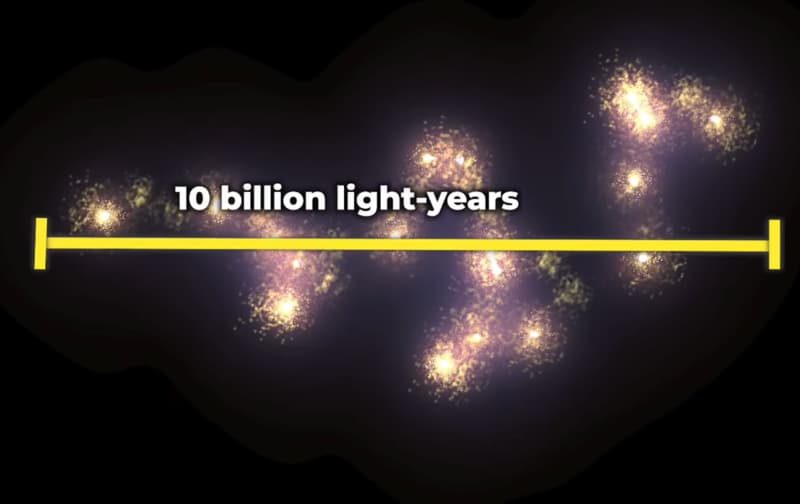
According to current astronomical observations, the Hercules–Corona Borealis Great Wall may be 10 billion light-years long, while the diameter of the known universe is approximately 93 billion light-years. This means that the Hercules–Corona Borealis Great Wall is more than one-tenth the length of the entire observable universe.
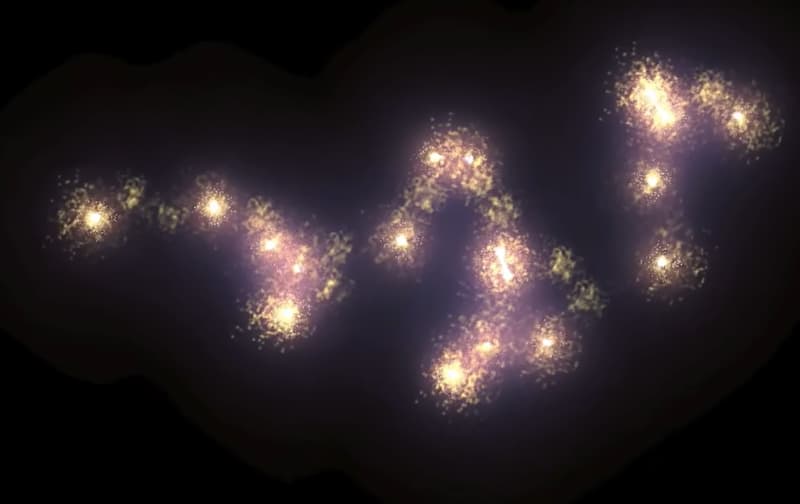
The Hercules–Corona Borealis Great Wall isn't actually a "wall," but rather a super-large-scale region of matter in the universe.
Some amateur astronomers, upon first hearing the name "Great Wall," might instinctively conjure up images of physical boundaries, as if it were a structure with clearly defined boundaries, like the edge of the Milky Way. However, in astronomy, the Great Wall doesn't refer to any specific type of wall. The Hercules–Corona Borealis Great Wall is essentially a large-scale structure.
It's composed of:
Galaxy clusters
Superclusters
Dark matter filaments
Millions of ordinary galaxies
a vast cosmic structure, or more accurately, a super-large node region within the Cosmic Web.
Modern astronomical observations reveal that the distribution of matter in the universe is not uniform. While the overall distribution of matter in the universe is nearly uniform on a large scale, local regions, influenced by Dark Matter and gravity, form giant celestial structures resembling neural networks.
Numerous galaxies cluster along "filamentary structures" formed by dark matter, with a vast void in the center. Familiar celestial objects like the Milky Way, the Local Group, and superclusters are essentially nodes on the Cosmic Web.
The Hercules–Corona Borealis Great Wall is one of the most exaggerated and expansive cosmic structures observed to date.
Why is it called the "Hercules–Corona Borealis Great Wall"?
Some amateur astronomers mistakenly believe the Hercules–Corona Borealis Great Wall belongs to Hercules or Corona Borealis, but in astronomy, a constellation is not an actual physical structure, but rather a directional division on the celestial sphere.
The International Astronomical Union divides the entire celestial sphere into 88 official constellation regions. If a celestial object is located in a corresponding direction, it belongs to a constellation.
Therefore, stars, nebulae, galaxies, black holes, supernovae, and even cosmic structures billions or tens of billions of light-years away could all be "located" in the direction of a constellation. The Hercules–Corona Borealis Great Wall is named so simply because it lies between Hercules and Corona Borealis.
However, this massive structure actually extends far beyond the area covered by these two constellations. Modern astronomical observations suggest it may even encompass large regions such as Boötes, Draco, and Lyra.
How was this 10 billion light-year-old superstructure discovered?
The discovery of the Hercules–Corona Borealis Great Wall was primarily due to Gamma-ray bursts data.
What is a Gamma-ray Burst (GRB)?
GRB are among the most violent explosive events in the universe. They are generally believed to originate primarily from:
● the collapse of supermassive stars
● neutron star collisions
● black hole formation.
A typical GRB releases more energy in a few seconds than the Sun releases in its entire lifetime. This is one of the brightest instantaneous events in the entire universe. Because of this, even if a GRB is billions of light-years away, it can still be detected by astronomical observation equipment.
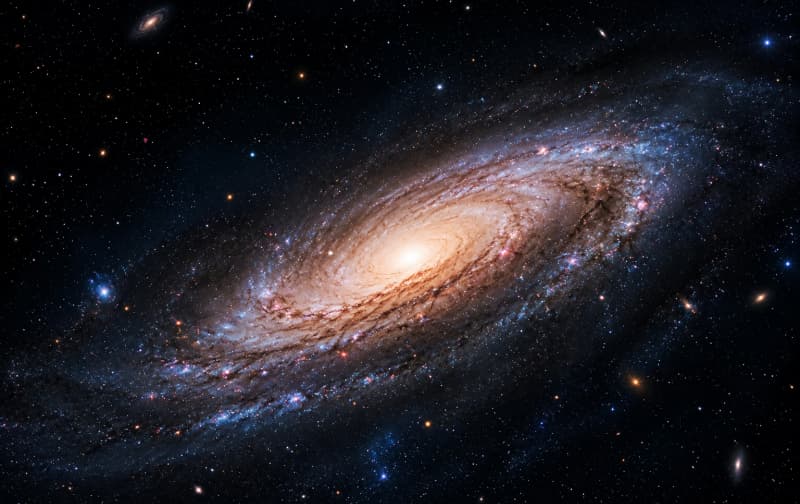
This is crucial for cosmology. GRBs can serve as important "tracers" for studying the structure of the distant universe. If a region frequently experiences a large number of GRBs, it indicates significant astronomical activity related to galaxy and star formation. In simpler terms, GRBs help scientists analyze regions where matter accumulates in the universe.
In 2013, scientists discovered an unusual cluster of GRB.
In 2013, astronomical researchers analyzed a large amount of GRB data from 1997 to 2012. The data revealed an unusually dense region of GRBs located approximately 10 billion light-years away in the direction of Hercules and Corona Borealis.
This means that this region may contain an extremely large cluster of galaxies. Based on the spatial distribution of these GRBs, scientists later inferred that a cosmic structure spanning over 10 billion light-years might exist in this region. This discovery shocked the entire field of cosmology at the time, because according to traditional theories, such an exaggeratedly large-scale cosmic structure should not exist in the universe.
Why does this structure challenge modern cosmological theory?
The most astonishing aspect of the Hercules–Corona Borealis Great Wall is not merely its size, but its absurdly large scale. Modern cosmology is built on a core theoretical foundation: the "Cosmological Principle."
The Cosmological Principle states that when the scale is large enough, the overall density of the universe should tend towards uniformity. Although galaxies, galaxy clusters, superclusters, and cosmic fragments may form in local regions, the theory suggests that these structures should not be this large.
The prevailing theory at the time believed that after 12 light-years, the universe should gradually become more uniform. However, the Hercules–Corona Borealis Great Wall spans over 10 billion light-years. Its discovery directly challenges modern cosmological models. If more data continues to support the existence of this structure, scientists will need to rethink several fundamental theories of modern astronomy, including the early evolution of the universe, the distribution of dark matter, and the Big Bang theory.
Does it really exist? The scientific community remains divided.
While a large amount of data supports the existence of the Hercules–Corona Borealis Great Wall, it is not yet 100% confirmed. The main reason is that the sample size of GRB data is still limited. Compared to ordinary galaxies, GRBs are relatively rare events, so the statistical error may be relatively large. Therefore, some scientists believe that this is merely a statistically random cluster, meaning that these GRBs may not belong to a truly continuous cosmic structure, but rather are simply an observational "visual illusion."
On the other hand, increasing research data suggests that large-scale structures in the universe may be much larger than previously thought.
With the deployment of next-generation sky surveys such as the James Webb Space Telescope, Euclid Mission, and Vera Rubin Observatory, humanity may observe even more spectacular cosmic superstructures in the future.
Why did the universe form cosmic filamentary structures?
Modern cosmology posits that all large-scale structures in the universe are essentially related to Dark Matter. Although Dark Matter cannot be directly observed, it possesses gravity. After the Big Bang, dark matter began to accumulate, and then ordinary matter formed along the gravitational pull of dark matter: galaxies, galaxy clusters, and superclusters. After billions of years of evolution, the entire universe eventually formed the cosmic filamentary structures we see today, and the Hercules–Corona Borealis Great Wall is likely just one of the most extreme parts of the Cosmic Web.