
Most stars visible to the naked eye are only a few dozen to a few hundred light-years from Earth. Yet in the constellation Cassiopeia, there is a relatively faint star that may be more than 8,000 light-years away: Rho Cassiopeiae (ρ Cas). It is often described as the farthest star visible to the naked eye, although uncertainties in its distance, changes in its brightness, and observing conditions make that record difficult to establish. What makes Rho Cassiopeiae remarkable is that its light can still reach our eyes across such an enormous distance under sufficiently dark skies.
How Far Away Is Rho Cassiopeiae?
Older astronomy references often place Rho Cassiopeiae at approximately 11,000 light-years from Earth. A 2025 study, however, adopted an estimated distance of about 2.5 kiloparsecs, or roughly 8,100 light-years. The difference is substantial. Measuring the distance to such a luminous, highly active star is difficult because precise stellar parallax measurements are challenging to obtain. Astronomers must also consider its spectrum, interstellar extinction, and stellar models when estimating how far away it is.
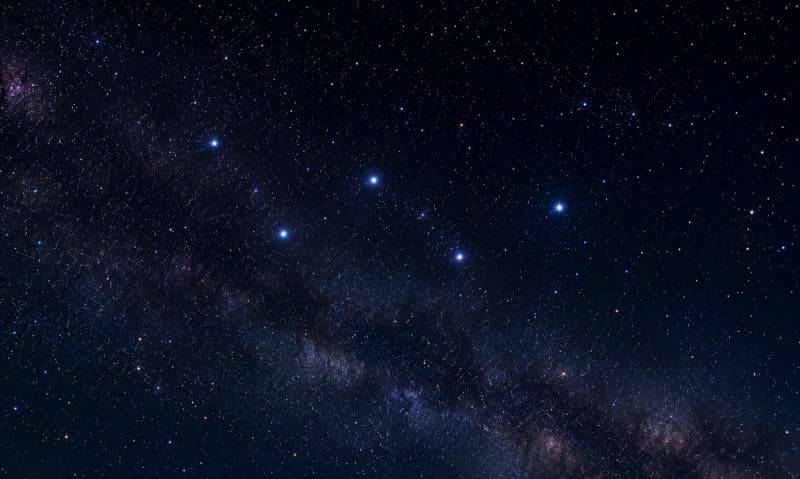
For comparison, Deneb, one of the stars of the Summer Triangle, is commonly placed at around 1,500 light-years, although its distance also carries some uncertainty. Even using the lower estimate of 8,100 light-years, Rho Cassiopeiae is considerably farther away. It is therefore more accurate to describe it as one of the most distant stars visible to the naked eye, rather than claiming it holds an undisputed record.
How to Find Rho Cassiopeiae in the Night Sky
Cassiopeia is easily recognized by the W-shaped or M-shaped pattern formed by its five bright stars. It is one of the most familiar northern constellations in the autumn sky across North America. Start by locating Caph (Beta Cassiopeiae) at one end of the W, then look about 2.5 degrees southwest to narrow down the position of Rho Cassiopeiae. That angular distance is roughly equivalent to the width of two or three fingers held at arm's length.
Rho Cassiopeiae usually shines at around magnitude 4 to 5, making it much less conspicuous than the brighter stars forming the W. The easiest approach is to identify Caph with the naked eye, then use 7×50 or 10×50 binoculars and a detailed star chart to locate the target. Cassiopeia is visible throughout the year from many mid- and high-northern latitudes in the United States and Canada, although it is particularly prominent on autumn evenings.
Can You Really See Such a Distant Star with the Naked Eye?
A star's visibility depends on more than its distance. Its intrinsic luminosity matters, as does the amount of interstellar dust blocking its light along the way. Rho Cassiopeiae has a typical apparent magnitude of about 4.5, but it is a variable star. Historical observations show that its brightness has ranged from approximately magnitude 4.1 to 6.2. Light pollution can easily hide it during its fainter phases, while observers with good eyesight may have a better chance of seeing it under dark, moonless rural skies.
Binoculars make the search more reliable, although the star will still appear as a tiny point of light rather than a visible disk. Its enormous physical size cannot be resolved through ordinary binoculars. If other faint stars of different colors appear nearby, their apparent proximity alone does not establish that they are physically associated companions.
Why Is This Yellow Hypergiant So Bright?
Rho Cassiopeiae is a rare yellow hypergiant, a massive star in a late stage of stellar evolution. It is vastly larger than the Sun and radiates an extraordinary amount of energy. Using an estimated distance of about 8,100 light-years, a 2025 study placed its luminosity at approximately 260,000 times that of the Sun. This tremendous intrinsic brightness explains how its light remains visible from Earth despite traveling thousands of light-years.
The star's outer layers are unstable, and its radius can reach several hundred times that of the Sun, changing as the star pulsates and passes through different phases of activity. Its brightness does not come from repeatedly directing jets of material toward Earth. Rho Cassiopeiae is intrinsically extremely luminous, while episodes of powerful mass ejection may produce cooling gas and dust that alter the amount of visible light reaching us.
Why Does Rho Cassiopeiae Fade, and Could It Become a Supernova?
The outer atmospheres of yellow hypergiants can expand and contract, sometimes ejecting substantial amounts of material. Rho Cassiopeiae has experienced significant dimming events. Astronomers study its changing temperature, pulsations, and mass loss using long-term brightness measurements and spectroscopic observations. Its apparent magnitude of 4.5 should therefore be treated as a typical value, not a constant one.
Massive stars in advanced evolutionary stages, such as Rho Cassiopeiae, may eventually undergo a supernova explosion or end their lives through other evolutionary pathways. There is currently no reliable way to predict when its final event might occur, nor is there evidence that it has already exploded. The light we see today left the star thousands of years ago, but that light-travel time alone tells us nothing definite about its present condition.
How Does Rho Cassiopeiae Compare with Eta Carinae?
Another famous distant luminous star is Eta Carinae, located approximately 7,500 light-years from Earth. It became extraordinarily bright during its Great Eruption in the 19th century. Eta Carinae lies in the southern constellation Carina and cannot be observed from most of North America. Rho Cassiopeiae, by contrast, is found in the much more accessible northern constellation Cassiopeia. Both stars are exceptionally luminous and exhibit unstable behavior, although they differ in stellar classification and evolutionary characteristics.
Finding a Star Thousands of Light-Years Away
To observe Rho Cassiopeiae (ρ Cas), begin with Caph at one end of Cassiopeia's W-shaped pattern and use a star chart to identify this variable yellow hypergiant. It is not conclusively established as the farthest star visible to the naked eye, and its distance should not be presented as an exact, unquestionable figure. Yet under dark skies, the fact that such an ordinary-looking point of light can come from roughly 8,000 light-years away offers a striking reminder of how dramatically stars can differ in luminosity.