
In the Northern Hemisphere, Polaris, the North Star, is one of the most reliable landmarks in the night sky. Because it lies very close to the North Celestial Pole, the other stars appear to circle around it while Polaris itself seems to barely move. That is why it is often described as a “fixed star” in the northern sky.
Over a few years or even a few decades, that description works well enough. Stretch the timeline to thousands or tens of thousands of years, however, and the picture changes. Earth’s rotational axis slowly shifts because of a motion known as axial precession, causing the North Celestial Pole to move against the background stars. Polaris will not remain the North Star forever, and other stars have occupied—or will eventually occupy—a similar position.
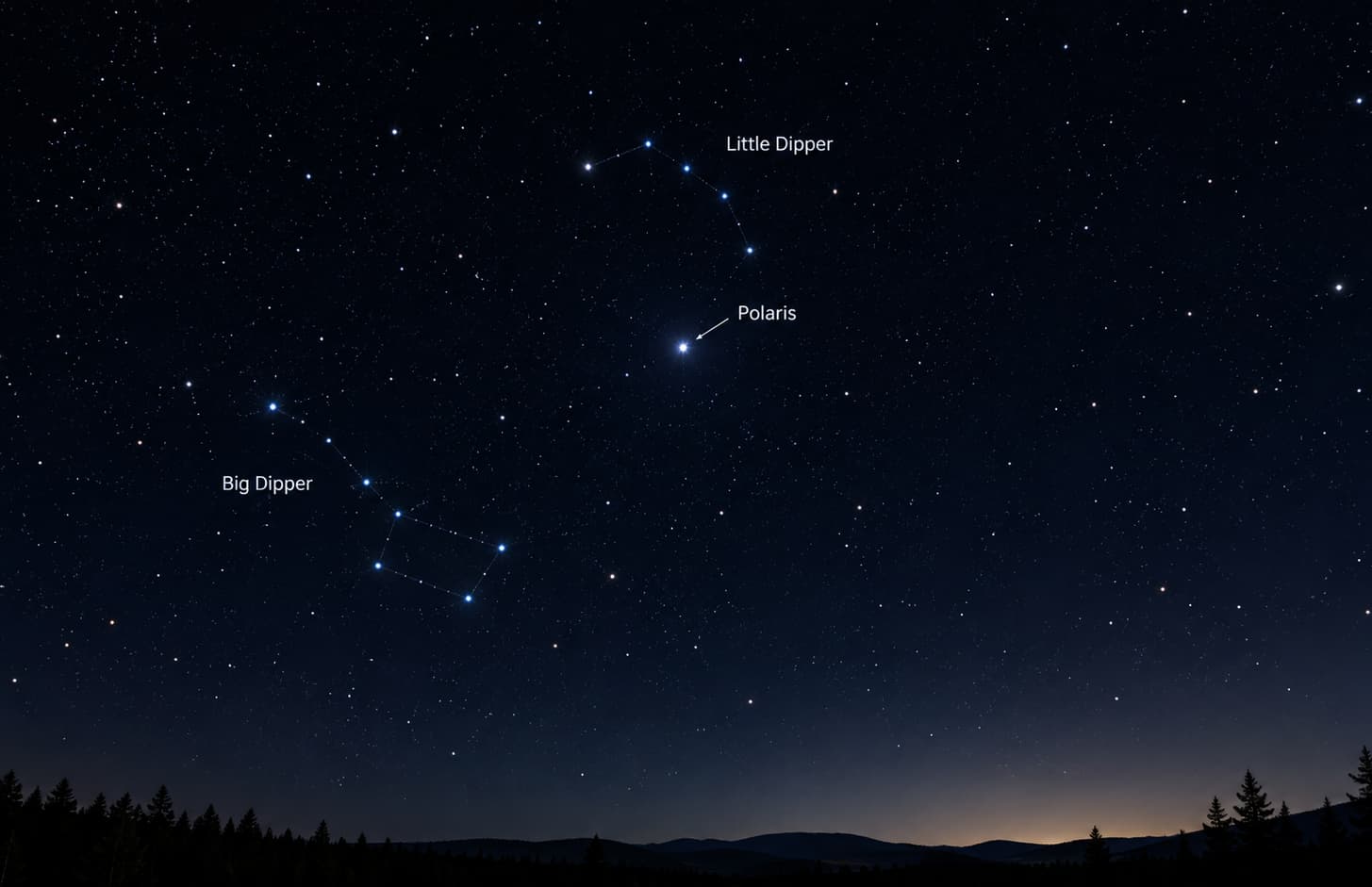
Why Does Polaris Appear Almost Motionless?
Earth rotates once each day around its axis. If we extend that rotational axis northward into the sky, it points to the North Celestial Pole.
Polaris currently lies less than 1 degree from that point. As Earth rotates, Polaris traces only a very small circle around the true celestial pole, while stars farther away sweep out much larger circular paths. Over a short period, that tiny movement is difficult to notice with the naked eye, creating the impression that Polaris does not move at all.
Strictly speaking, Polaris is not located exactly at the North Celestial Pole. It simply happens to be very close to it at the present time, which makes it useful for identifying true north from the Northern Hemisphere.
NASA also notes that Polaris is currently the bright star nearest the northward extension of Earth’s rotational axis, rather than a permanently fixed point in the sky.
What Is Axial Precession?
Earth is not a perfect sphere. It bulges slightly around the equator, and its rotational axis is tilted relative to the plane of its orbit around the Sun.
The gravitational pull of the Sun and Moon on Earth’s equatorial bulge causes the rotational axis to move in a slow, top-like wobble. This motion is known as axial precession.
Rather than simply tipping toward a new direction, Earth’s axis slowly sweeps out a roughly cone-shaped path through space. One complete precession cycle takes about 25,772 years, often rounded to about 26,000 years in general astronomy discussions.
Over a human lifetime, the direction of Earth’s axis changes very little. On the scale of civilizations or geological time, however, the position of the North Celestial Pole shifts noticeably across the stellar background.
Why Does the North Star Change Over Time?
The term “North Star” does not have to refer permanently to one particular star. More accurately, it describes a role: a relatively bright star that happens to lie close to the North Celestial Pole during a given era can serve as that era’s pole star.
Because of axial precession, the North Celestial Pole slowly traces a path around the north ecliptic pole. Stars located near that path can take turns approaching the celestial pole over thousands of years.
Sometimes there is a convenient bright star nearby, as there is today with Polaris. At other times, no particularly bright star lies close enough to the pole to serve as such a useful marker.
That also means there is no formal moment when one North Star suddenly “hands over” the role to another. The transition is gradual, with the celestial pole slowly moving from one region of the sky to the next.
What Was the North Star 5,000 Years Ago?
Today, Polaris in Ursa Minor serves as our North Star. Around 5,000 years ago, however, the northern sky looked different.
During the era of ancient Egypt and the construction of the pyramids, Thuban, Alpha Draconis, was closer to the North Celestial Pole than Polaris. For that reason, Thuban is often described as the pole star of that era.
According to NASA, around 3000 BCE Earth’s north rotational axis pointed near Thuban. Over the centuries, precession gradually carried the pole away from it. Some later periods did not have a pole star as conveniently placed or as easy to identify as Polaris is today.
This historical change is a clear example of how Earth’s slowly shifting rotational axis can alter the celestial coordinate system over thousands of years, even though the stars themselves do not suddenly jump across the sky.
Which Star Will Replace Polaris?
Polaris will remain close to the North Celestial Pole for a long time and is expected to make its closest approach to the pole around 2100. After that, the celestial pole will begin to drift farther away from it.
As axial precession continues, Gamma Cephei, also known as Errai, will gradually become a better pole-star candidate. By around 3100, it is expected to lie closer to the North Celestial Pole than Polaris. Gamma Cephei will come closest to the pole sometime around 4000 to 4200, although even then it will still be about 3 degrees away. That means it will not mark true north as precisely as Polaris does today.
The celestial pole will then continue moving through the region of Cepheus. Around 5900, Beta Cephei and Iota Cephei will lie closer to the pole, and by roughly 7500, Alderamin, Alpha Cephei, will become another prominent pole-star candidate.
It is worth remembering that there is no single date on which one star officially becomes the new North Star. The pole moves gradually over centuries, so sources may give different dates depending on whether they mean “closer than Polaris” or “closest approach to the celestial pole.”
Will Vega Become a Future North Star?
Yes, although Vega will not sit exactly on the North Celestial Pole.
Vega, the brightest star in Lyra and one of the three stars of the Summer Triangle, will move into the polar region as Earth’s axis continues its precessional cycle. Roughly 12,000 years from now, the North Celestial Pole will lie near Vega, making it one of the most prominent northern pole stars of that era.
NASA notes that Vega was also near the northern polar region about 14,000 years ago and will return to a similar position about 12,000 years in the future.
Because Vega is much brighter than Polaris, it would be an extremely obvious landmark in the northern sky if future observers still use bright stars to orient themselves.
Is Polaris the Brightest Star in the Night Sky?
Despite its fame, Polaris is not the brightest star in the night sky. Its importance comes from its position, not its brightness.
The brightest star in the night sky is Sirius. Other first-magnitude stars such as Vega, Capella, and Rigel also appear brighter than Polaris.
This is one of the most common mistakes beginners make when trying to find the North Star for the first time: they simply look for the brightest star in the northern sky.
A much more reliable method is to find the Big Dipper first. The two stars at the outer edge of its bowl, Merak and Dubhe, are often called the Pointer Stars. Extend a line through them and you will eventually reach Polaris.
Once you find it, you may be surprised by how ordinary it looks. Polaris is only moderately bright, yet its location near the North Celestial Pole gives it an outsized importance in navigation and astronomy.
Axial Precession Is Slowly Changing the Northern Sky
So, Polaris will not always be the North Star. It holds that role today because Earth’s rotational axis currently points very close to it. Over the roughly 25,772-year cycle of axial precession, the North Celestial Pole slowly shifts across different parts of the sky.
Thuban served as an important pole star thousands of years ago. Gamma Cephei and other stars in Cepheus will become future pole-star candidates, and roughly 12,000 years from now Vega will again lie near the northern celestial pole.
Understanding why Polaris appears fixed, why the North Star changes, what axial precession is, and which stars will become future pole stars is really a lesson in how Earth itself moves through space. The night sky may appear permanent on the scale of a human lifetime, but over thousands of years, even our celestial reference points slowly change.