
If you look up at night and notice an unusually bright, steady point of light, there’s a good chance you’re looking at a planet rather than a star. Jupiter is one of the easiest planets for beginners to recognize. It’s readily visible to the naked eye and, when well placed for observation, can be one of the most prominent objects in the night sky.
Still, finding Jupiter isn’t simply a matter of looking for “the brightest star.” Venus is usually brighter, and Jupiter’s position against the background stars changes from year to year. To identify Jupiter with confidence, it helps to know what it looks like, where to look, when it’s visible, and how it differs from other bright objects in the sky.
What Does Jupiter Look Like in the Night Sky?
To the naked eye, Jupiter looks like a very bright white or slightly cream-colored point of light. You won’t see its round disk, cloud bands, or Great Red Spot without optical aid. What usually gives Jupiter away is its brightness and relatively steady appearance.
Stars often twinkle noticeably because their light is disturbed as it passes through Earth’s atmosphere. Jupiter tends to look steadier, especially when it is high above the horizon. That makes it stand out from many of the stars around it.
Jupiter’s brightness does change over time, though, so the rule that “the brightest object must be Jupiter” doesn’t always work. When Jupiter is favorably placed and relatively close to Earth, it can dominate its part of the sky. At other times, it may be less conspicuous or too close to the Sun from our point of view to observe easily.
How to Find Jupiter
Jupiter does not stay in one constellation throughout the year. Both Earth and Jupiter orbit the Sun, so from our perspective, Jupiter slowly moves against the background of the zodiac constellations. It may spend one observing season near Gemini, for example, and appear in a different part of the zodiac several years later.
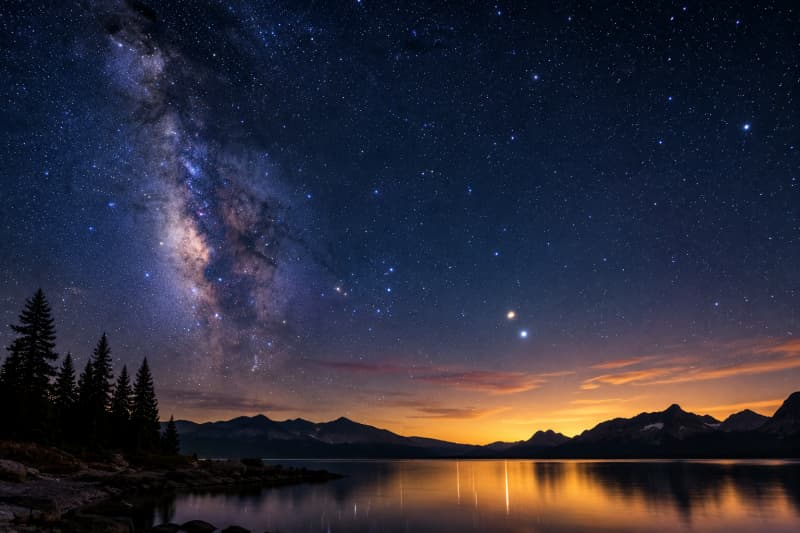
For beginners, the easiest way to find Jupiter is to check a current star chart or astronomy app before heading outside. Look up Jupiter’s rising and setting times, the constellation it is currently in, and its approximate direction. Once you know where to look, Jupiter is usually easy to pick out because it is brighter than the surrounding stars.
There are also a few useful clues. Unlike Mars, Jupiter does not normally have a strong orange-red color. Unlike Venus, Jupiter can appear far from the Sun in the sky and, at certain times of year, remain visible for most or all of the night. Venus, by contrast, is always seen relatively close to sunrise or sunset.
Why Is Jupiter So Bright?
Jupiter does not produce visible light the way a star does. What we see from Earth is primarily sunlight reflected from its upper atmosphere and clouds. Its impressive brightness comes partly from its enormous size: Jupiter is roughly 140,000 kilometers across, with a diameter about 11 times that of Earth.
Although Jupiter is much farther away than Mars or Venus, its huge visible surface reflects a substantial amount of sunlight. Its distance from Earth also changes as the two planets travel around the Sun. When Earth and Jupiter are relatively close, Jupiter appears both brighter and slightly larger through a telescope.
This is why Jupiter’s apparent brightness isn’t constant. It depends on where Earth and Jupiter are in their respective orbits.
When Is the Best Time to Observe Jupiter?
If you want to do more than simply identify Jupiter with the naked eye, one of the best times to observe it is around opposition. Jupiter is at opposition when Earth lies roughly between the Sun and Jupiter. Around this time, the planet is relatively close to Earth and remains visible for much of the night.
Near opposition, Jupiter rises around sunset, reaches its highest point in the sky around the middle of the night, and sets near sunrise. You don’t have to observe it on the exact date of opposition, however. The weeks and even months around opposition can provide excellent views.
For telescope users, altitude matters too. Jupiter usually looks sharper when it is high in the sky because its light passes through less of Earth’s atmosphere. Close to the horizon, atmospheric turbulence can make the planet appear blurry or unsteady, even through a good telescope.
How Can You Tell Jupiter from Venus or Sirius?
Jupiter is often confused with other exceptionally bright objects, particularly Venus and Sirius. Venus is usually brighter than Jupiter, but there is an easy way to narrow things down: Venus never appears very far from the Sun in our sky. You’ll see it either in the western sky after sunset or in the eastern sky before sunrise. If you see an extremely bright object high in the sky late at night, it isn’t Venus.
Sirius is the brightest star in the night sky, but it is generally fainter than Jupiter when Jupiter is favorably placed. Sirius also tends to twinkle much more noticeably, sometimes flashing different colors when it is low in the sky. Jupiter usually shines with a steadier white or pale cream light.
Brightness alone isn’t enough for a positive identification, though. Checking the object’s direction, the time of night, and a current star chart is much more reliable than relying on a single visual clue.
What Can You See with Binoculars?
Point a pair of binoculars at Jupiter and you may notice something that isn’t obvious to the naked eye: several tiny points of light lined up beside the planet. These are the four large Galilean moons—Io, Europa, Ganymede, and Callisto.
Their positions change constantly as they orbit Jupiter. Observe the planet on several consecutive nights and you can watch the moons shift from one side to the other. Sometimes one disappears behind Jupiter or passes in front of the planet.
For a beginner, this is one of the most rewarding observations you can make with simple equipment. You aren’t just looking at a distant dot in the sky; you are watching moons move around another planet, much as Galileo did more than four centuries ago.
What Can a Small Telescope Show on Jupiter?
Through a small astronomical telescope, Jupiter becomes a clearly defined disk rather than a point of light. Under reasonably good conditions, you should be able to see dark and light bands running roughly parallel to its equator. The two main equatorial belts are usually among the easiest atmospheric features to recognize.
With better seeing, sufficient aperture, and some observing experience, finer details may become visible. The famous Great Red Spot is also within reach of many amateur telescopes, but it isn’t visible at all times. Jupiter rotates quickly, so the Great Red Spot spends part of each rotation on the side facing away from Earth. Checking its predicted transit time before observing can save you from waiting for a feature that simply isn’t in view.
High magnification isn’t always the answer. A sharp, steady image at moderate magnification often reveals more than a larger but blurry view distorted by atmospheric turbulence.
Does Jupiter Have a Solid Surface?
Jupiter is a gas giant, composed mainly of hydrogen and helium, and its structure is fundamentally different from rocky planets such as Earth and Mars. The colorful bands we see in photographs are cloud layers in Jupiter’s atmosphere, not a solid surface that a spacecraft could land on.
Pressure and temperature increase dramatically with depth. Far below the visible clouds, hydrogen is compressed into states very different from the gas we encounter on Earth. At sufficiently high pressures, hydrogen behaves as an electrically conducting material known as metallic hydrogen. This region is thought to play an important role in generating Jupiter’s powerful magnetic field.
Jupiter’s deepest interior is still an active area of research. Rather than having a simple, sharply defined rocky core like the diagrams found in older textbooks, the planet may contain a more extended or “dilute” core in which heavier elements are mixed through part of the deep interior.
How Big Is Jupiter?
Jupiter is the largest and most massive planet in the Solar System. Its mass is about 318 times that of Earth, and it is more massive than all the other planets combined. Its enormous gravity has also allowed it to retain a large and complex system of moons.
Calling Jupiter a gas giant can sometimes give the wrong impression that it is simply a loose ball of gas. In reality, conditions change enormously as you travel deeper into the planet. Under extreme pressure, matter behaves in ways that are very different from anything we experience at Earth’s surface.
Studying Jupiter’s size, composition, gravity, and interior gives astronomers important clues about how giant planets formed and how the early Solar System evolved.
What Has Juno Taught Us About Jupiter?
NASA’s Juno spacecraft launched in 2011 and entered orbit around Jupiter in 2016. Since then, it has studied the planet’s atmosphere, gravity, magnetic field, polar regions, and deep interior. Its measurements have helped scientists move beyond some of the simpler models once used to describe Jupiter’s internal structure.
Juno has also returned remarkable views of Jupiter’s poles, revealing vast systems of cyclones that look very different from the familiar horizontal bands we see from Earth.
There is a fitting story behind the spacecraft’s name. Jupiter takes its English name from the king of the gods in Roman mythology. Juno was Jupiter’s wife, and in mythology she was able to see through the clouds Jupiter used to conceal his activities. The spacecraft named after her is, in a sense, doing something similar—looking beneath Jupiter’s clouds to investigate what lies below.
Start Your Planet Observing with Jupiter
Learning how to find Jupiter in the night sky doesn’t require expensive equipment. Start with a current star chart, check where Jupiter is that night, and look for a very bright, usually white or cream-colored object with relatively steady light. Once you’ve identified it with the naked eye, binoculars can reveal the four Galilean moons, while a small telescope can show Jupiter’s disk, major cloud belts, and, under the right conditions, the Great Red Spot.
Questions such as what Jupiter looks like in the night sky, why Jupiter is so bright, how to tell Jupiter from Venus, and when Jupiter is best seen are all connected to the same basic idea: the planets are moving worlds, and what we see changes as Earth and Jupiter travel around the Sun.
That makes Jupiter more than an easy object to identify. It is one of the best planets for learning how to observe the Solar System for yourself. Once you can confidently find Jupiter, following the changing positions of its moons and watching its atmospheric features through a telescope are natural next steps.