
How can we directly observe Mercury, Venus, Mars, Jupiter, and Saturn in the night sky without the aid of stargazing apps or telescopes? It is actually quite simple; by grasping a few basic principles, you can see them with the naked eye.
The most significant common characteristic of these five major planets is that they all orbit near the ecliptic; however, their visibility varies due to differences in brightness, color, and distance from the Sun.
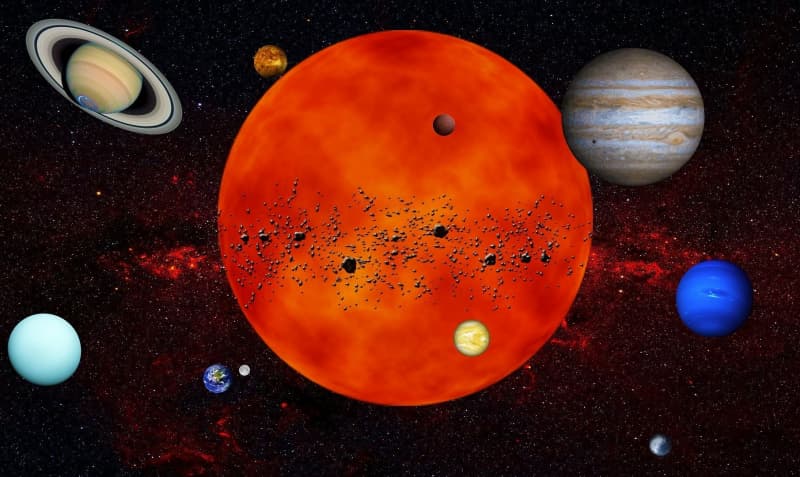
Let's start with the ecliptic: why do planets always appear near the same "band" in the sky?
To distinguish whether a celestial object is a star or a planet, the first step is to determine if it lies near the ecliptic. The orbits of the major planets in our solar system all lie roughly within the same plane; consequently, when viewed from Earth, the Sun, the Moon, and the five planets visible to the naked eye generally move within a narrow strip along the ecliptic.
Constellations located near the ecliptic—such as Taurus, Gemini, Leo, Scorpius, and Sagittarius—can help beginners form a general idea of where the ecliptic lies. If an unfamiliar point of light suddenly appears near these constellations and shifts its position relative to the background stars over the course of a few days or weeks, it is highly likely to be a planet. Indeed, one of the key differences between planets and stars is precisely this slow "wandering" motion along the ecliptic.
Why is Mercury the hardest of the five visible planets to spot?
Mercury is difficult to locate not because it lacks brightness, but primarily because it is so close to the Sun. Its orbit lies inside Earth's, and it is the planet closest to the Sun in the solar system; consequently, from Earth, Mercury appears only briefly—either low in the western sky after sunset or low in the eastern sky before sunrise.
The best opportunities to observe Mercury usually occur when it reaches "greatest elongation"—the point where it appears farthest from the Sun in the sky. According to NASA data, Mercury rises and sets very close in time to the Sun, meaning the viewing window is often limited to a brief period of twilight. For astronomy enthusiasts in the Northern Hemisphere, the key to spotting Mercury lies not in its color, but in timing the observation for the date of greatest elongation and finding a location with an unobstructed horizon.
Venus is the most easily recognizable planet in the night sky.
Among the planets in the solar system, Venus is the easiest to identify. It is the brightest natural object in the sky visible from Earth—surpassed in brightness only by the Sun and the Moon—and far outshines ordinary stars; consequently, it is sometimes mistaken for aircraft lights or an unusually bright "star."
Like Mercury, Venus orbits closer to the Sun than Earth does; therefore, it never appears high in the sky at midnight. Instead, it typically appears as the "Evening Star" in the western sky after sunset or as the "Morning Star" (famously known as the *Qimingxing*) in the eastern sky before sunrise. If you spot an exceptionally brilliant, whitish point of light with a steady glow—located not too far from the Sun's position—you should first consider Venus rather than Jupiter or Sirius.
Is the red color truly the most reliable characteristic of Mars?
While Mars's most prominent feature is indeed its orange-red surface, relying solely on color can easily lead to misidentification, as stars such as Antares, Aldebaran, and Betelgeuse also exhibit a distinct orange-red hue.
A reliable method is to observe both color and changes in position: the patterns formed by stars remain stable over time, whereas Mars noticeably shifts its position relative to background constellations over the course of weeks or months. Mars also undergoes significant fluctuations in brightness; when distant from Earth, it may appear merely like an ordinary bright star, yet around the time of opposition—when viewing conditions are optimal—it becomes exceptionally striking, sometimes even outshining Jupiter. NASA data indicates that while Jupiter is typically one of the brightest objects in the night sky, Mars can surpass it during certain oppositions.
How can you distinguish between Jupiter and Saturn?
When observed, Jupiter generally appears white or pale yellowish-white and is very bright; during favorable viewing periods, it often significantly outshines surrounding stars. NASA even ranks it among the most conspicuous objects in the night sky, surpassed only by the Moon, Venus, and Mars at opposition.
Saturn, on the other hand, typically displays a soft, pale yellow hue and has a brightness comparable to that of a bright star. Therefore, if two steady points of light appear near the ecliptic, the much brighter one is likely Jupiter, while the dimmer one is likely Saturn.
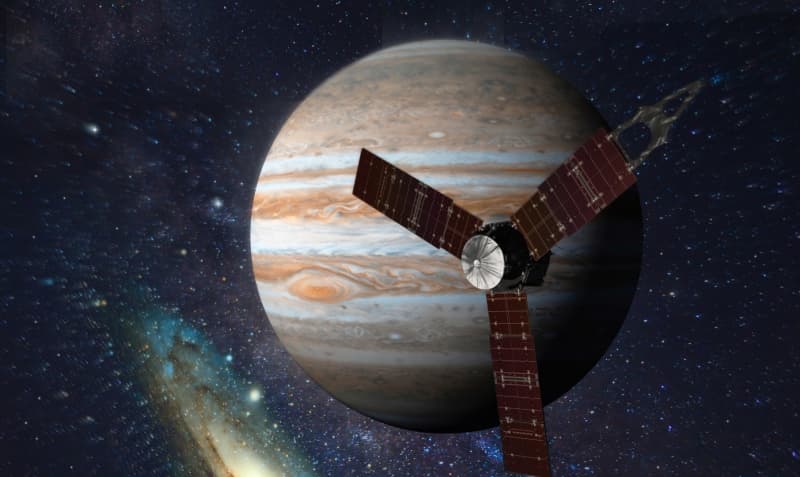
However, this assessment must take the specific celestial backdrop into account, as the positions of both planets are constantly changing. With a pair of binoculars or a small telescope, Jupiter's Galilean moons and Saturn's rings make their identities immediately unmistakable.
Is the rule "planets don't twinkle, but stars do" reliable?
This is a very practical rule of thumb, though it should not be viewed as an absolute standard. Because stars are extremely distant, they appear to the naked eye as mere point sources of light; consequently, pockets of air with fluctuating temperatures and densities cause rapid refraction of starlight, resulting in the familiar twinkling effect. In contrast, while planets also appear as mere points of light in the night sky, they actually possess measurable disks; atmospheric disturbances affecting different parts of the disk tend to partially cancel each other out, making them appear steadier.
However, when Jupiter, Venus, or Mars are very close to the horizon, their light must pass through a thicker layer of atmosphere, and they too can exhibit noticeable twinkling. Therefore, "whether or not it twinkles" serves best as a supplementary clue; it is best to evaluate this alongside factors such as position relative to the ecliptic, brightness, and color.
How can you determine step-by-step—without using software—whether an unfamiliar bright star is actually a planet?
During actual observation, first check whether the bright object is located near the ecliptic, then observe when it appears. If it is visible only in the twilight close to the Sun, it is likely Mercury or Venus. If it is extremely bright and appears in the late-night sky far from the Sun, Jupiter is the most probable candidate. A distinct orange-red hue suggests Mars, while a moderate, yellowish glow—combined with a position along the ecliptic—points to Saturn. Finally, observe the object over several consecutive nights; if the point of light gradually shifts position relative to nearby stars, you have strong evidence that it is a planet. NASA also notes that among the five planets visible to the naked eye, Venus and Jupiter are often exceptionally bright, whereas the others typically resemble ordinary bright stars.