
If you are just getting started with astronomical observation and want to look beyond the Moon and planets for an easy entry-level deep-sky object, the M13 Hercules Globular Cluster (Messier 13) is a target well worth trying. Also known as the Great Hercules Cluster, it is one of the most famous globular clusters in the Northern Hemisphere. With an apparent magnitude of around 5.8, M13 lies near the edge of naked-eye visibility under dark, clear skies away from city lights; using a standard pair of binoculars makes it even easier to see as a faint, concentrated circular patch of light. For beginner amateur astronomers in North America, M13 is particularly well suited as one of your first targets for learning star charts, star-hopping, and deep-sky observing.

What is the M13 Hercules Globular Cluster?
M13 is not a single star, but rather a globular cluster composed of a vast number of stars bound together by gravity. Located in the direction of the constellation Hercules, it lies approximately 25,000 light-years away from Earth. This means that the light from M13 we see through a telescope today actually left the cluster roughly 25,000 years ago.
M13 contains over 100,000 stars. Estimates of the exact count vary across different studies and sources, so rather than giving an absolute figure, it is more accurate to say that hundreds of thousands of stars are gathered here. These stars are distributed within a volume roughly 150 light-years in diameter, with the stellar density increasing dramatically toward the cluster's core.
This structure marks a striking difference between globular clusters and typical open clusters. When observed through a telescope, you will notice that M13 has an exceptionally bright center with brightness tapering off toward the edges. In larger-aperture telescopes, individual stars along the outer perimeter gradually resolve out of the hazy glow, revealing the quintessential appearance of a globular cluster.
How to Find M13 in the Night Sky
For beginners, the real challenge is often not "how to observe M13," but rather how to locate M13 in the first place.
M13 is located in the constellation Hercules. The problem is that while Hercules covers a large area of the sky, it lacks the extremely bright, eye-catching stars found in constellations like Orion, making it tricky for newcomers to recognize directly. A simpler approach is to start by finding two very bright stars in the Northern Hemisphere's spring and summer night sky: Vega and Arcturus.
Vega belongs to the constellation Lyra and is a prominent bright star in the summer sky, while Arcturus belongs to Boötes. Hercules lies roughly in the region of the sky between these two obvious targets. Once you locate this general area, you can look for Hercules's famous asterism, the "Keystone."
The Keystone consists of four stars that form an irregular quadrilateral, serving as one of the most practical landmarks for finding M13.
M13 is situated along one side of this quadrilateral, lying between Eta Herculis and Zeta Herculis, positioned closer to Eta Herculis. Beginners can first confirm the Keystone with the naked eye, then use low-magnification binoculars to slowly sweep along the line between Eta Herculis and Zeta Herculis. When a small, hazy circular patch of light appears in your view—rather than a sharp point of light like a typical star—you have very likely found M13.
What is the best time to observe M13?
For most mid-latitude regions in the United States and Canada, late spring through summer is a very suitable period for observing M13, with summer being particularly convenient. After nightfall, Hercules rises to a relatively high position in the sky, minimizing the impacts of atmospheric turbulence and light pollution near the horizon on M13.
However, observing deep-sky objects requires looking at more than just the month—you also need to pay attention to moon phases and sky conditions.
If you are searching for M13 for the first time, try to avoid bright nights around the full moon. Moonlight significantly reduces the contrast of the sky background, making globular clusters—which already appear as faint, grayish-white patches of light—even harder to discern. Choosing a clear, high-transparency, moonless night and staying as far away as possible from city centers, parking lots, and street lighting will generally yield better observing results.
After arriving at a darker observing site, do not immediately set up your telescope to search for the target. Allowing your eyes to adapt to the dark environment for about 20 minutes—and avoiding looking directly at bright white phone screens—will help you spot fainter deep-sky objects.
Can you see M13 with binoculars?
Yes, and observing M13 with binoculars is very suitable for beginners.
Under sufficiently dark skies, M13 can even be detected by the naked eye as a very faint, fuzzy point of light. However, for most North American observers living in cities or suburbs, using standard binoculars—such as 7x50, 8x42, or 10x50—makes locating it much easier.
When viewing through binoculars, do not expect to see the massive, spherical structures composed of countless stars seen in astrophotography. The actual visual view is usually a small, round, grayish-white patch of light that is slightly brighter toward the center.
This does not mean your equipment is poor. Astrophotography accumulates vast amounts of light through long exposures, whereas the human eye perceives real-time views, so there is inherently a striking difference between the two. Understanding this helps beginners avoid unnecessary disappointment during their first deep-sky observations.
What Can You See When Observing M13 with a Small Astronomical Telescope?
If you use a small astronomical telescope with an aperture of about 80–100 mm, M13 will look significantly more pronounced than through binoculars. At low magnification, it typically appears as a bright, circular patch of light that gradually fades toward the edges; as aperture, magnification, and sky quality improve, a grainy texture may begin to show around the perimeter of the cluster, and some individual member stars will gradually resolve.
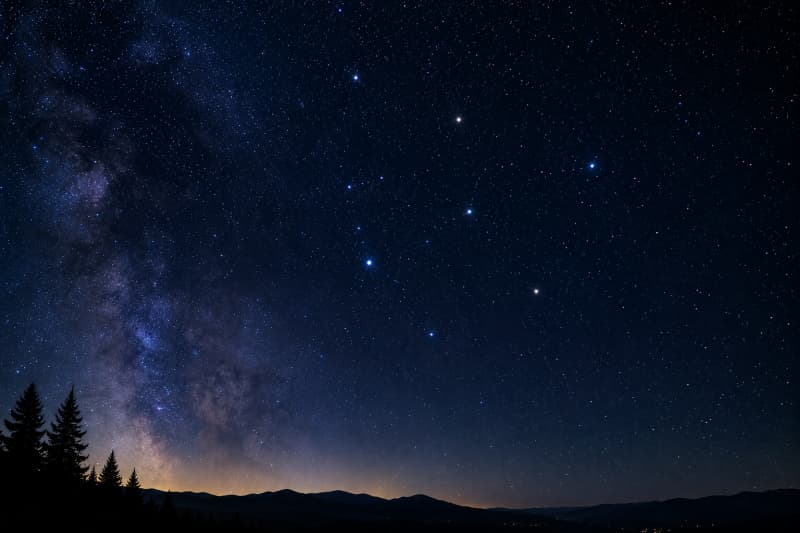
Using a telescope with an aperture of about 150 mm or larger under good seeing conditions and dark skies, M13 will reveal a much richer stellar structure. However, beginners do not need to purchase large equipment right away just to observe M13. When searching for the target, low magnification and a wider field of view are usually far more important than blindly chasing high magnification.
It is recommended to first use a low-power eyepiece to confirm M13's location and center it in your field of view, then gradually step up the magnification to examine its core and outer structure. Doing so not only makes finding the target easier, but also gives you a clear, intuitive understanding of how different magnifications impact deep-sky views.
Why does M13 look like just a small patch of light?
M13 is actually immense in physical size, spanning roughly 150 light-years in diameter. However, because it lies about 25,000 light-years away from Earth, its apparent diameter in our night sky is only about 20 arcminutes. For comparison, the full Moon has an apparent diameter of about 30 arcminutes, meaning M13 covers roughly two-thirds the angular size of the full Moon.
Even more striking is its stellar density. In the solar neighborhood, stars are typically separated by light-years; in contrast, the average distance between stars in the core of a globular cluster is vastly smaller. Because hundreds of thousands of stars are packed into a relatively confined space, when viewed across cosmic distances from Earth, they merge into a single, intensely concentrated central glow.
This is precisely what makes observing globular clusters so fascinating: that unassuming, tiny smudge of light in your telescope eyepiece is actually a bustling "city" housing hundreds of thousands of stars.
Common Questions and Troubleshooting Tips for Beginners Observing M13
If you cannot find M13 on your first attempt, don't immediately blame your equipment. City light pollution, moonlight, cloud cover, atmospheric transparency, and target elevation can all significantly impact deep-sky viewing. Start by verifying whether you have truly identified the Keystone asterism in Hercules, then check whether the orientation of your star chart matches the field of view in your binoculars or finder scope.
Another common pitfall is using excessive magnification right away. Many beginners assume higher magnification makes deep-sky targets easier to spot, but high power actually narrows your field of view, making the initial search far more frustrating. When hunting for M13, always start with your lowest-power eyepiece to locate the target before stepping up magnification to examine details.
Once you have successfully found M13, consider trying for M92—another brilliant globular cluster located nearby in Hercules. Observing both M13 and M92 in the same session is an excellent way for beginners to hone their star-hopping skills and practice comparing the visual features of different globular clusters.