
In the depths of space, approximately 700 million light-years from Earth, a unique celestial object is displaying a truly peculiar cosmic phenomenon: the "Ghost Face Galaxy."
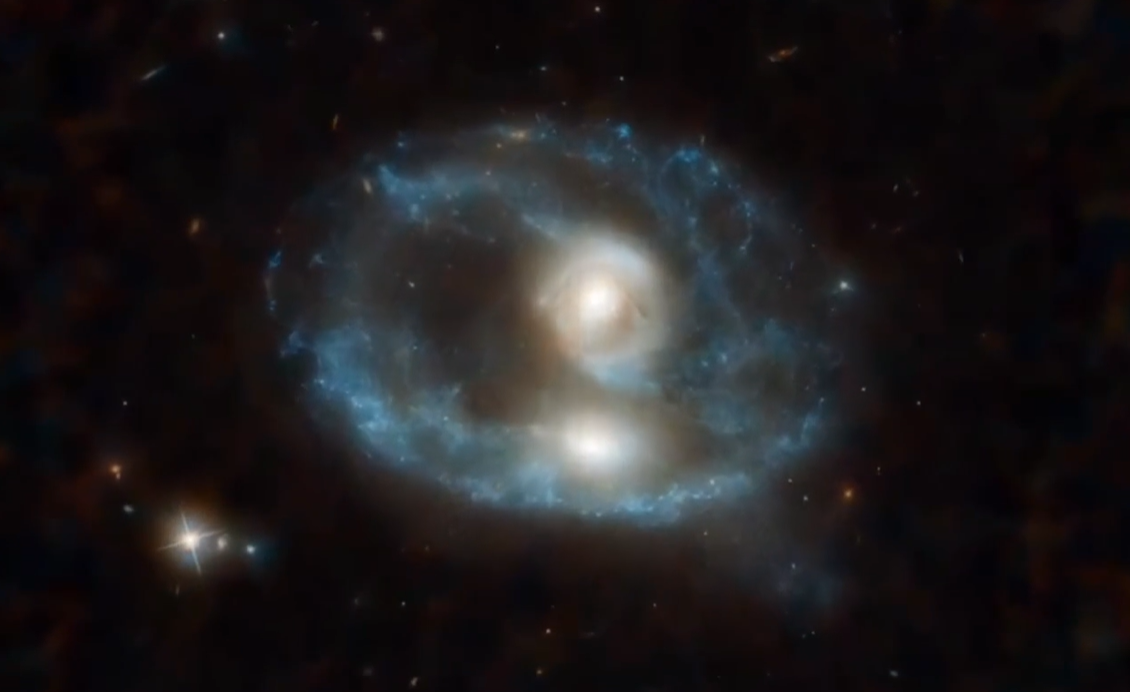
This "cosmic face" features structures resembling eyes, a nose, and an outline, appearing much like a colossal ghostly visage floating in the cosmos.
What is the "Ghost Face" galaxy? A "spectral visage" in the cosmos.
Formally designated as AM 2026-424 (and also known as ISO 285-19) within the international astronomical community, this galaxy is located in the southern constellation of Microscopium, approximately 704 million light-years from Earth. Its most striking feature is that its overall structure resembles a giant, ghostly face:
bright regions on either side resemble "eyes";
the central structure resembles a "nose";
an outer ring of blue stars forms the outline of the face.
Its appearance is not the result of some mysterious cosmic signal, but rather the outcome of prolonged gravitational interaction between two galaxies—a phenomenon known in astronomy as "interacting galaxies."
How did the "Face-like" galaxy form? The secrets behind galactic collisions
When people unfamiliar with astronomy first hear the term "galactic collision," their immediate reaction is often to imagine a violent impact—like a meteorite striking Earth. In reality, however, a galactic collision is a slow and complex cosmic process.
A galaxy typically consists of:
billions or even hundreds of billions of stars;
vast amounts of gas and dust;
dark matter structures.
Although two galaxies may approach or even pass through one another, direct stellar collisions are extremely rare due to the vast distances separating individual stars.
The factors that truly shape the galaxies are:
gravitational pull;
tidal forces;
gas compression;
star formation activity.
The two galaxies involved in this "Face-like" system are similar in size; consequently, there was no instance of a large galaxy swallowing a smaller one. Instead, gravitational forces caused them to form a structure resembling a ring.
Why does the "Face" galaxy appear to have two "eyes"?
The most striking feature of the "Face" galaxy is its two bright regions. These two "eyes" actually correspond to the core regions of two separate galaxies.
The centers of galaxies typically contain:
dense regions of stars;
supermassive black holes;
vast amounts of hot gas.
As two galaxies approach each other, gravitational forces disrupt their originally stable structures, causing stars to redistribute. At the same time, the compression of gas resulting from the collision triggers the formation of new stars. These young stars are hotter and emit intense blue light, creating the distinct blue ring-like structure seen in the photograph.
How did the Hubble Space Telescope capture the "Face-like" galaxy?
The most famous image of this "Face-like" galaxy comes from the Hubble Space Telescope.
On June 19, 2019, Hubble captured this unique celestial object in visible light using its Advanced Camera for Surveys (ACS).
Hubble is able to observe such distant galaxies because it is located above Earth's atmosphere, thereby avoiding:
atmospheric turbulence;
light scattering;
urban light pollution.
Compared to ground-based telescopes, space telescopes can obtain much clearer images of deep space, enabling scientists to study the evolution of galaxies hundreds of millions of light-years away.
Does the "Face-like" Galaxy still exist? What we see is the universe's past.
A key characteristic of observing the distant universe is that we are looking into the past. The "Face-like" Galaxy is located approximately 700 million light-years from Earth, meaning the light it emitted took about 700 million years to reach us.
In other words, the "Face-like" Galaxy we see today actually reflects how it appeared 700 million years ago. Over this vast span of time, the two galaxies likely continued to draw closer and gradually completed their merger. Scientists believe that this ring-like structure is not permanent; over the next several hundred million to over a billion years, the two galaxies will ultimately merge into a single, larger galaxy.
How can beginners observe deep-sky objects like the "Ghost Face" galaxy?
Although the Ghost Face galaxy is too distant and faint to be seen directly with standard amateur equipment, it represents a very important category of observational targets: deep-sky galaxies.
For astronomy beginners in North America, here are some good targets to start with:
Andromeda Galaxy (M31)
This is one of the easiest extragalactic galaxies to observe from the Northern Hemisphere.
In locations far from urban light pollution, it is even visible to the naked eye as a faint, hazy patch of light.
Whirlpool Galaxy (M51)
Also known as M51, this is a classic target for observing galactic interaction.
Sombrero Galaxy (M104)
Characterized by a prominent dust lane, this is a popular target for deep-sky observation during the spring.
By observing these galaxies, beginners can gradually gain an understanding of galactic structure and evolution in the universe.