
On summer nights, many astronomy enthusiasts across North America seek out one of the most spectacular deep-sky targets: the direction of the Galactic Center. Unlike the scattered stars found elsewhere in the sky, the region near the Galactic Center teems with bright stars, nebulae, and star clusters, making it one of the most rewarding areas to observe all year round.
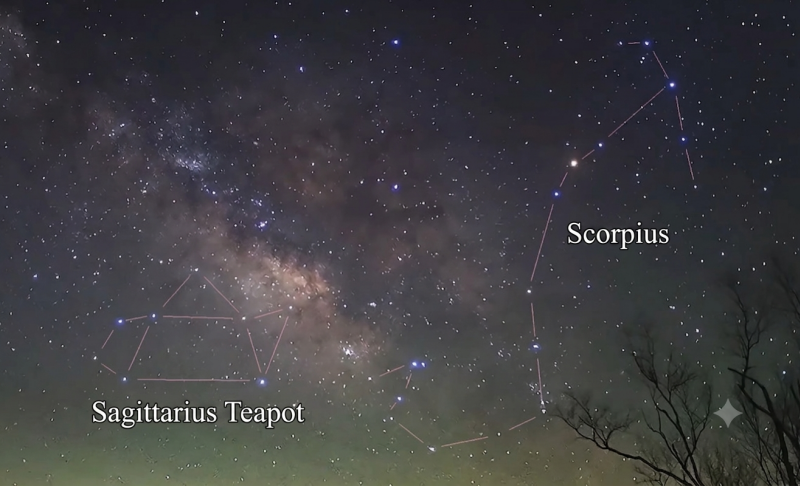
Locating the Galactic Center is not difficult for novice stargazers. On a clear, moonless summer night—away from city light pollution—simply facing south offers a view of the Milky Way’s brightest and broadest section. Key landmarks for identification include the "Teapot" asterism in Sagittarius and the nearby constellation Scorpius.
What is the Galactic Center, and why is it best viewed in the summer?
The Milky Way is a massive barred spiral galaxy; while our Sun is located near the Orion Arm on the galaxy's outskirts, the true Galactic Center lies approximately 26,000 light-years away.
From Earth, the Galactic Center appears in the direction of the constellation Sagittarius. Because this region is densely packed with stars, it forms one of the brightest and widest sections of the Milky Way visible in the night sky.
However, the Galactic Center itself cannot be seen directly with the naked eye.
This is due to vast amounts of interstellar dust lying in that direction, which block the passage of visible light. Consequently, astronomers typically study the galactic core using infrared and radio observations.
Yet, for the casual observer, this does not detract from the magnificent view in the direction of the Galactic Center. The area surrounding the galactic core is rich in bright stars, nebulae, and star clusters—celestial objects that combine to create one of the most captivating regions of the summer night sky.
When is the best time to view the Galactic Center in North America?
For most of the United States and Canada, summer is the best time to observe the direction of the Galactic Center.
Generally:
May to August: The Galactic Core rises progressively higher;
June to July: Viewing conditions are optimal around midnight;
August to September: The Galactic Center remains visible in the early evening.
The best viewing time is usually after 10:00 PM, as the constellation Sagittarius has risen to a higher position by then.

For a more distinct view of the Milky Way's structure, it is recommended to choose:
Dates around the new moon;
Clear, cloudless skies;
Nights with low humidity;
Dark-sky locations rated Bortle Class 1–3.
National parks in the western United States, mountainous areas, and remote regions of Canada are excellent locations for viewing the Milky Way.
How do you find the Sagittarius Teapot asterism?
For beginners, the easiest way to locate the center of the Milky Way is to first find the Sagittarius Teapot.
Although the constellation Sagittarius covers a large area of the sky, a few of its key stars form a very distinct teapot shape:
four stars form the body of the teapot;
two stars form the lid;
several stars form the spout and the handle.
On summer nights in the Northern Hemisphere, you can see this giant "cosmic teapot" by facing south.
Even more interesting is that the brightest region of the Milky Way looks like "steam" rising from the teapot's spout. This area actually corresponds to the direction where stars are most densely packed within the Milky Way galaxy.
Once you have found the Sagittarius Teapot, you are close to the direction of the galactic center.
Scorpius: The Most Easily Recognizable Constellation Near the Galactic Center
In addition to Sagittarius, **Scorpius** is a prominent feature of the summer Milky Way.
Scorpius possesses a very distinct structure:
The bright star Antares;
A curved scorpion tail;
An elongated body outline.
Among these features, Antares is a massive red supergiant with an orange-red hue, making it very easy to identify.
From mid-to-low latitudes in North America, Scorpius can be seen near the horizon when facing south on summer nights; Sagittarius lies to its east, and together they point toward the region near the Galactic Center.
What deep-sky objects are worth observing in the direction of the Galactic Center?
The region near the Galactic Center is not only visually stunning but also home to numerous deep-sky objects suitable for observation by beginners.
M7 (Ptolemy Cluster)
Located in the constellation Scorpius, M7 is a very famous open cluster.
Situated approximately 980 light-years from Earth, it consists of a large number of young stars. Under good sky conditions, M7 is even visible to the naked eye, though it appears much more distinct when viewed through binoculars.
Lagoon Nebula (M8)
The Lagoon Nebula (M8) is one of the most famous nebulae in the constellation Sagittarius.
It is a vast star-forming region where numerous new stars are being born. Through a small telescope or binoculars, it appears as a hazy, cloud-like structure.
Sagittarius Star Cloud (M24)
Also known as the Small Sagittarius Star Cloud, M24 is a region of the Milky Way where stars are densely packed.
It is not a true, independent star cluster, but rather a region of high stellar density against the background of the Milky Way. Viewed through a telescope, it offers a spectacular sight of a vast number of stars clustered together.
What is the Great Rift? Why are there dark regions in the Milky Way?
When observing the Milky Way for the first time, many beginners notice distinct dark bands within it.
These dark areas are not devoid of stars; rather, the stars are obscured by vast amounts of interstellar dust.
The most famous of these features is the Great Rift.

Located within the galactic disk, these dust clouds block the light from stars situated behind them, creating a visual effect resembling dark rifts or cracks.
In locations far from urban light pollution, the interplay of light and dark within the Milky Way is clearly visible to the naked eye; this feature is also a classic element in summer Milky Way photography.
What equipment do beginners need to observe the Galactic Center?
Observing the direction of the Galactic Center does not require expensive equipment.
Naked-eye observation
Suitable for experiencing the overall structure of the Milky Way.
Binoculars
7×50 or 10×50 models are recommended; they allow you to observe:
Star clusters;
Nebulae;
Dense regions of the Milky Way.
Small astronomical telescopes
Suitable for further exploration of:
The Lagoon Nebula (M8);
The M7 star cluster;
Other Messier objects.
For beginners, a good observing environment is more important than expensive equipment.
Summary: The direction of the Galactic Center is the most rewarding region of the summer sky to explore.
For astronomy enthusiasts in North America, locating the Galactic Center is a crucial step in learning deep-sky observation.
By identifying the "Teapot" asterism in Sagittarius, the constellation Scorpius, and nearby nebulae and star clusters, beginners can quickly master the skills needed to observe the summer Milky Way.
On a night away from city lights, facing south reveals one of the Milky Way's most magnificent regions: the brilliant Galactic Core, the mysterious Great Rift, and a multitude of deep-sky objects hidden within.
Whether through naked-eye viewing, binocular exploration, or astrophotography, the Galactic Center is a target well worth the attention of every novice stargazer.