
The Northern Hemisphere has entered its annual peak season for stargazing. During the summer months, the brilliant Milky Way stretches across the night sky, and many bright stars and famous constellations become optimally visible. Mastering essential observation techniques and learning to identify prominent summer constellations not only allows you to quickly locate celestial highlights—such as the Milky Way and the Summer Triangle—but also ensures a more rewarding stargazing experience.
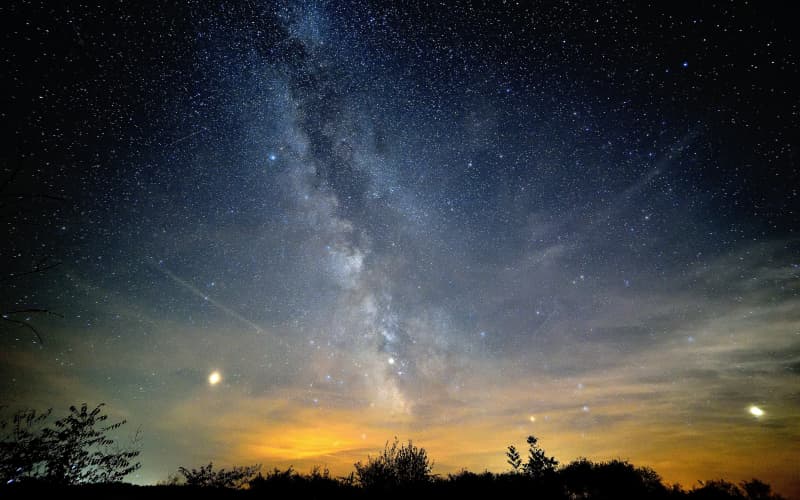
Scorpius and Sagittarius: Key Coordinates for Locating the Galactic Center
To observe the Milky Way—the most famous galaxy—one should first locate the constellations Scorpius and Sagittarius in the sky. Situated side-by-side in the southern sky during summer, these constellations point toward the center of the Milky Way, which is the galaxy's brightest and most spectacular region.
The most distinctive feature of Scorpius is a striking red star known as Antares. Emitting an orange-red glow, it is easily distinguished from surrounding stars; because its color closely resembles that of Mars, it was known in ancient China as the "Great Fire Star" (Dahuoxing)—a name recorded in numerous historical texts.
Although Sagittarius—located right next to Scorpius—is somewhat more challenging to identify, it contains a wealth of nebulae, star clusters, and deep-sky objects, making it a favorite among astrophotography enthusiasts. Even with just a pair of binoculars or a small telescope, one can observe intricate details of the Milky Way within this region.
Aquila, Lyra, and the Summer Triangle
Continuing northward along the Milky Way, one can spot two other famous constellations: Aquila and Lyra. The brightest star in Aquila is the renowned Altair; flanked by two fainter stars—resembling a carrying pole balanced on a shoulder—it is highly distinctive and easy to identify.

On the opposite side of the Milky Way lies Lyra, home to the famous star Vega. Vega is not only one of the brightest stars in the summer night sky but also one of the easiest bright stars to locate in the Northern Hemisphere.
Altair and Vega gaze at each other across the Milky Way, an arrangement that serves as the astronomical basis for the traditional Chinese legend of the Cowherd and the Weaver Girl. For Chinese-speaking astronomy enthusiasts in North America, locating these two stars in the summer night sky is a delightful activity.
Cygnus: Discovering the Summer Night Sky's Most Striking Cross
Continuing northward along the Milky Way, you will encounter another iconic constellation: Cygnus (the Swan).
Spanning the Milky Way, the constellation resembles a white swan with its wings spread in flight, hence its name. Several of its bright stars form a prominent cross shape, often referred to as the "Northern Cross."
The brightest star in Cygnus is Deneb. Together with Altair and Vega, it forms the famous Summer Triangle.
The Summer Triangle serves as perhaps the most important navigational landmark in the summer night sky. Even without prior stargazing experience, simply locating these three brightest stars allows you to quickly pinpoint the Milky Way and subsequently identify other surrounding constellations.
It is worth noting that the Summer Triangle is visible not only throughout the summer but also remains prominent on early autumn nights, though it rises progressively earlier as the season advances.

How can you more easily observe the summer night sky in North America?
For astronomy enthusiasts in North America, choosing the right location is crucial for a great viewing experience; national parks, rural areas, or mountainous regions far from urban light pollution are ideal choices. Additionally, your latitude plays a role: at higher latitudes, the Galactic Center appears lower in the sky, whereas the lower latitudes of the southern United States offer a better view of the Milky Way's full structure.
Regarding equipment, a pair of 7×50 or 10×50 binoculars is sufficient for a beginner to appreciate numerous star clusters, nebulae, and details of the Milky Way; combining a camera with an equatorial mount allows for spectacular photography of the Milky Way and the Summer Triangle.
Furthermore, using smartphone stargazing apps to help identify constellations significantly lowers the learning curve, making the hobby highly accessible for beginners.
Familiarizing oneself with the prominent constellations of the summer sky is a fundamental step for any astronomy enthusiast. From using the Big Dipper to determine the season and locating Scorpius and Sagittarius, to identifying the Summer Triangle—formed by Altair, Vega, and Deneb—these activities help novices quickly build a comprehensive understanding of the summer night sky.