
Imagine standing at the geographic North Pole during the long polar night. The sky above you would look very different from the one seen across most of the United States, Europe, or even lower parts of the Arctic. The difference goes far beyond months without a sunrise. At the North Pole, the night sky appears to rotate around a point almost directly overhead.
Polaris, the North Star, sits very close to that point, while the stars of the northern sky trace circles around it. Instead of following the familiar pattern of rising in the east and setting in the west, many stars remain at nearly the same altitude as they circle the sky. To understand why, we need to look at the geometry of Earth's rotation and what happens when an observer stands at 90° north latitude.
When Does Polar Night Begin at the North Pole?
At the geographic North Pole, the Sun drops below the horizon around the September equinox and does not rise again until around the March equinox. In simple terms, the pole experiences roughly half a year with the Sun above the horizon and half a year with it below.
That doesn't mean the sky suddenly becomes completely dark as soon as the Sun disappears. After the September equinox, the Sun continues to sink gradually below the horizon, producing a long progression through civil, nautical, and astronomical twilight. Truly dark conditions arrive later. The process reverses as spring approaches and the Sun begins creeping back toward the horizon.
So while polar night means the Sun does not rise, it should not be confused with six uninterrupted months of complete darkness.
Why Is Polaris Almost Directly Overhead at the North Pole?
One of the most useful relationships in northern-sky observing is that the altitude of the north celestial pole above the horizon is approximately equal to your latitude.
At 40° north latitude, for example, the north celestial pole appears about 40° above the northern horizon. Travel farther north and it climbs higher. At the geographic North Pole, latitude 90° north, the north celestial pole reaches the zenith—the point directly overhead.
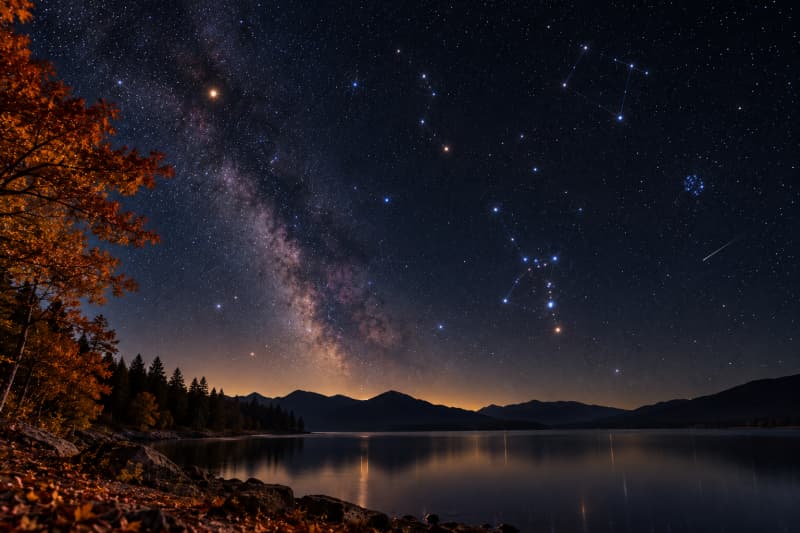
Polaris lies very close to the north celestial pole, which is why it appears almost overhead from the North Pole. But “almost” matters. Polaris is not located exactly on the celestial pole. Over the course of a day it traces a very small circle around the true pole, although the movement is subtle enough to be easily missed with the naked eye.
Do Stars Rise and Set at the North Pole?
Across most mid-northern latitudes, we are used to watching stars rise in the east, cross the sky, and eventually set in the west. That apparent motion is caused by Earth rotating from west to east.
At the North Pole, the geometry changes dramatically. An observer is standing at one end of Earth's rotational axis, with the north celestial pole directly overhead. As Earth turns, the stars appear to travel in circles around the zenith.
Rather than climbing steeply from the horizon and later dropping below it, northern stars remain at nearly constant altitudes as they circle the sky. A star that is well above the horizon stays above it, while one below the theoretical horizon never rises.
This circular motion is one of the defining features of the night sky at the North Pole.
Which Direction Is North When You Are at the North Pole?
Direction becomes a little strange at exactly 90° north. There is no place on Earth's surface farther north. Take a step away from the geographic North Pole in any horizontal direction and you are, initially, heading south.
That is why the familiar language of stars “rising in the east” and “setting in the west” becomes less intuitive at the pole. Astronomers can instead describe positions using altitude and azimuth, or celestial coordinates such as right ascension and declination.
It is one of those situations where the ordinary compass directions we use every day are less useful than the geometry of the sky itself.
Can You See Southern Constellations from the North Pole?
Under ideal geometric conditions, an observer at the North Pole can see the northern half of the celestial sphere. The celestial equator runs around the horizon, so objects with positive declinations lie above the theoretical horizon while those with negative declinations remain below it.
Familiar northern constellations such as Ursa Major, Ursa Minor, Cassiopeia, and Draco can therefore remain visible as they circle the sky. Far-southern constellations, including Crux, the Southern Cross, never rise at the North Pole.
Constellations that cross the celestial equator are more complicated. Only their northern portions can lie above the theoretical horizon. In real observing conditions, stars very close to the horizon may also be difficult or impossible to see because of atmospheric extinction, refraction, haze, and the local landscape.
Why Does the Sky Look So Different at the Equator?
Move from 90° north all the way to Earth's equator and the geometry changes almost completely. The north and south celestial poles now sit near opposite points on the horizon, while the celestial equator passes high across the sky.
Over the course of a year, observers near the equator can potentially see stars from almost the entire celestial sphere. Northern and southern constellations both get their chance to rise above the horizon.
This is a useful way to understand how latitude affects the night sky. As you travel south from Canada or the northern United States, southern stars and constellations gradually climb higher. Continue toward the equator and parts of the sky that were hidden from northern locations become much easier to see.
The stars themselves haven't changed. Your viewing angle on the celestial sphere has.
What Would Star Trails Look Like at the North Pole?
Long-exposure photography would make the unusual geometry of the polar sky immediately obvious. At the North Pole, the north celestial pole is near the zenith, so star trails would form arcs and circles centered almost directly overhead.
Polaris would leave a very small circular trail because it lies close to the celestial pole. Stars farther from the pole would trace progressively larger circles.
At mid-northern latitudes, photographers usually point their cameras toward the northern horizon to capture circular star trails around Polaris. At the North Pole, you would point the camera upward instead. The resulting pattern would provide a striking visual record of Earth's rotation.
Does Polar Night Mean Six Months of Perfect Stargazing?
Having the Sun below the horizon for months sounds like ideal astronomy weather, but polar night does not guarantee perfect stargazing. Long periods of twilight reduce the amount of truly dark time near the beginning and end of the polar night. Clouds, blowing snow, ice crystals, wind, and extreme cold can also make practical observing difficult.
The Moon still rises and sets according to its own cycle and can brighten the sky considerably. There is also another spectacular feature of high-latitude skies that astronomers have to consider: the aurora.
Bright auroras can be breathtaking to watch, but they also brighten the background sky. If your goal is to observe faint galaxies or nebulae, a strong auroral display may actually work against you.
Darkness alone is only one part of good observing conditions.
What the North Pole Sky Teaches Us About Earth's Rotation
So, what does the night sky look like at the North Pole? During the dark part of the year, the northern sky appears to rotate around a point almost directly overhead. Polaris sits close to that point, while the stars trace nearly horizontal circles around the sky instead of following the familiar rising-and-setting paths seen from mid-latitudes. Most of the southern celestial hemisphere remains permanently hidden below the horizon.
Understanding why Polaris is nearly overhead at the North Pole, why stars move differently there, and how latitude changes which constellations you can see is also a simple way to understand the geometry of the celestial sphere.
You don't have to travel to 90° north to see the same principle at work. Find Polaris from your own location and measure how high it appears above the northern horizon. Its altitude gives you a good approximation of your latitude—and offers a direct visual connection between your place on Earth and the way the entire night sky appears to move above you.