
For those of us living in the Milky Way galaxy, witnessing the Milky Way stretching across the night sky is an incredibly awe-inspiring experience. However, for beginners just starting out in astronomical observation, certain techniques are required. Many beginners find that, when looking up at the night sky, some places clearly show the bright band and dark dust structure of the Milky Way, while others only reveal scattered stars. Therefore, "What conditions are needed for Milky Way observation?" is one of the most pressing questions for many stargazers.
In reality, the quality of Milky Way observation depends not only on clear weather but also on numerous other astronomical conditions, including light pollution, lunar phase, season, altitude of the observation location, and atmospheric transparency. Understanding the scientific principles behind these factors can not only improve the success rate of observation but also help stargazers find the best opportunities for Milky Way observation.
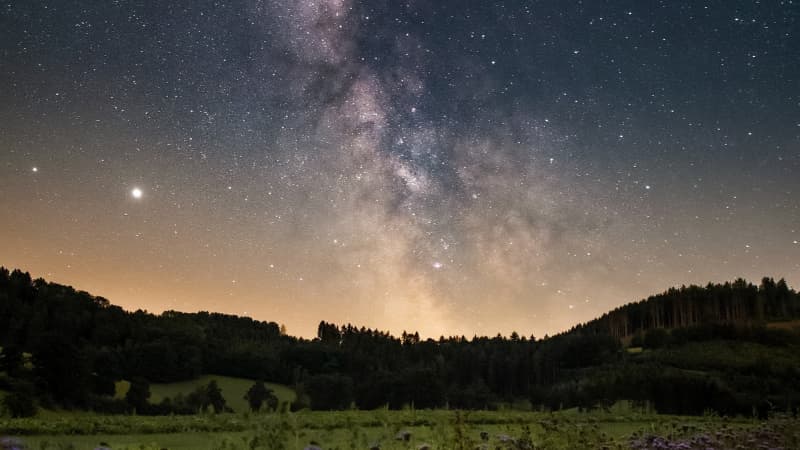
Light pollution is the most critical factor affecting Milky Way observation.
To better see the Milky Way, it's essential to consider light pollution conditions. The Milky Way in the night sky is essentially a projection of the Milky Way's stellar disk onto the night sky. Its surface brightness is far lower than the moon's. When scattered light from city lights enters the atmosphere, it creates sky glow, significantly reducing the contrast of the night sky background.
Internationally, the Bortle Scale is widely used to assess night sky quality. From Bortle 1 to Bortle 9, the lower the number, the darker the night sky. Typically, the main structure of the Milky Way is only clearly visible in areas below Bortle 4. To observe the abundant dust lanes, nebulae, and dark slits near the Milky Way's center, it's best to visit locations with a Bortle 1 to Bortle 3 dark sky.
Many national parks and internationally certified Dark Sky Reserves in North America are renowned stargazing locations. For example, the western deserts and highlands of the United States, as well as some remote mountainous areas of Canada, all boast extremely low levels of light pollution. Therefore, checking light pollution maps through relevant apps and platforms before going to observe is often more important than preparing expensive equipment.
The phase of the moon and moonlight have a decisive impact on the visibility of the Milky Way.
Even after avoiding light pollution, it's crucial to pay attention to the changing phases of the moon. If the wrong phase is chosen for observation, the Milky Way will still be difficult to see clearly. Therefore, the lunar phase is the second core factor among the conditions required for Milky Way observation.
The moon's surface has a high reflectivity, and because of its proximity to Earth, its brightness during a full moon can be thousands of times greater than the brightness of the Milky Way's background. When the moon rises, its scattered light significantly increases the brightness of the sky background, weakening the contrast between the Milky Way and the night sky.
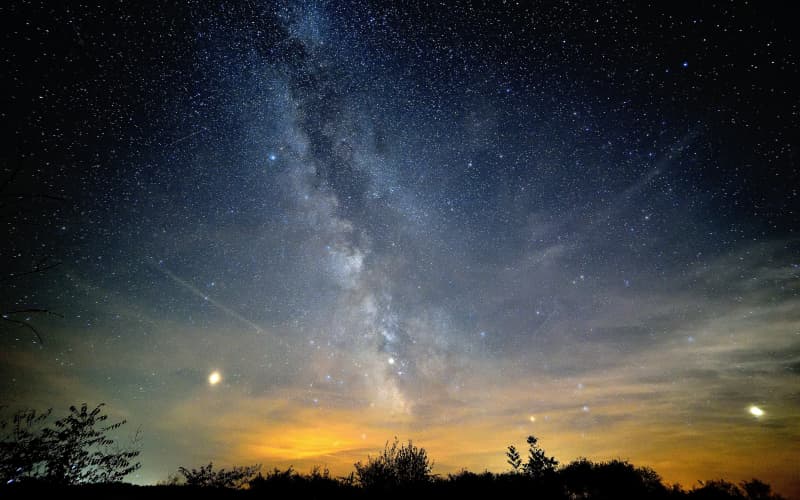
The best time to observe the Milky Way generally occurs within about three days before and after the new moon. At this time, the moon is either not in the night sky or its brightness is extremely low, minimizing its impact on Milky Way observation. If a new moon is not possible, ensure that the moon has already set before starting observation.
Many professional astrophotographers check the moonrise and moonset times in advance and combine this with the Milky Way's rising time to plan their shooting. This principle also applies to naked-eye observation.
Atmospheric transparency determines whether Milky Way details are visible.
Atmospheric transparency is another crucial factor affecting observation results, even more important than simply clear skies. Water vapor, dust, smog, and suspended particles in the air scatter starlight, blurring Milky Way details. Even without clouds, high humidity reduces the clarity of the Milky Way's bright bands.
The western highlands of North America are a popular location for Milky Way photography largely due to their dry air. Dry air has weaker scattering effects, making dark nebulae and densely packed stellar regions in the Milky Way easier to observe.
Before observation, pay attention to transparency indicators in meteorological data. Typically, after a cold front passes, atmospheric particulate matter decreases, significantly increasing transparency; this is often the golden time for Milky Way observation.
The Milky Way's season is just as important as the location of its center.
Seasonal factors must also be considered. Although the Milky Way is present in the night sky year-round, its most spectacular part—the galactic center—is not visible at all times.
The Milky Way galaxy is located near the constellations Sagittarius and Scorpius in the celestial sphere. Due to the Earth's revolution around the Sun, the direction the night sky faces changes with the seasons, thus altering the visibility time of the Milky Way's center.
For stargazers in North America, the Milky Way season is from March to October each year. June to August is generally considered the best observation window. During this period, the galactic center rises higher in the night sky, forming a spectacular Milky Way arch.
In spring, the Milky Way tends to rise later, while in autumn it sets earlier. Therefore, summer not only offers the longest observation period but is also the season when the Milky Way is easiest to spot.
Altitude significantly improves the quality of Milky Way observations.
Altitude is a crucial factor in the conditions required for Milky Way observation. As altitude increases, the atmosphere thins, reducing dust and water vapor content, thus lessening the scattering and absorption of starlight.
This is why most of the world's renowned observatories are built in high mountains. For example, many professional astronomical observatories are located at altitudes above 2000 meters.
For casual stargazers, traveling to extremely high altitudes isn't always necessary. However, choosing mountainous areas over urban plains often yields significantly better observation results. Especially in the western mountainous regions of North America, high altitude and low light pollution often coexist, creating an ideal environment for Milky Way observation.
However, it's important to note that nighttime temperatures drop rapidly at high altitudes, so adequate warm clothing should be prepared for observation.
The Difference Between Naked-Eye and Equipment-Based Observation
Many beginners believe that a telescope is necessary to view the Milky Way, but this is not the case. The Milky Way is best observed with the naked eye or wide-angle binoculars.
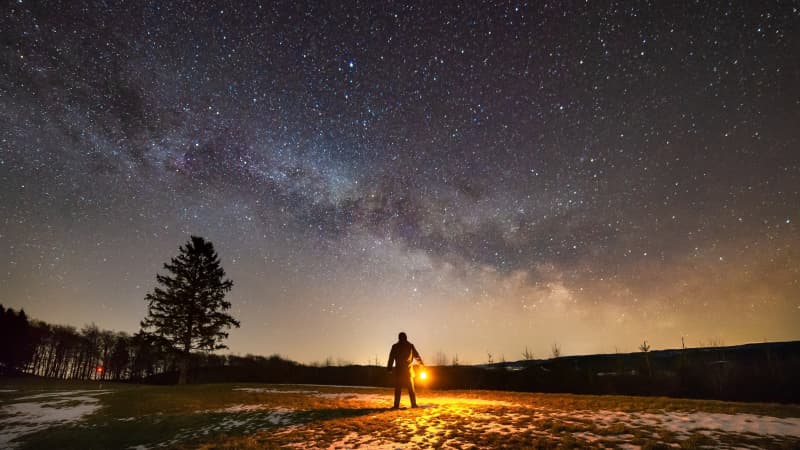
Due to the Milky Way's vast coverage, ordinary high-magnification telescopes have a limited field of view, making it difficult to see its overall structure. The naked eye usually provides the best experience during dark adaptation.
Dark adaptation is one of the most important techniques for Milky Way observation. It takes about 20 to 30 minutes for the rod cells in the human eye to reach their optimal night vision capability. During this time, avoid looking at mobile phone screens, car headlights, or white flashlight beams.
If you wish to observe star clusters and nebulae within the Milky Way further, you can use 7×50 or 10×50 binoculars. These devices offer a good balance of field of view and light-gathering ability, revealing more details of the Milky Way.
For photography enthusiasts, a full-frame camera paired with a 14mm to 24mm wide-angle lens is the classic setup for photographing the Milky Way, capable of capturing dark dust structures and nebula regions that are difficult to see with the naked eye.
How to Quickly Locate the Milky Way
Even if all conditions are met, many beginners still don't know where the Milky Way is. Actually, finding the Milky Way isn't difficult.
On summer nights, you can first find the famous "Summer Triangle," a giant triangle formed by Vega, Altair, and Deneb. The Milky Way crosses the night sky through this region.
Then look towards the southern horizon in the constellations Sagittarius and Scorpius; this is where the center of the Milky Way is located, and it's also the brightest and most spectacular part of the Milky Way.
In North America, the Milky Way usually appears as a huge band of light extending from northeast to southwest. If the night sky is dark enough, you can also see dark dust bands running through it; these dark areas are actually interstellar dust clouds that block the light from background stars.
In summary, there is no single answer to the conditions required for Milky Way observation; rather, it is the result of multiple factors working together. Low light pollution, a moonless night sky, excellent atmospheric transparency, the right season, a relatively high altitude, and sufficient dark adaptation are all important prerequisites for successful Milky Way observation. For North American astronomy enthusiasts, visiting a Dark Sky Reserve during the summer new moon often provides the best observation experience. When these conditions are met simultaneously, one can not only see the bright band of the Milky Way stretching across the sky but also distinguish its complex dark nebulae, densely packed stellar regions, and the rich celestial structures near the Milky Way's center, thus truly appreciating the magnificent and awe-inspiring appearance of the Milky Way.