
Mars is a popular observation target among amateur astronomers and one of the most well-known planets. It is also the most Earth-like rocky planet in the solar system. With its polar ice caps, dust storms, dark landscapes, and distinct seasonal changes, Mars has long been a subject of observation for many amateur astronomers in North America.
However, many beginners find that even with a telescope, Mars appears as a blurry red dot. In fact, to observe clear details of Mars, simply choosing more suitable equipment is not enough; it also requires mastering the correct observation techniques and understanding different atmospheric conditions and planetary observation methods.
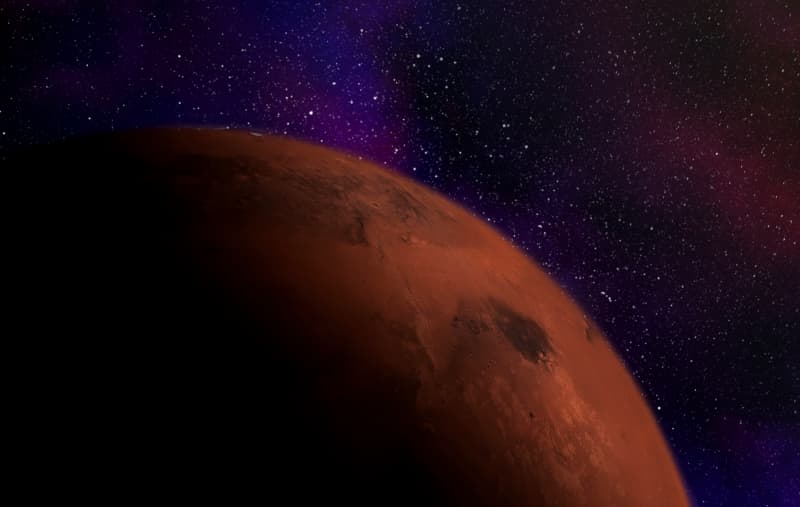
Why is Mars so difficult to observe?
Many people believe that Mars, being relatively close to Earth, is easier to observe than other deep-sky objects. However, in reality, observing Mars is more difficult than observing many bright nebulae or star clusters.
Mars has a diameter of approximately 6,779 kilometers, only about half the diameter of Earth. When Mars is near its aphelion, its apparent diameter is less than 5 arcseconds. Even during opposition, the apparent diameter is typically only 15 to 25 arcseconds. In such conditions, it's almost impossible to discern details with ordinary binoculars. Even with medium-sized telescopes, observers must contend with the seeing effects caused by atmospheric turbulence.
Observers in North America need to be particularly aware of the impact of jet streams on high-magnification planetary observations. When high-altitude winds are strong, noticeable jitter appears at the Martian edge, and surface details are blurred. Therefore, the key to better observing Mars is not increasing the magnification of your telescope, but rather choosing stable atmospheric conditions.
Mastering the Best Time to Observe Mars
In all astronomical observations, mastering the observation window is the first skill to learn.
The best time to observe Mars is around Mars Opposition. Mars Opposition refers to the period when Mars, Earth, and the Sun are roughly aligned in a straight line, with Earth in the middle. At this time, Mars is closest to Earth, its brightness is at its peak, and its apparent diameter is also at its largest.
Besides Mars Opposition, it's also important to pay attention to Mars' altitude in the sky. When Mars rises near the local meridian, the light passes through the thinnest layer of the atmosphere, effectively reducing the effects of atmospheric refraction and turbulence. For observers in North America, winter and spring offer more stable atmospheric conditions, while summer's thermal currents may reduce the quality of Mars observations.
Furthermore, Mars is not suitable for high-magnification observation year-round. When far from opposition, Mars' apparent diameter is relatively small, making it difficult to discern surface features even with large telescopes. Therefore, consulting planetary ephemeris tables and astronomical software in advance to plan observations for the coming months is crucial for improving observation efficiency.
The Impact of Different Magnification Telescopes on Mars Observation
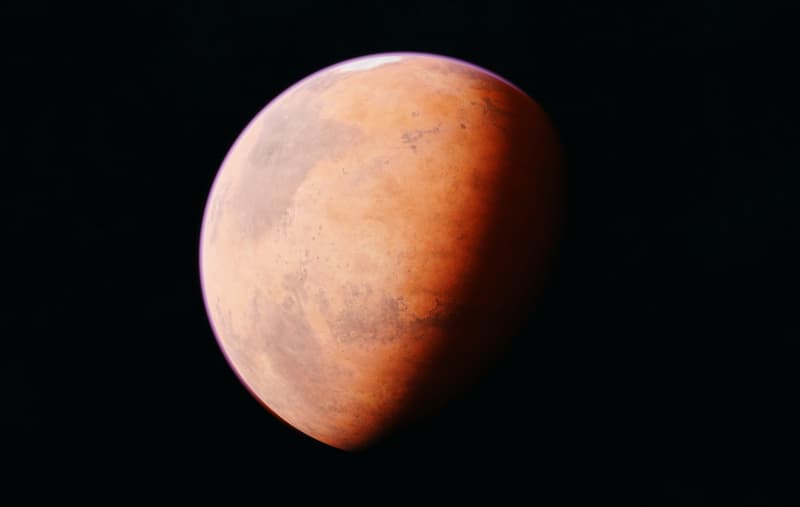
Equipment selection is a crucial factor affecting the quality of Mars observations. For beginners, an 80mm to 100mm refracting telescope is sufficient to display the Martian disk and polar ice caps. When the aperture reaches 130mm to 200mm, major dark areas on the Martian surface begin to become apparent, such as the well-known Syrtis Major and Mare Acidalium.
Newtonian reflecting telescopes, with their larger apertures, typically offer higher resolution. High-quality APO refracting telescopes, on the other hand, offer better contrast and excel at observing the Martian polar ice caps and fine terrain features.
It is worth noting that many observers mistakenly believe that higher magnification is always better. In reality, the optimal magnification for Mars observation is typically between 30 and 50x per inch of aperture. For example, an 8-inch telescope has an optimal magnification of approximately 240 to 400x. Magnification exceeding the limits allowed by atmospheric conditions will only amplify blurry images without adding detail.
How Filters Enhance Martian Details
In Mars observation techniques, the application of color filters is crucial. Red filters enhance the contrast between dark and light areas on the Martian surface, making them highly effective for observing topographical structures. Orange filters balance brightness and contrast, making them a popular choice among many planetary observers.
Blue filters highlight cloud and haze structures in the Martian atmosphere. When dawn or dusk clouds appear on Mars, blue filters often reveal details that are invisible to ordinary observations.
Green filters are helpful for observing changes at the polar ice cap edges and some dust activity.
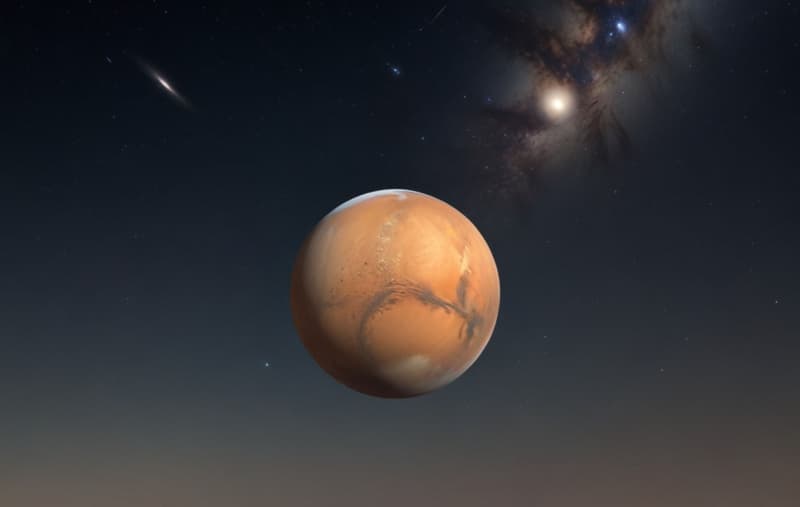
With the widespread use of CMOS astronomical cameras, more and more amateur astronomers are employing RGB color separation photography techniques, using post-processing stacking to obtain Martian images approaching professional-level quality. This method is, in fact, a fundamental aspect of modern planetary photography.
How to Identify Martian Surface Features
The most easily identifiable features on Mars are the polar ice caps at the north and south poles. These caps are primarily composed of water ice and carbon dioxide ice and expand or shrink with the Martian seasons. Many long-term Martian observation projects record changes in the polar cap area to understand the Martian seasonal cycle.
Additionally, near the Martian equator, several well-known dark regions can be observed. The most easily identifiable is the Thertis Large Region, a triangular dark area and a classic Martian feature featured in many astronomy textbooks.
When Mars experiences a global dust storm, previously clearly visible dark regions may completely disappear. For example, the 2018 global dust storm even rendered many large telescopes unable to resolve surface details. Understanding these changes helps observers determine whether what they see is a surface feature or atmospheric activity.
Practical Tips for Observing Mars from North America
For observers in North America, while light pollution doesn't have the same severe impact as when observing galaxies and nebulae, a good observation environment is still crucial.
Meanwhile, the urban heat island effect increases atmospheric turbulence near the Earth's surface. Therefore, to obtain better and more stable seeing, the telescope should be allowed to cool down sufficiently before observation, as temperature differences inside the tube can create air convection, causing continuous image fluctuations.
In addition, some bright red stars can be used as star finders, such as Betelgeuse and Antares in Scorpius, which appear distinctly red in the winter sky. However, it's important to note that these stars only appear red visually and are not actually Mars. When using finder scopes and star charting software, planetary orbits should be considered for confirmation.
Many astronomical software programs now display Mars' position, central longitude, and visible terrain in real time. Using these tools in planned observations can significantly improve the success rate.
In conclusion
Mastering Mars observation techniques requires a combination of equipment, weather, timing, and observational experience. For North American amateur astronomers, choosing a period close to Mars' opposition, paying attention to changes in seeing, using telescope magnification and filters appropriately, and being familiar with Martian terrain features are often more important than blindly pursuing larger apertures.
With accumulated observational experience, observers can not only identify Martian polar ice caps, dark regions, and dust activity, but also record their long-term seasonal variations. This is why Mars observation remains one of the most challenging and rewarding activities in amateur astronomy.