
As the largest gas giant in our solar system, Jupiter is renowned for its vibrant and ever-changing cloud bands. For amateur astronomers in North America, spotting this giant in a clear night sky isn't difficult. However, truly discerning the intricate details of its surface, especially the faint cloud bands and the famous Great Red Spot, requires a certain level of knowledge in optical physics and observational skills.
Since Jupiter is primarily composed of hydrogen and helium, its outer atmosphere, driven by rapid rotation, creates complex convection currents and storms. This necessitates not only high-quality equipment but also the ability to utilize various environmental conditions. This article will delve into the key factors affecting Jupiter observation and provide a systematic and practical guide for amateur astronomers, helping them more easily master methods and tutorials for viewing Jupiter's bands in the night sky.
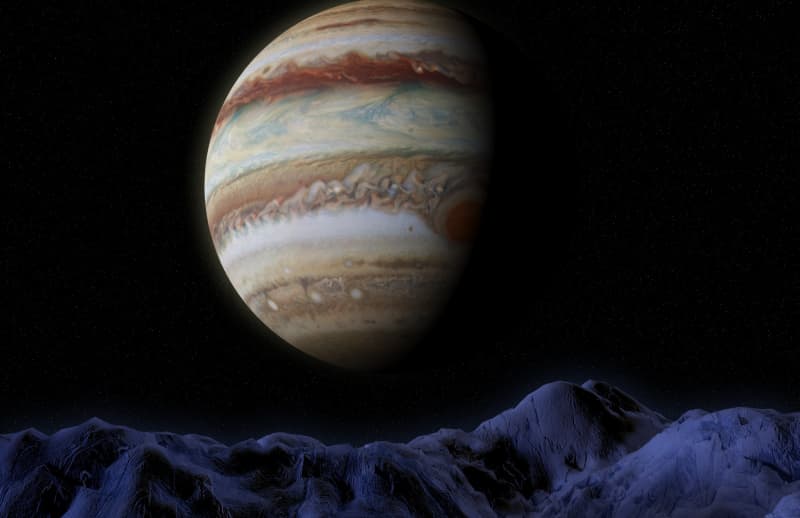
The aperture and optical resolution of a telescope are crucial for observational results.
To better observe the stripes and the Great Red Spot on Jupiter's surface, the key is to choose an astronomical telescope with appropriate resolution. According to Rayleigh's criterion in optical physics, the resolving angle of a telescope is inversely proportional to the objective lens aperture. This means that the larger the aperture of an astronomical telescope, the smaller the distance between two points it can resolve, and the finer the Jupiter stripes will appear in the eyepiece.
For planetary observation, small-aperture refracting telescopes smaller than 70mm can usually only barely see the two thickest main stripes (i.e., the northern equatorial band NEB and the southern equatorial band SEB). To clearly see the jagged edges of Jupiter's stripes, plumes, and cyclonic disturbances, it is recommended to use a refracting telescope with an aperture of 150mm (approximately 6 inches) or larger, or a Schmidt-Cassegrain (SCT) or Newtonian reflecting telescope with an aperture of 200mm (approximately 8 inches) or larger. In addition, systems with long focal lengths and high focal ratios (such as f/10 or higher) have an advantage in planetary observation because they are easier to pair with high-magnification eyepieces to achieve the golden magnification of 150x to 250x without sacrificing image quality.
The Influence of Atmospheric Seeing on Typical North American Geographical Environments
Even with high-performance telescopes, atmospheric turbulence is often a key factor in determining the details of planets. In astronomy, we use "seeing" to measure atmospheric stability. When strong jet streams exist at high altitudes, starlight is violently refracted through the atmosphere, causing Jupiter to appear like a blob of syrup melting in water through the eyepiece.
Amateur astronomers in North America need to pay special attention to the direction of high-altitude jet streams. For example, observers in the northern United States and southern Canada are often affected by the polar jet stream flowing south from the Canadian Arctic Circle, resulting in extremely poor seeing even when the night sky is cloudless and highly transparent. Conversely, when the subtropical high pressure system controls parts of southern or west coast North America, the atmospheric stratification is stable, and these weather conditions provide the best opportunity to see the details of Jupiter's banding. Before observation, it is recommended to check the local seeing forecast through a professional light metering website (such as Clear Dark Sky) and choose a night with seeing of level 4 or 5 (out of 5) for in-depth observation.
The Scientific Applications and Contrast Enhancement of Chromatic Aberration Filters
The reddish-brown, bluish-white, or bright yellow stripes on Jupiter are due to varying concentrations of ammonia ice, ammonium hydrogen sulfide, and complex organic chromophores in its clouds at different altitudes. Using planetary filters with specific spectral ranges is an extremely effective way to visually enhance the contrast between these chemical components.
Based on the principle of complementary colors, blue filters (such as Wratten #80A or #38A) can significantly deepen the darkness of the reddish-brown stripes and Great Red Spot on Jupiter's surface, making them stand out against a bright background; while orange (#21) or red (#23A) filters can enhance the boundary contrast between the white temperate zones and the dark bands. Furthermore, because Jupiter itself is extremely bright, glare from large-aperture telescopes can obscure subtle cloud band details. In such cases, adding a neutral density filter (ND filter) or a lunar filter to reduce overall brightness can often instantly make previously blurry fine stripes clearly discernible.
Assessment of the Actual Interference of Light Pollution on Planetary Observation
Many amateur astronomers in North America seem to have a misconception that they must drive to international dark sky parks far from cities (such as Bryce Canyon in Utah or Joshua Tree in California) to obtain the best planetary observation results. In fact, light pollution (measured by the Bortle Scale) primarily affects faint deep-sky objects (such as galaxies and nebulae), while Jupiter, with an apparent magnitude typically above -2.5, has a very high surface brightness that is more than sufficient to penetrate the "light pollution" over cities.
In the suburbs of major North American metropolitan areas with Bortle Scale levels 8 or 9, high-quality Jupiter observations are entirely possible, provided direct streetlights are avoided. Interestingly, faint atmospheric haze or a slight urban heat island effect can sometimes suppress intense atmospheric convection, resulting in surprisingly good seeing. Therefore, the key to seeing Jupiter's stripes is not how dark the night sky is, but whether the micro-airflow of the observation environment is calm.
Techniques for Locating Jupiter's Coordinates and Reference Points in the North American Night Sky
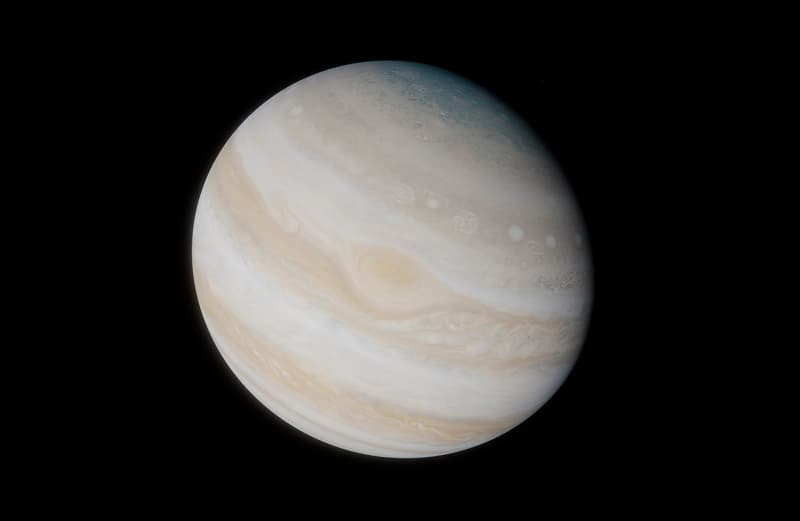
In practice, accurately locating Jupiter and choosing the time of its highest altitude above the horizon is crucial. Due to the strong refraction and dispersion effects of Earth's atmosphere at lower altitudes, when Jupiter's altitude is below 30 degrees, atmospheric dispersion causes red-green ghosting at the planet's edges, completely obscuring cloud band details. Therefore, observations should ideally be conducted within two hours before and after Jupiter's highest zenith (when it passes through the local meridian at its highest altitude).
In the North American night sky throughout the year, we can use some bright stars as references. For example, in winter and spring, we can look for Aldebaran (a bright orange-red first-magnitude star easily recognizable in the North American night sky), a red giant star in Taurus, which often travels along the ecliptic near its midheaven. By comparing Aldebaran's flickering red light due to atmospheric turbulence with Jupiter's large, stable, and unflickering disk light, observers can quickly adjust their eye's adaptation and, by following the paths of these well-known stars, accurately locate Jupiter on the ecliptic.
In summary, seeing Jupiter's banded patterns under the North American sky is a complex interplay of optical hardware, environmental conditions, and observational techniques. By using a large-aperture telescope with sufficient physical resolution, avoiding the adverse seeing caused by the North American jet stream, cleverly utilizing chromatic aberration filters to enhance the contrast of specific cloud bands, and observing when Jupiter is at its highest altitude above the horizon, amateur astronomers can capture Jupiter's stunning atmospheric storms and banded structures from their own backyards or local parks, free from the interference of Earth's atmosphere. Astronomy is a science that emphasizes both practice and rigor; mastering these principles ensures that every time you point a telescope at Jupiter, it will be a rewarding scientific exploration.