
Jupiter, the largest planet in our solar system, boasts immense brightness and a clearly defined disk. Even with ordinary telescopes, its moons are visible, making it an ideal observation target for novice astronomers. Compared to many deep-sky objects that require large telescopes and exceptionally clear skies, Jupiter's requirements for equipment and environment are relatively low, making it a top choice for many beginners.
Jupiter's greatest appeal lies in its sheer size. It is the second largest object in our solar system after the Sun, 1300 times the size of Earth. Furthermore, Jupiter's atmospheric activity is extremely intense. Through telescopes, one can observe the famous Jupiter equatorial cloud belts, the Great Red Spot, and the transits and eclipses of its primary moons.
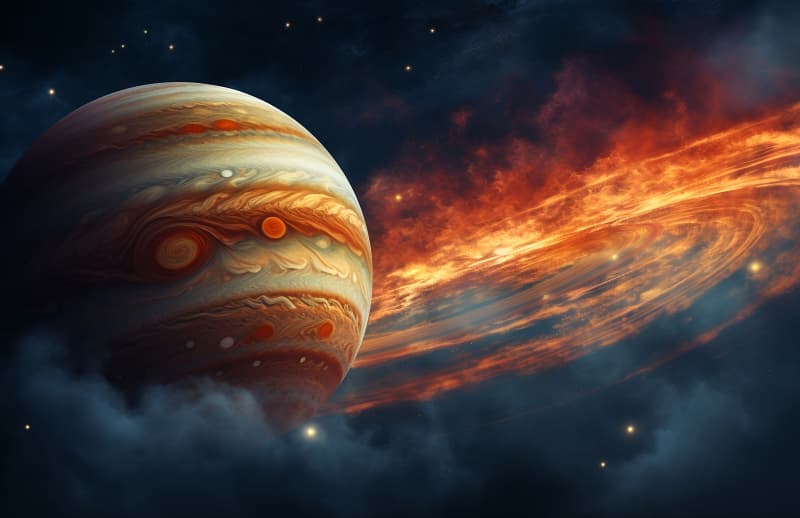
In the desert regions of the southwestern United States or near the Canadian Rockies, with the right timing and equipment, observing Jupiter can reveal truly breathtaking astronomical phenomena.
Why is Jupiter so bright?
Before learning how to observe Jupiter, it's necessary to understand why it's one of the easiest planets to spot in the night sky.
Jupiter is approximately 778 million kilometers from the Sun and is more than 1300 times the size of Earth. Due to its massive cloud cover and high albedo, Jupiter reflects a large amount of sunlight, making it appear extremely bright in the night sky. Generally, Jupiter's apparent magnitude is between -1.5 and -2.9, second only to Venus in brightness.
Compared to stars in the night sky, Jupiter's most distinctive feature as a planet is its very low flicker frequency. This is because stars are much farther away and are more prone to flickering due to atmospheric disturbances. Jupiter, on the other hand, has a resolvable apparent diameter and is closer to Earth, resulting in more stable light. For beginners learning astronomical observation, if they find a bright, non-flickering yellowish-white star in the night sky, it is very likely Jupiter. Moreover, because Jupiter is very bright, it remains one of the easiest celestial bodies to find and observe even in environments with moderate light pollution.
What is the best time to observe Jupiter in North America?
Many astronomy enthusiasts have purchased expensive telescopes but often fail to see the desired results. One major reason for this is that they haven't chosen the correct observation time.
The best time to observe Jupiter is around its opposition:
Jupiter reaches opposition approximately every 13 months. At opposition, Earth is positioned between the Sun and Jupiter, resulting in Jupiter's closest distance, peak brightness, and largest apparent diameter of the year. This period is considered the best time of year to observe Jupiter.
In the weeks surrounding opposition, Jupiter typically rises after sunset and is visible all night, providing observers with a longer observation window.
Besides seasonal factors, the time of day for observation is also very important. It is generally recommended to start observing after Jupiter rises to 30 to 60 degrees above the horizon. When Jupiter is high in the sky, less light passes through the atmosphere, and atmospheric disturbances and dispersion effects are significantly reduced, resulting in a clearer image. Generally speaking, the best time for observation at night is from around midnight to early morning to obtain the best seeing.
What equipment is needed to observe Jupiter?
The type of observation equipment used directly affects the amount of detail on Jupiter that can be seen. Therefore, understanding different aperture telescopes is very important.
For inexperienced beginners, binoculars are the simplest introductory tool. The following sizes are recommended:
7×50
10×50
15×70
This aperture telescope can reveal the outline of Jupiter's disk and its four Galilean moons. Its advantages include low cost, portability, and a low learning curve. The disadvantages are that it cannot reveal much detail in Jupiter's equatorial cloud bands, and its magnification is limited. Therefore, binoculars are also a suitable introductory tool for observing Jupiter.
To see Jupiter's disk, it is recommended to use an 80mm to 120mm aperture refractor. A telescope of this aperture can provide a clear view of:
Jupiter's north and south equatorial cloud bands
Color variations in the extremely low-lying regions
Satellite occultation
Satellite transiting Jupiter
The advantages of 80mm to 120mm aperture refractors lie in their sharp imaging, high contrast, and excellent performance in planetary observation.
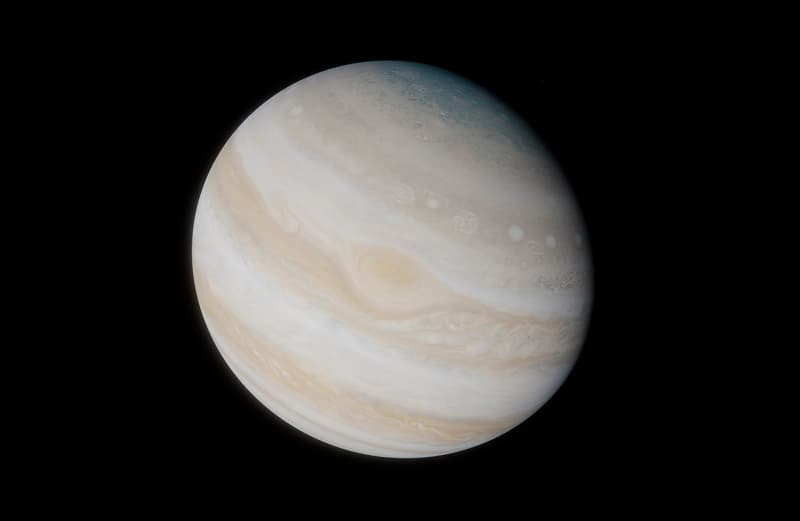
Additionally, the commonly used 8-inch Dobsonian Telescope is a cost-effective option for observing Jupiter.
When seeing is good, you can see:
Great Red Spot
Multi-layered cloud structure
Satellite shadows
Detailed textures within the cloud bands
For users who conduct long-term planetary observations, reflectors often offer superior detail resolution.
It's important to note that aperture is not the only determining factor. A high-quality optical system, a stable support, and good collimation also significantly impact the viewing experience of Jupiter.
How to Observe Jupiter's Details with a Telescope
Many beginners have questions when observing Jupiter for the first time: why are the photos online so clear, while I only see a blurry bright spot? This is because there is a huge difference between what the naked eye sees through a telescope and photographic images. Photographs are the result of multiple exposures using professional astronomical telescopes, while telescope observations provide real-time data, hence the significant difference.
At around 100x magnification, astronomical observers can generally identify Jupiter's disk and the two main equatorial cloud bands. As the magnification increases to 150x to 200x, more cloud bands begin to appear, and the color differences in the polar regions gradually become more pronounced.
If atmospheric conditions are favorable, one can try observing Jupiter's famous Great Red Spot. The Great Red Spot is actually a massive storm that lasted for hundreds of years, its size even exceeding that of the Earth. Although its area has shrunk somewhat in recent years, it remains one of the most interesting Jupiter features for amateur astronomers.
Besides cloud structures, the movements of Jupiter's moons are also worth noting. Through several hours of continuous observation, one can see changes in the moons' positions and even witness the spectacular sight of their shadows passing across Jupiter's surface.
The Impact of Light Pollution on Jupiter Observation
Some astronomy beginners might mistakenly believe that since Jupiter is bright enough, light pollution won't affect morning observations. This is incorrect. While light pollution doesn't make Jupiter invisible, it reduces the contrast between the star and the background sky, affecting the observation of details. Especially at high magnification, a brighter background sky weakens the visibility of cloud structure and color differences.
For observers living in large cities, while Jupiter itself may be visible under significant light pollution, many details will be noticeably affected.
Why Seeing is More Important Than Light Pollution
In planetary observation, seeing is more important than sky transparency.
Seeing refers to the stability of the atmosphere. When there is severe disturbance in the upper atmosphere, even if the sky is very dark, images of Jupiter will still appear shaky and distorted. Some beginners lacking knowledge may mistakenly believe this is a problem with the telescope's quality, but it is actually caused by atmospheric activity.
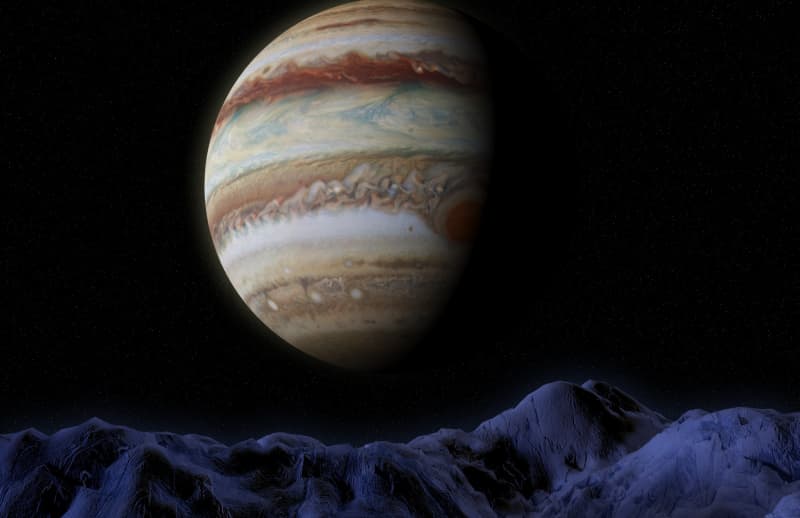
Excellent seeing makes Jupiter's edges appear sharper and cloud band details more clearly visible, while poor seeing makes Jupiter appear to float on water, making it difficult to obtain ideal results regardless of magnification.
Therefore, observers typically prioritize the Seeing Index in weather forecasts before observing Jupiter, rather than just cloud cover. For North America, autumn and winter often offer more stable atmospheric conditions, making them crucial periods for Jupiter observation.
Jupiter Photography for Beginners
With the decreasing prices of astrophotography and observation equipment, more and more amateur enthusiasts are beginning to learn how to observe and photograph Jupiter.
Unlike nebula photography, Jupiter photography uses planetary photography techniques. Because of Jupiter's high brightness, long exposures are not required; instead, thousands or even tens of thousands of frames of video are recorded using a high-speed camera.
Then, using specialized software such as AutoStakkert and RegiStax, the clearest parts are selected from a large number of images and overlaid. This technique, known as "lucky imaging," effectively overcomes the effects of atmospheric disturbances.
Even using an 8-inch telescope and an entry-level planetary camera, it is possible to capture clear images of the Great Red Spot, cloud structures, and moon shadows over Jupiter.
So how to observe Jupiter and get the best experience?
For astronomy enthusiasts, Jupiter is undoubtedly one of the most worthwhile objects in the solar system to observe over a long period. It is bright, rich in detail, and changes frequently, and it is relatively easy to observe with equipment. Whether using binoculars to observe the Galilean moons or using a large reflecting telescope to study the Great Red Spot and cloud band structures, Jupiter continues to offer new discoveries.