
For beginners learning astronomical observation, there's no need to buy an expensive telescope at the start. The human eye is the most amazing "optical instrument." Under ideal observation conditions, the naked eye can see approximately 2,500 to 3,000 stars in the night sky.
Core Methods and Techniques for Naked-Eye Stargazing
To observe the brilliant starry sky with the naked eye, not only is good weather necessary, but also sufficient basic astronomical knowledge and stargazing observation methods are required.
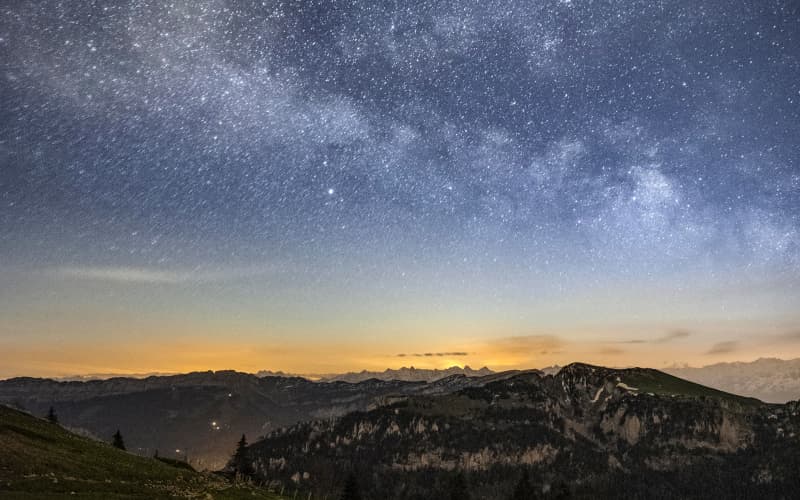
1. First, upon arriving at the stargazing location, your eyes need to undergo "dark adaptation."
Human eyes require time to adjust to darkness, especially when transitioning from bright light to darkness. The pupils dilate, and the rod cells in the retina (responsible for low-light vision) become active. Therefore, after entering a dark environment, wait at least 20 to 30 minutes to allow your eyes to fully adapt. Additionally, during this adaptation period, avoid exposing your eyes to bright light sources such as phone screens or flashlights, as this will require your eyes to readjust to the darkness.
2. Master the "Peripheral Vision" Observation Method
The central part
of the human retina (macula) is very sensitive to color, but its sensitivity decreases in low light conditions. The peripheral area of the retina is more sensitive to faint light. Therefore, when astronomers want to find low-brightness stars or nebulae directly with their eyes, they should avoid looking directly at them. Instead, they should shift their gaze slightly away and observe with their peripheral vision. This makes it easier to find the target.3. Another point to note is that if you need to check star charts or organize equipment in the dark, it is recommended to use a red light flashlight. This is because red light has the least impact on human night vision. If you don't have a dedicated red light flashlight, you can make your own by wrapping a regular flashlight in red plastic or red cloth.
The biggest obstacle to stargazing with the naked eye: Light pollution
Due to high urbanization brought about by economic development, pristine, dark night skies are becoming increasingly scarce, making light pollution the biggest enemy hindering astronomical observation.
To determine the darkness of the night sky, the astronomical community generally uses the Porter's Dark Sky Classification (from 1 to 9), with lower numbers indicating better conditions for astronomical observation.
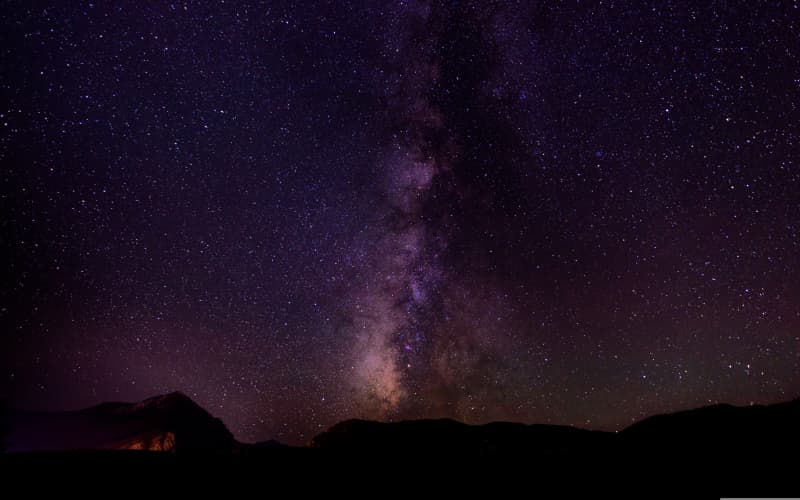
Levels 1-3 (Excellent Dark Sky): Generally located in areas far from cities, such as some national parks or deserts in the United States (e.g., Utah, the heart of Arizona, and the Nevada desert). In these areas, even the dust lanes of the Milky Way can be seen, and large deep-sky objects can be easily observed with the naked eye.
Levels 4-6 (General Observation Conditions): Usually located in the outskirts of cities or rural areas. Under good weather conditions, the Milky Way can be faintly seen, as well as major constellations and relatively bright planets (e.g., Orion, the Big Dipper, Venus, Jupiter, etc.).
Levels 7-9 (City Centers): Such as urban areas like New York and Los Angeles. Due to the large amount of light scattering across the sky at night, the sky appears grayish-white. Under these conditions, only a few of the brightest stars, such as Polaris and Vega, and bright planets like Jupiter and Venus, can be barely seen.
How to find the right stargazing location?
North America is one of the world's best regions for astronomical observation, boasting the world's most comprehensive Dark Sky Reserve system. Astronomy enthusiasts can use the Light Pollution Map website or app to find nearby areas classified as "blue" or "green."
Among these, the Grand Canyon, Death Valley, and Cherry Springs State Park are certified International Dark Sky Parks by the International Dark Sky Association (IDA), making them ultimate paradises for naked-eye stargazing.
Advantages and disadvantages of stargazing with the naked eye vs. binoculars vs. astronomical telescopes
1. Naked-eye observation
(1) Advantages: Zero cost, no preparation time required, largest ultra-wide field of view, best suited for observing meteor showers and constellations;
(2) Disadvantages: Cannot see the surface details of celestial bodies, limited ability to collect light, cannot see the dark and deep sky;
(3) Suitable celestial bodies for observation: meteor showers, artificial satellites/space stations, large constellations, auroras, planetary conjunctions with the moon.
2. Binoculars
(1) Advantages: Wide field of view (usually 5°-7°), easy to carry, conforms to binocular vision habits, and has a very high cost-performance ratio (e.g., 7x50 or 10x50);
(2) Disadvantages: Limited magnification (usually 7-10x), easy to shake when held, tiring to watch for a long time, it is recommended to use a professional tripod;
(3) Suitable celestial objects for observation: bright star clusters (Pleiades, Beehive), lunar craters, and comets.
3. Astronomical Telescope
(1) Advantages: High magnification, extremely strong light-gathering power, able to see details on the surface of planets and faint galaxies;
(2) Disadvantages: Extremely narrow field of view, difficult to find targets, expensive, bulky and time-consuming to assemble;
(3) Suitable celestial objects for observation: Jupiter's stripes and satellites, Saturn's rings, distant galaxies and emission nebulae.
The four main categories of celestial bodies observable with the naked eye and techniques for observation
1. Planet
Under suitable weather conditions and lighting, the five planets of our solar system—Venus, Jupiter, Mars, Saturn, and Mercury—are easily visible. The biggest difference between these planets and stars is that stars twinkle, while planetary light is typically more stable and flickers at a very low frequency.
Venus: The brightest object in the night sky besides the Moon (Venus/Morning Star). When it appears, it shines so brightly it's almost like an airplane searchlight.
Jupiter: A dazzling white object, second only to Venus in brightness, visible all night.
Mars: Has a distinct reddish/orange hue, and reaches opposition approximately every two years, at which time it becomes exceptionally bright.
Saturn: A pale yellow object; although its rings are not visible to the naked eye, its position is clearly discernible.
2. Constellations and Bright Stars
Identifying constellations is a fundamental skill for naked-eye stargazing. You can find landmark constellations based on the North American seasons:
Spring: Look for Ursa Major (the Big Dipper). Extend the line connecting the two stars at the end of the dipper to find Polaris (the North Star).
Summer: Look for the Summer Triangle, formed by Vega, Altair, and Deneb. This is an absolute landmark spanning the Milky Way during the summer.
Autumn: Look for Cassiopeia, which forms a "W" or "M" shape.
Winter: The prime season for stargazing. The iconic Orion constellation is highly recognizable, with its three stars in its belt and the red Betelgeuse in the lower right corner being particularly striking.
3. Deep Space Objects
In sufficiently dark conditions (below Porter magnitude 4), the following cosmic wonders can be observed with the naked eye:
Pleiades (M45): Located in the constellation Taurus. To the naked eye, it appears as a delicate, spoon-shaped cluster of blue light. Those with good eyesight can count 6-7 bright stars within it. In Native American cultures, it is often referred to as the "Seven Sisters."
Andromeda Galaxy (M31): This is the most distant celestial object directly visible to the naked eye (approximately 2.5 million light-years away). In the dark northern sky during autumn, it appears as a faint, blurry wisp of cotton. When you see it, it means that photons from 2.5 million years ago have just entered your eyes.
Orion Nebula (M42): Located in the constellation Orion's Sword, it appears to the naked eye as a faintly glowing, hazy mist—a cosmic incubator where new stars are being born.
4. Artificial Celestial Objects and Special Phenomena
International Space Station (ISS): By checking the transit time (using NASA's Spot the Station website), you can see a point of light brighter than all the stars, moving quickly and silently across the night sky, without any navigation lights flashing.
Meteor Showers: For meteor showers such as the Perseids in August and the Geminids in December, the naked eye is the best tool for observation. Telescopes have too small a field of view, and you won't be able to capture anything.