
The night sky this week, October 16–23, 2026, has plenty in store for stargazers across the Northern Hemisphere. The biggest event is the Orionid meteor shower, which reaches its peak around October 21. Saturn and its moons are also well placed for evening viewing, while several star clusters, bright stars, and distant galaxies offer worthwhile targets for anyone with binoculars or a telescope.
The Moon grows brighter throughout the week, making observing conditions less favorable for faint deep-sky objects. Fortunately, there are still several good opportunities to explore the autumn sky, especially if you plan your sessions around local moonset times.
October 16: Explore Capricornus and Its Double Stars
Start the week by looking south toward Capricornus, a relatively faint constellation that's easier to recognize once you know where to look.
Two useful landmarks are Alpha and Beta Capricorni, both visible through ordinary binoculars. Alpha Capricorni appears as a widely separated pair of stars, although the two main stars aren't physically bound to each other.
Beta Capricorni, on the other hand, belongs to a genuine multiple-star system. Its brighter components show an attractive color contrast, making it an interesting target for observers learning to distinguish double stars.
Capricornus may not be as eye-catching as Orion or Cassiopeia, but it offers a good introduction to navigating the southern autumn sky.
October 17: Find the Wild Duck Cluster, M11
On October 17, turn your attention to the Wild Duck Cluster (M11) in the constellation Scutum.
Also cataloged as NGC 6705, M11 is one of the richest open star clusters visible through amateur telescopes. At approximately magnitude 5.8, it can be found with binoculars, although a small telescope gives a much better view.
The cluster contains hundreds of young stars packed into a relatively small area of sky. Astronomers estimate that it lies roughly 6,000 light-years away and is about 250 million years old.
Through binoculars, M11 may resemble a small patch of misty light. Increase the magnification, and individual stars begin to emerge from the glow.
Even with some moonlight around, this bright cluster remains a rewarding target for beginners.
October 18: Watch Saturn and Its Moons
Saturn takes center stage on October 18, offering another excellent opportunity to observe the ringed planet through a telescope.
Saturn is bright enough to identify with the naked eye, but its real appeal comes through magnification. Even a modest telescope can reveal the rings, while Titan, Saturn's largest moon, is often visible nearby.
Observers with larger instruments may also be able to identify Tethys, Dione, and Rhea.
A particularly challenging event involves Tethys crossing Saturn's disk. The moon and its tiny shadow are difficult to distinguish against the planet's bright atmosphere, so capturing the transit generally requires advanced equipment and imaging techniques.
If you're new to planetary observing, concentrate on Saturn's rings and Titan first. They're much easier to find and just as satisfying to see.
October 19: Spot Fomalhaut, the Lonely Star of Autumn
Look toward the southern sky on October 19 for Fomalhaut, the brightest star in Piscis Austrinus.
Shining at around magnitude 1.2, Fomalhaut stands out because relatively few bright stars surround it. This isolated appearance has earned it a reputation as one of autumn's loneliest bright stars.
Fomalhaut is also scientifically interesting. Astronomers have detected a broad debris disk around the star, providing valuable clues about how planetary systems develop.
An object once identified as a possible planet, Fomalhaut b, was later interpreted as a spreading cloud of dust, potentially produced by a collision between smaller bodies.
For casual stargazers, though, Fomalhaut is simply a useful landmark in the southern autumn sky. No telescope is needed.
October 20: Search for NGC 7331 in Pegasus
If you have access to a larger telescope, October 20 is a good night to try locating NGC 7331, a spiral galaxy in northern Pegasus.
NGC 7331 shines at approximately magnitude 10 and lies around 40 million light-years from Earth. Its bright central region is easier to detect than its faint outer structure.
Through a telescope under suitable conditions, the galaxy appears as an elongated patch of light with a brighter core. Larger apertures and darker skies can reveal more of its structure.
NGC 7331 is more challenging than the Wild Duck Cluster, particularly with increasing moonlight, but it's a worthwhile target for observers beginning to explore galaxies beyond the Milky Way.
October 21: Orionid Meteor Shower Reaches Its Peak
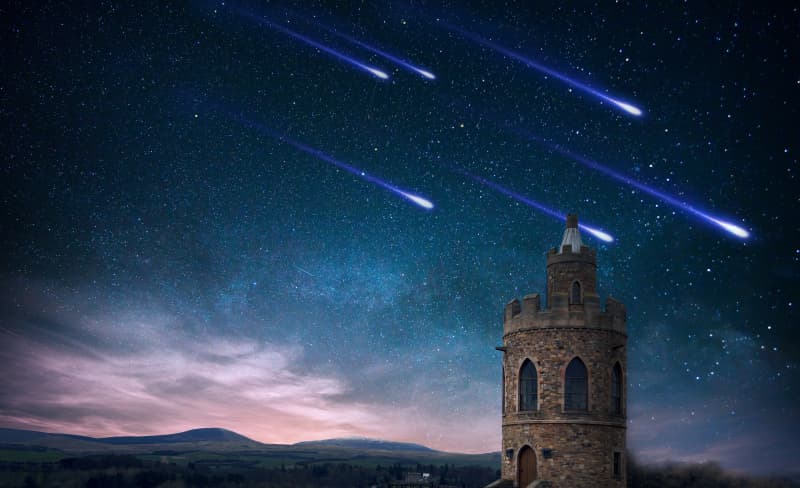
The highlight of the week arrives before dawn on October 21, when the Orionid meteor shower reaches its peak.
The Orionids are among the better-known annual meteor showers, and observers across the Northern Hemisphere have a chance to catch meteors streaking through the early morning sky.
The best viewing window is generally between 2 a.m. and dawn, local time, when Orion climbs higher and the Moon has set at many locations.
Look for Orion's distinctive three-star belt, then find Betelgeuse, the reddish star marking one of the hunter's shoulders. The shower's radiant lies in the general direction of Orion, but you don't need to stare directly at it.
In fact, looking about 40 to 60 degrees away from the radiant can make longer meteor trails easier to spot.
Under favorable conditions, the 2026 Orionids are expected to produce roughly 15–18 meteors per hour near the peak, although actual counts will depend on sky darkness, cloud cover, and local viewing conditions.
For the best experience, choose an open location away from city lights, dress warmly, and allow your eyes at least 20 to 30 minutes to adjust to the dark.
You won't need a telescope or binoculars. A comfortable chair, a clear sky, and some patience are all that's required.
October 22: Look for Iapetus, Saturn's Two-Toned Moon
On October 22, return to Saturn and try identifying one of its more unusual satellites: Iapetus.
Unlike Titan, which is relatively easy to spot, Iapetus is much fainter. Its brightness changes considerably as it travels around Saturn because one hemisphere is much darker than the other.
This week, Iapetus appears at roughly magnitude 11, making it a challenging target that calls for a telescope and an accurate finder chart.
Saturn's brighter moons, including Titan, Tethys, Rhea, and Dione, are also worth observing.
For beginners, finding Titan and comparing the positions of Saturn's moons over several nights can be just as interesting as attempting to locate faint Iapetus.
October 23: The Moon, Saturn, and Neptune Share the Sky
By October 23, the Moon is approaching full phase and appears in the same general region of the sky as Saturn and Neptune.
Saturn is easy to recognize with the naked eye, while Neptune is far more difficult. The distant ice giant requires optical assistance, and bright moonlight makes the search even harder.
Through a telescope, Neptune appears as a tiny blue-gray disk, with little visible detail. Saturn offers a much more dramatic view, particularly through instruments capable of showing its rings and brighter moons.
If you plan to observe both planets, use an astronomy app or a detailed star chart to confirm their positions for your location.
Stargazing Guide: What to Watch This Week in the Northern Hemisphere
The night sky this week offers a good selection of targets for different observing interests and equipment.
Binocular users can explore the Wild Duck Cluster and identify Fomalhaut. A small telescope opens the door to Saturn, Titan, and other bright satellites, while larger instruments make more challenging targets such as NGC 7331 and Iapetus possible.
But the event most observers should put on their calendars is the 2026 Orionid meteor shower peak on October 21.
With a dark observing location and clear skies, the early morning hours offer the best chance to catch the Orionids. Check local moonset and weather forecasts beforehand, since conditions vary across the Northern Hemisphere.
Whether you're watching meteors overhead or taking a closer look at Saturn's rings, October 16–23, 2026 is a rewarding week to spend some time beneath the autumn stars.