
The celestial events from October 2 to 9 offer a spectacular week for astronomy enthusiasts in North America. Saturn reaches opposition, marking the best time of the year to observe the planet; the early-morning Moon makes successive close approaches to Mars and Jupiter; and parts of North America will witness a rare lunar occultation of Jupiter. Meanwhile, Venus and Mercury appear low in the evening sky, while the asteroid Pallas and the globular cluster M30 in Capricornus offer rewarding challenges for those using binoculars or small telescopes. For beginners, the week features both easily identifiable bright planets and deep-sky targets suitable for progressive exploration.
October 2: Spotting Venus and Mercury at Dusk
After sunset on October 2, look toward the western horizon to spot Venus and Mercury. Shining at a magnitude of approximately -4.8, Venus is one of the most conspicuous objects in the twilight sky; while Mercury is slightly fainter, it will appear at a slightly higher altitude than Venus.
Since both planets are very close to the horizon, an unobstructed view to the west is essential. This is also an excellent opportunity for beginners to learn how to distinguish between planets and stars.
Once night has fully fallen, you can turn your gaze southward to find the famous "Teapot" asterism in the constellation Sagittarius. Composed of several stars with magnitudes between 2 and 3, it has a distinctive shape that is easy to recognize, making it a classic starting point for exploring the late-summer and early-autumn night sky.
October 3–4: Saturn at Opposition—Prime Time for Observation
One of the week's most significant astronomical events is Saturn reaching opposition. On October 4, the planet arrives at this position, rising at sunset and setting at sunrise, making it visible throughout the night.
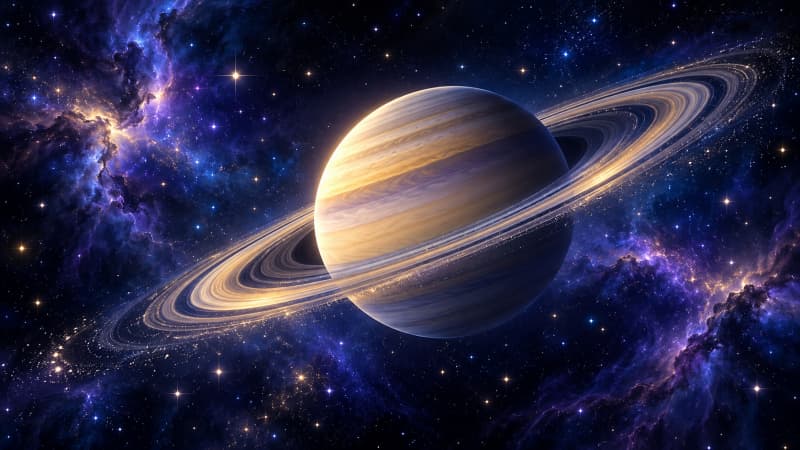
With a magnitude of approximately 0.3, Saturn stands out prominently against the surrounding stars. An entry-level telescope is sufficient to reveal its famous ring system; under steady atmospheric conditions, observers may also spot Titan, its brightest moon.
Around the time of opposition, Saturn sits high in the sky and remains visible for an extended period, making it an ideal target for enthusiasts using a telescope to observe a planet for the first time. For beginners, identifying Saturn, its rings, and Titan is a more practical and rewarding goal than attempting to track complex phenomena like satellite transits.
October 5: Waning Moon Approaches Mars and the Beehive Cluster
In the early hours of October 5, the Moon passes near Mars. Both objects are located in the constellation Cancer, and the waning Moon also passes close to the famous Beehive Cluster (M44).
Mars shines at a magnitude of approximately 1.1, displaying a distinctive orange-red hue. Observing the cluster near the waning Moon with binoculars reveals a much richer background of stars than is visible to the naked eye.
The Beehive Cluster is an excellent target for beginners. Because it spans a relatively large area of the sky, binoculars or a low-power eyepiece offer a more natural view than a high-magnification telescope.
October 6: Lunar Occultation of Jupiter Visible in Parts of North America
The early morning of October 6 may be the week's most notable event. A waning moon will pass very close to Jupiter, and a lunar occultation—where the Moon passes in front of Jupiter from the observer's perspective, temporarily obscuring the planet—will be visible from parts of Canada, the United States, Mexico, and Cuba.
Because visibility depends heavily on geographic location, the start and end times of the event will vary by region.
Even if you are not located within the zone of full occultation, you can still enjoy the sight of the Moon in close proximity to the bright planet. Jupiter shines at a magnitude of approximately -1.9, making it easily visible to the naked eye; using a telescope allows for a view of the Galilean moons as well.
October 7–8: Continuing Saturn Observations and a Challenge to Spot Pallas
The evening of October 7 remains excellent for observing Saturn and its moons. Titan, the brightest of them, is positioned near the planet, while the positions of the other, fainter moons shift constantly due to their orbital motion.
On October 8, you can try to spot the asteroid 2 Pallas. Having recently reached a position near opposition, it shines at a magnitude of approximately 8.3; under dark skies, it can be detected using binoculars or a telescope.
One of the most engaging ways to observe asteroids is to record the same patch of sky over two consecutive nights. While the positions of the stars remain essentially fixed, the asteroid moves slowly. By comparing star charts or photographs from the two nights, you can identify which point of light is the actual asteroid Pallas.
October 9: Locating the Globular Cluster M30 in Capricornus
On the evening of October 9, you can turn your gaze toward the globular cluster M30 in the constellation Capricornus.
With a magnitude of approximately 7.2, M30 is well-suited for observation with binoculars or a small telescope. Located about 28,000 light-years from Earth and estimated to be around 13 billion years old, it is one of the Milky Way's ancient stellar systems.
Through a small telescope, M30 typically appears as a hazy patch of light with a bright, dense core; as the telescope's aperture increases, individual stars in the outer regions gradually become resolvable. It is an excellent autumn target for observers just beginning to explore globular clusters.
Highlights for Stargazing in North America This Week: From Saturn at Opposition to the Lunar Occultation of Jupiter
Overall, the night sky in North America from October 2 to 9 offers a mix of targets suitable for naked-eye viewing, planetary observation, and deep-sky exploration. Beginners can start with Venus, Mercury, Mars, Jupiter, and Saturn, then use binoculars to try spotting the Beehive Cluster, the asteroid Pallas, and the globular cluster M30.
Among these, Saturn at opposition is the week's most reliable and easily scheduled highlight, whereas the lunar occultation of Jupiter depends more heavily on your specific location. Weather permitting, prioritize a Saturn observation session around October 4, then determine—based on your location—whether the lunar occultation of Jupiter on the morning of October 6 is visible to you.
As the New Moon approaches, moonlight interference will continue to diminish. For North American enthusiasts looking to begin autumn deep-sky observing, this week offers an excellent opportunity to transition from viewing bright planets to exploring star clusters and asteroids.