
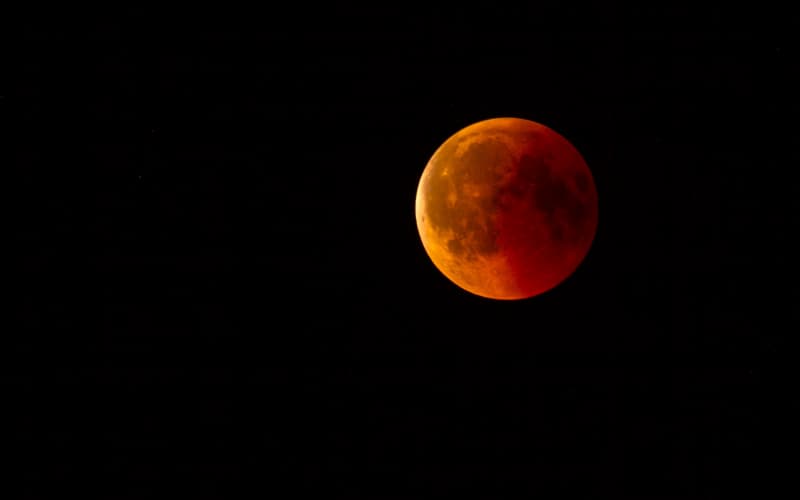
As we enter the latter half of August, the North American night sky will witness one of the most noteworthy celestial events of the month. The highlight of this week's celestial events, from August 21st to 28th, 2026, is a deep partial lunar eclipse occurring from the evening of August 27th to the early morning of August 28th. During this eclipse, approximately 96% of the Moon's surface will be within the Earth's umbra, appearing a distinct orange-red, making it ideal for naked-eye observation. Simultaneously, this week also offers opportunities to observe Saturn and its moons, the Moon's approach to Antares, Barnard's Star, the M73 star cluster, and several asteroids. For novice astronomers in North America, this is an excellent week to schedule lunar eclipse observation, planetary observation, and summer deep-sky observation.
Five Most Watched Astronomical Events This Week
1. Partial Lunar Eclipse: The Biggest Astronomical Highlight of the Week
The partial lunar eclipse from August 27th to 28th is undoubtedly the most watchable astronomical event of the week. The moon will gradually enter the Earth's shadow from evening to late at night, and the main phase of the eclipse can be observed in its entirety in the eastern regions. Data shows that the eclipse begins around 9:23 PM Eastern Time, with the moon truly entering the umbra and the partial eclipse starting around 10:33 PM; at maximum eclipse, approximately 96% of the lunar surface will be covered by the Earth's umbra.
Since lunar eclipses do not require special protective equipment like solar eclipses, they are ideal for beginners. After the moon enters the Earth's shadow, the bright lunar surface will gradually darken and may appear orange, red, or reddish-brown. It is recommended to choose a location with a clear eastern sky and observe the entire process from moonrise.
If time is limited, focus on the period around maximum eclipse, when the area of the moon covered by shadow is largest, and the visual effect is most pronounced.
2. Sturgeon Moon: Full Moon and Lunar Eclipse Coincident in August
The full moon on August 28th is known as the Sturgeon Moon. This name originates from Native American tradition, as sturgeon are abundant in lakes around August.
This year, the Sturgeon Moon coincides with a deep partial lunar eclipse, giving this full moon even greater observational value. Around the time of maximum eclipse, most of the moon's surface is within Earth's umbra, with only a small area remaining bright. The moon's color will continuously change as it enters and leaves the shadow.
For North American observers, this is a very easy astronomical event to participate in: no telescopes or special equipment are needed; it can be viewed with the naked eye. Binoculars can help observe the lunar rim and changes in shadow.
3. Saturn and its Moons: Challenging Titan, Dionysus, and Iapetus
Saturn's early morning this week is also worth watching. Around 4 AM on August 22nd, Saturn will be high in the southern sky, a good target for telescope observation.
Saturn's most striking feature is, of course, its rings, but this week also offers opportunities to observe several of its moons. Titan, at approximately magnitude 8, is one of the easiest moons to spot; Dionysus, Enceladus, and Enceladus, at approximately magnitude 10, may also be visible under good viewing conditions.
For enthusiasts with large-aperture telescopes, Iapetus is another option. On August 24th, Iapetus will be at its greatest eastern elongation, approximately 9.4 arcminutes from Saturn, but its darker hemisphere will face Earth, reducing its brightness to approximately magnitude 12, significantly increasing the difficulty of observation.
4. Moon Approaches Antares: Red Giant Star Accompanying the Moon
In the early morning of August 21st, the Moon passed approximately 0.6° south of Antares, the brightest star in the constellation Scorpius. By the evening, the Moon and Antares had separated by more than 10°, but they could still be seen simultaneously in the southern sky.
Antares itself is a very conspicuous red giant star. The bright white of the Moon contrasts sharply with the reddish hue of Antares, making it ideal for naked-eye observation and astrophotography.
That day, you can also try to find the nearby globular cluster M62. It is located near the boundary between Ophiuchus and Scorpius, with a magnitude of approximately 6.5 and a diameter of about 15 arcminutes. Due to moonlight interference, dimmer stars may be difficult to see, so it is recommended to conduct deep-sky observations after the Moon has set.
5. Barnard's Star and M73: Targets for Telescope Challenges
August 25-26 offers a good opportunity to focus your observations on some unique deep-sky objects.
M73, located in the constellation Aquarius, is a very special object in the Messier catalogue. It is actually just four stars that appear close together, not a true star cluster. Its unique triangular arrangement can be observed with a small telescope.
Another challenging target is Barnard's Star. Located in the constellation Ophiuchus, it has a magnitude of about 9.5 and is invisible to the naked eye, requiring binoculars or a small telescope. Its most remarkable feature is not its brightness, but its enormous proper motion, moving approximately 10.3 arcseconds across the sky each year.
For beginners, Barnard's Star is an excellent target for understanding that "stars also move." Recording its position over several years reveals a significant change in its position relative to the background stars.
Which asteroids can be observed this week?
On August 27th, asteroid Pallas (Pallas 2) reaches stationary and then begins to move westward relative to background stars, entering its retrograde phase.
On August 28th, Metis (Metis 9) reaches opposition, offering opportunities for observation throughout the night. However, due to strong moonlight during the full moon and eclipse, observing asteroids of magnitude 9 or around will be challenging.
On the same day, Vesta (Vesta 4) also reaches stationary. Compared to Metis, Vesta is brighter and farther from the moon, making it a better starting point for asteroid observation.
Best Observation Times for North American Beginners This Week
If you're just starting out with astronomical observation, here's a suggested schedule:
Evening: Observe the Moon, Antares, and the night sky before the eclipse begins.
9 PM to Midnight: Focus on the partial lunar eclipse starting on the night of August 27th.
Midnight to Early Morning: Ideal for observing the maximum eclipse and searching for fainter asteroids and deep-sky targets.
3 AM to Sunrise: Focus on observing Saturn and its moons.
Equipment: The lunar eclipse, Moon, and Antares can be observed with the naked eye; binoculars are suitable for M62, M73, and Barnard's Star; larger aperture telescopes are better suited for challenging targets such as Iapetus and faint asteroids.