
The week of September 4–11, 2026, presents exceptional skywatching opportunities for amateur astronomers. As the Moon progresses from Last Quarter toward the New Moon phase, lunar glare steadily diminishes throughout the night. Pre-dawn observers can watch the Moon pass close to Mars and Jupiter in succession, while also tracking the brightness fluctuations of Algol, viewing Saturn and its moon Titan, and targeting deep-sky objects like Uranus and the spiral galaxy NGC 7331. For observers across North America, this week offers an ideal mix of naked-eye targets requiring no special equipment, as well as rewarding planetary, lunar, and deep-sky features suited for binoculars and small telescopes.
September 4: Observing the Brightness Dip of the "Demon Star" Algol
On the evening of September 4, Algol (Beta Persei) in the constellation Perseus is a prime target for observation. Algol is a famous eclipsing binary system; as viewed from Earth, its primary component is periodically blocked by its companion star, causing a noticeable drop in its overall brightness approximately every 2.87 days. Under normal conditions, Algol shines at about magnitude 2.1, but near mid-eclipse, its visual brightness drops to around magnitude 3.4—a variation exceeding a full magnitude that can easily be detected with the naked eye. The night of September 4 is particularly favorable for North American observers, as Algol reaches minimum brightness at approximately 9:50 PM EDT (6:50 PM PDT), gradually recovering over the following few hours. Beginners can start by locating the distinctive W-shape of Cassiopeia, star-hop down to neighboring Perseus to find Algol, and compare its brightness against neighboring stars whose light remains steady.
September 5: Targeting Saturn and Titan with a Telescope
On September 5–6, turn your attention toward Saturn and its largest moon, Titan. Saturn itself is easily visible to the naked eye, shining as a bright, steady, yellowish-white beacon in southern Pisces. However, resolving Titan requires optical aid. As Saturn's largest satellite, Titan is the easiest of its moons for amateur telescopes to pick out, shifting its position from northeast to northwest of the planet over these two days. Under good sky conditions and with a larger aperture, you may also attempt to spot fainter moons like Rhea, Tethys, and Dione. Beginners need not try identifying every moon in one go; resolving Saturn's rings first and then pinpointing nearby Titan makes for a perfect initial observation of the Saturnian system.
September 6: The Waning Crescent Moon, Mars, and Jupiter Highlight the Pre-Dawn Sky
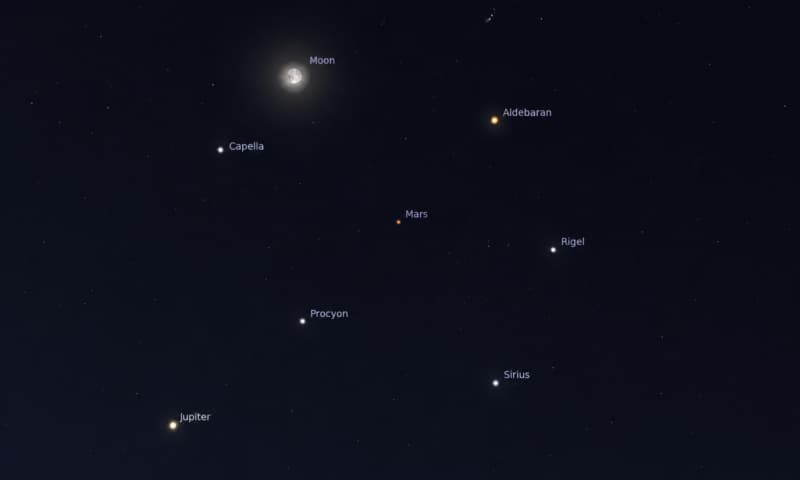
On the morning of September 6, attention shifts to the eastern sky before dawn. A waning crescent Moon sits near the constellation Gemini alongside Mars, while brilliant Jupiter shines lower on the horizon toward Cancer. About an hour before sunrise, these objects reach a comfortable altitude for naked-eye identification. Mars displays its characteristic reddish-orange color, though its apparent angular diameter currently measures only around 5 arcseconds—making surface details challenging to resolve even with a small telescope. By contrast, Jupiter presents a generous disk of about 32 arcseconds, allowing amateur telescopes to easily reveal its equatorial cloud belts and four Galilean moons. For beginner astronomers, directly comparing the relative brightness and distinct colors of Mars, Jupiter, and the bright stars of Gemini provides a fantastic exercise in planetary identification.
September 7: Spotting Venus and Spica Low in the Twilight Sky
After sunset on September 7, Venus and Spica—the brightest star in Virgo—appear together low on the western horizon, separated by less than 5°. The primary obstacle for observation is not visual brightness, but altitude: approximately one hour after sunset, both objects hover just a few degrees above the horizon, meaning trees, buildings, or hills can easily obstruct your line of sight. If you plan to observe this pairing, select a location with an unobstructed view toward the western horizon well in advance. Through a telescope, Venus currently exhibits a clear crescent shape, offering a great opportunity to witness the phases of Venus—a phenomenon arising because Venus orbits inside Earth's orbit, causing it to display lunar-like phase changes as seen from our perspective.
September 8: The Thin Waning Crescent Meets Jupiter Near the Beehive Cluster
The pre-dawn hours of September 8 present one of the finest multi-object observing opportunities of the week for beginner skywatchers. A slender waning crescent Moon enters the constellation Cancer, sharing the sky with brilliant Jupiter, while the renowned Beehive Cluster (M44) rests close by. About an hour before sunrise in the eastern sky, Jupiter shines so intensely that it remains easy to spot even through moderate urban light pollution. The Beehive Cluster, meanwhile, is best viewed with binoculars, though it can appear as a delicate, hazy patch to the naked eye under darker skies. Scanning M44 through binoculars resolves this faint patch into a brilliant swarm of individual stars, making this morning an ideal introduction to observing open clusters.

September 9: Using the Moon, Jupiter, and Mars to Identify the Ecliptic
On the morning of September 9, the waning crescent Moon continues its eastward journey into Leo, positioning itself near the bright star Regulus (Alpha Leonis). Scanning the pre-dawn sky reveals Regulus, the slender Moon, Jupiter, and Mars lined up in succession, tracing the path of the ecliptic across the night sky. The ecliptic represents the apparent annual path of the Sun against the background stars. Because the orbital planes of the major planets in our solar system align closely with Earth's orbital plane, the Moon and major planets consistently appear along or near this band as viewed from Earth. For star-hoppers and beginner astronomers, tracing this live alignment of planets and the Moon in the morning sky provides a far more intuitive lesson than simply memorizing the definition of the ecliptic.
September 10: Spotting Uranus as the New Moon Delivers Dark Skies
On September 10, Uranus reaches a stationary point among the background stars of Taurus before transitioning from direct (prograde) to retrograde motion. Because its brightness hovers near the threshold of naked-eye visibility, using binoculars or a small telescope is essential for successfully locating it. Start by identifying the prominent Pleiades star cluster (M45) and reddish-orange Aldebaran, then star-hop toward Uranus using a detailed sky map. Through a telescope, Uranus presents an apparent angular diameter of only about 4 arcseconds, appearing point-like under low magnification; resolving its subtle, tiny blue-green disk requires higher magnification and steady atmospheric seeing. That same evening brings the New Moon, eliminating lunar glare entirely and establishing pristine dark-sky conditions for deep-sky observation over the next several nights.
September 11: Dark-Sky Challenge—Targeting Galaxy NGC 7331
On the evening of September 11, point your telescope toward Pegasus. After nightfall, the distinctive Great Square of Pegasus rises prominently in the eastern sky, serving as your primary landmark for locating NGC 7331. Shining at magnitude 9.5, this spiral galaxy can occasionally be picked out with large binoculars under exceptionally dark skies, but using an astronomical telescope remains far more practical for most observers. NGC 7331 forms the anchor of the famous "Deer Lick Group," sharing the immediate field of view with several fainter background galaxies, including NGC 7335, NGC 7336, NGC 7337, and NGC 7340. However, these companions range from 13th to 15th magnitude, requiring larger apertures and truly dark skies to resolve—making NGC 7331 itself the ideal primary target for your visual session.
What Are the Top Skywatching Highlights for the Week of September 4–11?
If you are just beginning your journey in stargazing and amateur astronomy, do not feel pressured to observe every single target listed for this week. For naked-eye observing, prioritize tracking Algol's brightness variations on September 4, as well as the striking pre-dawn alignment of the Moon, Mars, and Jupiter from September 6 through September 9. If you own binoculars, try searching for the Beehive Cluster (M44) and Uranus. If you have access to a small astronomical telescope, turn it toward Saturn's rings and Titan, Jupiter's atmospheric belts and Galilean moons, or challenge yourself to resolve the spiral galaxy NGC 7331 around the New Moon window.
The greatest observing advantage during this week of September 4–11, 2026, is that moonlight steadily diminishes each night, culminating in the New Moon on September 10. For amateur astronomers across North America, this provides a versatile window: you can leverage the morning crescent Moon to identify Jupiter and Mars, then shift your attention to star clusters, Uranus, and distant galaxies as the night sky grows progressively darker. Preparing a sky map for your specific observation night and picking just two or three targets that match your available equipment will yield a far more rewarding experience than trying to hunt for every celestial body at once.