
Uranus is the seventh planet from the Sun, and although it is extremely far from Earth, it is not entirely beyond naked-eye visibility. Its apparent magnitude is usually around 5.6, placing it close to the limit of what most people can see without optical aid. Under dark, moonless skies, far from city lights, observers with good eyesight may be able to spot it.
The difficulty is that Uranus looks almost exactly like a faint star, making it hard to identify. Autumn, particularly the weeks around opposition, is generally a good time to look for the planet. A pair of ordinary binoculars and an accurate star chart will usually make the search much easier than relying on your eyes alone.
Can You Really See Uranus with the Naked Eye?
Mercury, Venus, Mars, Jupiter, and Saturn are traditionally known as the five naked-eye planets. Uranus is rarely included in that group, but this does not mean it is completely invisible without a telescope. It is simply much fainter, and whether you can see it depends heavily on sky transparency, moonlight, and light pollution.
Even if you know exactly where Uranus is, spotting it from a city can be difficult. Under a truly dark rural sky, however, it may appear as a faint, unremarkable point of light. The real challenge is often not seeing the planet, but recognizing it among the surrounding stars.
Uranus slowly changes position relative to the background stars. By observing the same patch of sky several days apart and comparing its position with a detailed star chart, you can identify the planet more reliably than by looking for a particular color.
Where Is Uranus in the Night Sky in Fall 2026?
In late October and November 2026, Uranus is located in the constellation Taurus, near the Pleiades and Hyades star clusters. For observers at mid-northern latitudes in North America, the planet rises higher in the eastern sky after dusk in late October, making the later evening hours more suitable for observation.
How to Find Uranus Using the Pleiades
Begin by locating Aldebaran, the bright orange-red star in Taurus. Then look for the Pleiades (M45), a compact cluster of bright stars that is easy to recognize in the autumn sky. During fall 2026, Uranus lies roughly in the region between the Pleiades and the Hyades star cluster.
These landmarks can help narrow your search, but Uranus itself is not an obvious target. Binoculars are useful, especially when paired with a digital star chart set to your actual observing date. Compare the stars in the chart with what you see through the binoculars to identify the planet.
When Is the Best Time to See Uranus?
The best time to observe Uranus is generally around opposition. This occurs when Earth lies approximately between the Sun and Uranus. Around opposition, Uranus rises in the east near sunset, remains visible throughout the night, and reaches close to its greatest apparent brightness of the year.
In 2026, Uranus reaches opposition on November 25, with an apparent magnitude of about 5.6. The weeks before and after that date are also favorable for observation, so there is no need to limit your search to the night of opposition itself.
There is one complication this year: a full Moon occurs around November 24, 2026. Bright moonlight can make such a faint planet harder to detect. If you want to try finding Uranus with the naked eye, a night with less moonlight may offer better conditions. Binocular observers will still have plenty of opportunities around opposition, provided the weather is clear.
What Does Uranus Look Like Through Binoculars?
With ordinary 7×50 or 10×50 binoculars, Uranus is within reach, but it will usually appear as a tiny point of light. Do not expect to see the clearly defined planetary disk or atmospheric details familiar from spacecraft photographs.
A small astronomical telescope, used at a suitable magnification under steady atmospheric conditions, may reveal the planet's tiny disk, which is approximately 4 arcseconds across. Some observers can also detect a subtle blue-green tint, although the color is generally much less pronounced than it appears in photographs. To the eye, Uranus may even look pale gray or nearly white.
Uranus has a very faint ring system that is normally beyond the reach of ordinary amateur telescopes. Its major moons are also challenging targets, requiring a larger telescope, higher magnification, and favorable observing conditions.
Why Is Uranus Blue-Green?
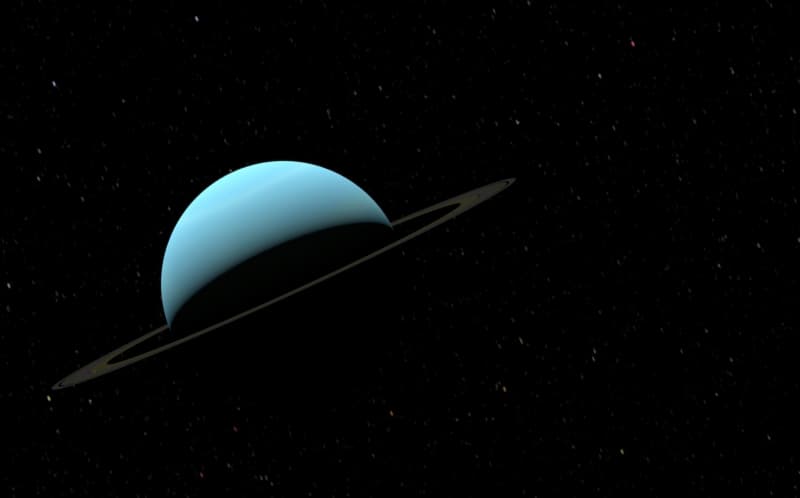
Uranus is classified as an ice giant. Its atmosphere consists mainly of hydrogen and helium, along with a smaller amount of methane. Methane absorbs some of the red wavelengths in sunlight, leaving the reflected light with a blue-green appearance. This is one of the main reasons Uranus has its distinctive color in spacecraft images.
Despite its classification as an ice giant, Uranus does not have oceans of liquid hydrogen or nitrogen in the conventional sense. Current models suggest that its deep interior may contain hot, high-pressure fluids made up of substances such as water, ammonia, and methane. Unlike Earth, Uranus has no clearly defined solid surface.
The planet is roughly four times Earth's diameter and has about 14.5 times Earth's mass. It takes approximately 84 Earth years to complete one orbit around the Sun, while a single rotation takes only about 17 hours.
Why Does Uranus Rotate on Its Side?
One of the most unusual features of Uranus is its extreme axial tilt of approximately 97.8 degrees. By comparison, Earth's rotational axis is tilted by about 23.4 degrees. Uranus is therefore often described as rotating on its side as it travels around the Sun.
This unusual orientation produces extreme seasonal changes. As Uranus moves along its lengthy orbit, the amount of sunlight reaching each pole changes dramatically. Some polar regions can experience periods of darkness lasting around 21 Earth years.
Scientists have suggested that a massive collision early in the solar system's history may have contributed to the planet's unusual tilt. However, the precise origin of this feature remains an active area of research.
Who Discovered Uranus, and How Many Moons and Rings Does It Have?
Uranus was discovered through a telescope by astronomer William Herschel on March 13, 1781. Herschel initially believed he had found a comet, but subsequent observations established that the object was a previously unknown planet. Uranus became the first planet discovered with the aid of a telescope in modern times. Its name comes from Ouranos, the Greek god of the sky.
Uranus also has a ring system. Thirteen faint rings have been identified, consisting mainly of small particles and dark material. According to NASA's information updated in August 2026, the planet has 29 known moons. Among the best known are Miranda, Ariel, Umbriel, Titania, and Oberon.
How to Find Uranus in the Night Sky
The most reliable way to find Uranus is to identify the constellation it currently occupies, use recognizable stars or star clusters to narrow down the area, and then compare what you see through binoculars with an accurate star chart.
In fall 2026, the Pleiades in Taurus provide a useful starting point. Even if Uranus appears as nothing more than a faint dot, that tiny point represents a distant ice giant with a blue-green atmosphere, an unusually tilted rotation axis, faint rings, and numerous moons. Its appearance may be modest, but the planet itself is very different from the world we know on Earth.