
Mars is one of the most compelling planets for beginner observers. Under proper sky conditions, it requires no telescope to spot: viewed from Earth, Mars typically appears as a bright, reddish-orange or yellowish-red point of light that slowly shifts its position relative to the background stars over time. However, locating Mars in the night sky is not as simple as pointing toward a fixed direction like Polaris, because its position and brightness constantly change due to the orbital motions of both Earth and Mars. During certain months it dominates the sky, while at other times it becomes difficult to observe. For those beginning planetary observation, rather than memorizing the exact rise time for a single date, it is far more useful to master the fundamentals—Mars's color, brightness variations, motion patterns, and key differences from stars—methods that remain applicable year after year.
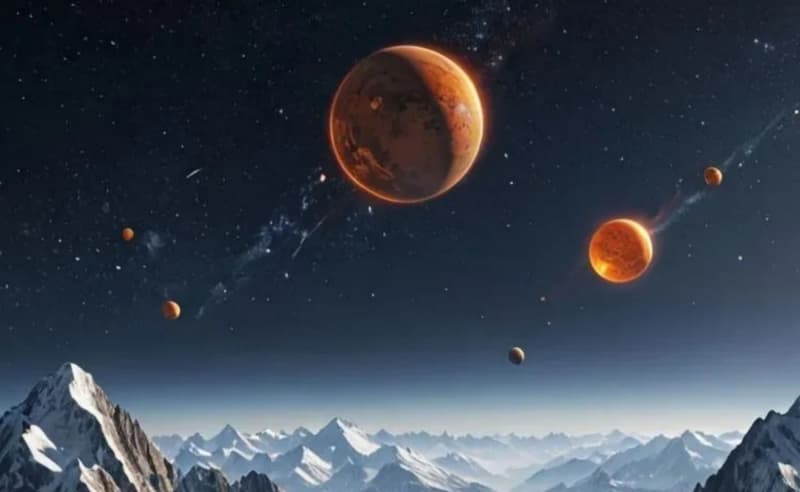
What Does Mars Look Like in the Night Sky?
When observing Mars with the naked eye, we cannot see the sand dunes, canyons, and impact craters visible in spacecraft photography, nor can we directly discern its spherical shape. It still appears simply as a bright, compact point of light. However, its color is generally far more recognizable than that of most stars, typically showing an orange, reddish-orange, or yellowish-red hue. When Mars is particularly bright, this color contrast stands out vividly against the backdrop of neighboring white and blue-white stars. Nevertheless, assuming that "any bright red star is Mars" is not a reliable identification method, as the night sky also features orange-red stars like Antares, Betelgeuse, and Aldebaran. Accurately identifying Mars requires combining its color, brightness, current zodiacal constellation, and relative position change against background stars, rather than relying on any single trait.
Why Does Mars Look Red?
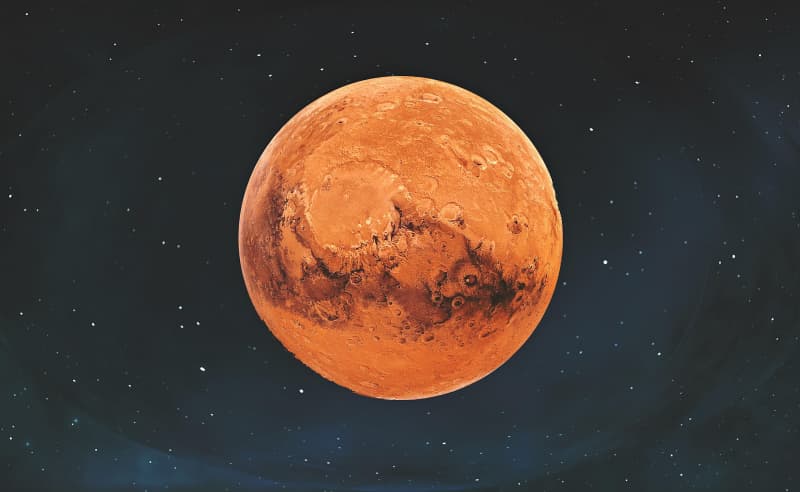
Mars is known as the "Red Planet" primarily due to the abundance of iron-bearing minerals in its surface rocks and dust. As these materials oxidized over time, they formed iron oxides, imparting a reddish-brown hue to vast expanses of Martian soil and dust. Fine dust particles are frequently swept up into Mars's thin atmosphere by surface winds, helping the entire planet retain a distinctly warm tone when viewed from a distance. As a result, Mars viewed from Earth rarely displays the white or pale-yellow appearance typical of Jupiter, instead exhibiting a far more pronounced reddish-orange tint. Ancient civilizations recognized this distinctive hue long ago; the Romans ultimately named it after Mars, their god of war, corresponding to Ares in Greek mythology. This unique coloration is not only a physical signature of the planet, but also an enduring cultural symbol throughout human history.
How to Find Mars in the Night Sky
The most important rule when searching for Mars is to never rely on a fixed direction or time as a permanent guide. Because both Mars and Earth orbit the Sun, Mars constantly changes its position along the ecliptic when viewed from Earth, moving through different constellations in different years. It may dominate the evening sky during one period, only to require midnight or early-morning viewing during another season. Consequently, the most reliable approach for beginners is to consult a sky chart or astronomy mobile app to confirm Mars's current host constellation, rise time, and general direction before heading outside for field observation.
Once you spot a candidate reddish-orange point of light, continue observing the same region of sky over several days or weeks. While the stars that outline constellations maintain fixed relative positions, Mars will slowly shift its position relative to these background stars. In fact, the term "planet" itself derives from this characteristic movement across the starry backdrop. For beginner stargazers, recording Mars's position firsthand over successive nights makes it far easier to understand how ancient observers distinguished planets from distant stars.
Why Does Mars Vary So Much in Brightness?
Mars does not maintain a constant brightness; its visual magnitude fluctuates dramatically between different observation periods, driven primarily by the changing distance between Earth and Mars. Earth completes an orbit around the Sun in about one year, whereas Mars requires nearly two Earth years. Because the two planets orbit at different speeds, the physical distance separating them decreases and increases in a dynamic orbital cycle. When Mars is close to Earth, it appears noticeably larger and brighter; when the two planets are on opposite sides of their orbits, both Mars's apparent brightness and angular diameter drop significantly.Understanding this distinction is crucial, as introductory astronomy guides often broadly label Mars as "one of the brightest objects in the night sky"—a description that lacks proper timing context. Mars can indeed be exceptionally prominent during favorable oppositions, but during unfavorable orbital alignments, it fades into an unexceptional point of light or becomes lost in the solar glare when positioned too close to the Sun from Earth's perspective. Therefore, if you do not spot a strikingly brilliant "red star" on a given night, it does not mean Mars is absent—it simply means the current orbital phase is not ideal for observation.
What Is Martian Opposition and Why Is It Ideal for Observing?
When studying Mars observation, you will frequently encounter the term opposition. Opposition occurs when the Sun, Earth, and Mars line up roughly in a straight line, with Earth positioned directly between the Sun and Mars. The period surrounding opposition represents the premier window in a given Martian observation cycle because Mars is near its closest distance to Earth, reaching peak visual brightness and displaying its largest apparent angular diameter through a telescope. For observers aiming to resolve surface features, targeting this timeframe is far more effective than selecting a random night of the year.
Around opposition, Mars remains visible for most of the night. Near the date of opposition, it rises in the east around sunset, reaches its highest altitude in the southern sky near midnight, and sets in the west around sunrise. However, keep in mind that this dusk-to-dawn pattern applies specifically to the opposition period; Mars does not follow this exact schedule throughout the entire year. Determining the optimal viewing hours for Mars always requires checking the specific year, date, and local latitude.
How to Distinguish Mars from Stars
Beyond color, examining light stability provides another effective way to differentiate Mars from distant stars. Because stars are located at immense distances, they function essentially as point sources of light from our perspective. As starlight passes through Earth's turbulent atmosphere, atmospheric refraction causes the light rays to fluctuate, producing the familiar phenomenon of "twinkling." By contrast, while Mars also appears as a point of light to the naked eye, it actually presents a finite, minute angular disk. This slight physical extent averages out atmospheric fluctuations, causing Mars to shine with a noticeably steadier light than surrounding stars.
However, the rule of thumb that "stars twinkle, planets shine steady" should serve only as a secondary clue rather than an absolute rule. When a planet sits low near the horizon, its light travels through a significantly thicker layer of atmosphere, which can induce noticeable shimmering and subtle color shifts. The most reliable approach remains combining star chart confirmation, color identification, and tracking position changes over time. If a reddish-orange object visibly shifts its location relative to nearby stars over the course of several days, its identity as a planet becomes unmistakable.
Why Are Mars and Antares So Easily Confused?
Antares, the brightest star in the constellation Scorpius, is an essential benchmark when learning to identify Mars, as both exhibit a striking reddish-orange color. In fact, the name Antares translates directly from Greek as "Rival of Mars" (Anti-Ares)—Ares being the Greek god of war corresponding to Mars in Roman mythology. The name itself shows that ancient observers recognized the remarkable visual similarity between the two objects long ago.
When both happen to occupy neighboring regions of the sky, first examine their light stability: as a distant star, Antares suffers more from atmospheric turbulence and usually displays noticeable twinkling, whereas Mars typically shines with a steadier beam. An even more definitive method is to observe them over several nights: Antares remains fixed within the familiar pattern of Scorpius, while Mars gradually changes its position relative to the starry backdrop. For beginners, conducting a direct "Mars vs. Antares" comparison in the field provides a remarkably intuitive lesson in distinguishing planets from stars.
What Can You See on Mars Through an Astronomical Telescope?
Once you can reliably locate Mars with the naked eye, you can attempt visual observation through an astronomical telescope. Unlike the simple point of light seen without optical aid, Mars reveals a distinct, miniature disk when viewed under sufficient magnification. When Mars is near its closest approach to Earth and atmospheric seeing conditions are favorable, small-to-medium amateur telescopes can resolve bright polar caps and subtle dark surface markings. However, real-time views are far less dramatic than high-resolution spacecraft photography; because Mars presents a small angular diameter, successful observation depends heavily on Earth-Mars distance, atmospheric stability, telescope aperture, and observer experience.
A common misconception among beginner astronomers is that higher magnification automatically reveals more planetary detail. In reality, pushing magnification beyond what your telescope optics and ambient atmospheric seeing can support yields an image that is larger, but significantly dimmer and blurred. Consequently, when observing Mars through a telescope, prioritizing a sharp, steady image is far more effective than chasing extreme magnification. A practical technique is to first center the target and establish precise focus at lower magnification before incrementally stepping up power.
How Large Is Mars, and How Does It Differ from Earth?
As the fourth planet from the Sun, Mars has a diameter of approximately 6,780 kilometers—roughly half that of Earth—and possesses a mass equal to about 11% of Earth's. It features an extremely thin atmosphere composed predominantly of carbon dioxide, resulting in a cold, dry surface environment. Today, Mars lacks large, stable bodies of liquid surface water like Earth's oceans; however, extensive geological evidence indicates that ancient Mars once harbored a much more active aqueous environment.
Although Mars is significantly smaller than Earth overall, it boasts some of the solar system's most awe-inspiring topographies. Olympus Mons is a colossal shield volcano and the largest known volcano in the solar system, while Valles Marineris forms a vast canyon network stretching across thousands of kilometers. Furthermore, the Martian surface is marked by numerous impact craters, sand dunes, ancient dry riverbeds, and polar ice caps. These landforms make Mars not only a rewarding target for amateur observation, but also one of the premier objects of study in planetary science and solar system exploration.
How Many Moons Does Mars Have?
Mars possesses two natural satellites—Phobos and Deimos. Both are tiny and irregularly shaped, lacking the spherical form of Earth's Moon. Phobos orbits remarkably close to Mars and is larger than Deimos, whereas Deimos occupies a much higher, more distant orbit. Because both moons are extremely faint and situated in close proximity to the brilliant glare of Mars itself, they are notoriously difficult to resolve through standard entry-level astronomical telescopes; thus, targeting them is not necessary when observing Mars for the first time.
Rather than hunting for these two elusive moons, beginner observers will find it far more rewarding to focus on Mars itself: admiring its distinct reddish-orange hue, recording its shifting motion relative to background stars, and using a telescope near opposition to attempt resolving its disk and subtle surface markings. As your observing experience grows, tackling Phobos and Deimos becomes a far more practical next challenge.