
Modern large optical telescopes are far more than giant cameras built to see deeper into space. They combine visible-light and infrared observations with spectroscopy, adaptive optics, interferometry, and highly specialized instruments to study everything from exoplanets and stellar nurseries to black holes and galaxies near the edge of the observable universe.
Keck, the Very Large Telescope, Gemini, Subaru, the Large Binocular Telescope, SALT, and the Gran Telescopio Canarias are seven of the most important ground-based optical and infrared facilities developed since the 1990s. They are often grouped together because of their large apertures, but aperture alone does not determine which telescope is “best.” Light-gathering power matters, but so do field of view, angular resolution, observing wavelength, instrumentation, atmospheric conditions, and the type of science a telescope was designed to do.
Why Large Telescopes Cannot Be Ranked by Aperture Alone
A larger primary mirror generally collects more light, allowing astronomers to study fainter objects and gather higher-quality spectra. But a telescope’s scientific performance depends on much more than mirror diameter.
Two observatories with similar apertures may have very different strengths. One may be optimized for wide-field imaging, another for high-resolution spectroscopy, while a third may use interferometry to achieve exceptionally fine angular resolution.
Location matters just as much. This is why some of the world’s leading observatories are concentrated on high, dry mountains in places such as Hawaii, northern Chile, and the Canary Islands. High altitude reduces the amount of atmosphere above the telescope, while dry air, low light pollution, and stable atmospheric conditions improve both optical and infrared observations.
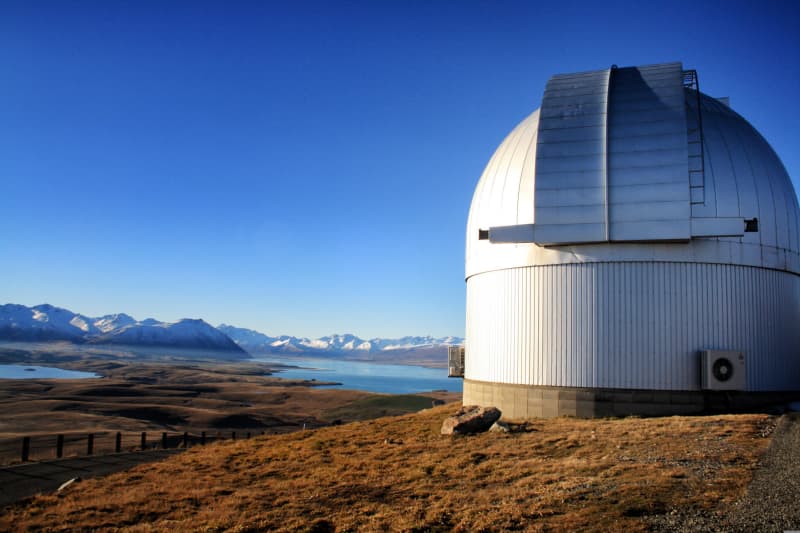
A large mirror is only part of the system. The quality of the observing site, the instruments attached to the telescope, and the technologies used to correct atmospheric distortion can be just as important.
Seven Major Optical and Infrared Telescopes
Keck Observatory: A Landmark in Segmented-Mirror Design
The W. M. Keck Observatory on Maunakea in Hawaii operates two 10-meter optical and infrared telescopes, Keck I and Keck II. Each primary mirror is built from 36 hexagonal segments that work together as a single reflecting surface.
When Keck I received its first astronomical light in 1990, its segmented-mirror design represented a major step forward in telescope engineering. Building a single solid 10-meter mirror would have been extremely difficult, so engineers instead created a precisely controlled mosaic of smaller mirror segments.
That approach later became central to the design of a new generation of giant telescopes.
Keck is also known for laser-guide-star adaptive optics and a wide range of powerful spectrographs. Its observations have contributed to major advances in the study of the supermassive black hole at the center of the Milky Way, exoplanets, distant galaxies, and the evolution of stars.
The Very Large Telescope: Four 8.2-Meter Telescopes Working Together
The European Southern Observatory’s Very Large Telescope, or VLT, is located at Paranal Observatory in Chile’s Atacama Desert. It consists of four 8.2-meter Unit Telescopes, supported by four movable 1.8-meter Auxiliary Telescopes.
Each of the four main telescopes can operate independently. They can also be linked through the Very Large Telescope Interferometer, or VLTI, allowing light from multiple telescopes to be combined.
This makes the VLT unusual: it is not simply one large telescope, but a flexible system that can switch between conventional observing and optical interferometry.
What Does the VLT's “Equivalent Aperture” Really Mean?
Descriptions of the VLT sometimes say that its four main telescopes are equivalent to a 16-meter telescope. That comparison needs some context.
In terms of total light-collecting area, four 8.2-meter mirrors do indeed gather roughly as much light as a single mirror around 16 meters across. But interferometry works differently.
When the telescopes are combined through the VLTI, the main advantage is not an increase in total light-gathering area. Instead, the wide separation between the telescopes provides much finer angular resolution. With sufficiently long baselines, the interferometer can resolve details far smaller than a single 8-meter telescope could distinguish.
That distinction between light-gathering power and angular resolution is important when comparing modern observatories.
Gemini and Subaru: Similar Apertures, Different Strengths
The International Gemini Observatory operates two 8.1-meter telescopes: Gemini North on Maunakea in Hawaii and Gemini South on Cerro Pachón in Chile.
Because the two observatories are located in opposite hemispheres, Gemini can access nearly the entire sky. This makes the pair especially valuable for programs that need broad sky coverage or follow-up observations of transient objects.
Gemini’s scientific work includes stellar evolution, exoplanets, supernovae, galaxies, and time-domain astronomy.
Nearby on Maunakea, the Subaru Telescope follows a different design philosophy. Operated by the National Astronomical Observatory of Japan, Subaru uses an 8.2-meter monolithic primary mirror and is especially well known for wide-field imaging.
Its Hyper Suprime-Cam has made Subaru a major tool for large-area surveys, helping astronomers study galaxy evolution, dark matter, and the structure of the distant universe.
The comparison between Gemini and Subaru is a good reminder that two telescopes with almost identical mirror diameters can be built for very different scientific goals.
Large Binocular Telescope: Two 8.4-Meter Mirrors on One Mount
The Large Binocular Telescope, or LBT, sits on Mount Graham in Arizona. Unlike most large observatories, it carries two 8.4-meter primary mirrors side by side on a single mount.
Together, the two mirrors collect as much light as a single telescope with an aperture of roughly 11.8 meters.
That figure, however, refers to equivalent collecting area. It does not mean that the LBT contains one physical 11.8-meter mirror.
The real advantage of the binocular design is that light from both sides can also be combined interferometrically. This gives the telescope access to much finer spatial detail than either 8.4-meter mirror could achieve alone.
Its combination of large aperture, adaptive optics, and interferometric capability makes the LBT especially useful for high-resolution studies of stars, planetary systems, and distant galaxies.
SALT and GTC: Two Different Approaches to 10-Meter-Class Astronomy
The Southern African Large Telescope, better known as SALT, is located near Sutherland in South Africa. Its primary mirror is made of 91 hexagonal segments and spans roughly 11 meters at its widest dimension.
SALT uses an unusual fixed-elevation design rather than moving like a conventional fully steerable telescope. This allows it to achieve a very large effective collecting area at lower construction cost, although it also means the telescope observes objects in a different way from most large observatories.
Its strength lies particularly in spectroscopy, where astronomers use it to analyze the physical properties of stars, galaxies, quasars, and transient events.
The Gran Telescopio Canarias, or GTC, takes another approach. Located at Roque de los Muchachos Observatory on La Palma in the Canary Islands, its 10.4-meter primary mirror consists of 36 hexagonal segments.
GTC remains one of the largest optical and infrared telescopes currently in operation. Its large collecting area and advanced instrumentation allow astronomers to study faint galaxies, stellar populations, exoplanet atmospheres, and compact objects.
Why Segmented Mirrors and Adaptive Optics Matter
Modern giant telescopes have reached a point where simply making a single solid mirror larger becomes increasingly difficult. Very large mirrors can deform under their own weight, and manufacturing, transporting, and supporting them becomes an engineering challenge.
Segmented mirrors solve part of that problem. Instead of building one enormous piece of glass, engineers assemble many smaller mirror segments and continuously adjust them so they behave like a single optical surface.
Active optics helps maintain the precise shape of large mirrors as gravity and temperature change during the night.
Adaptive optics tackles a different problem. Earth’s turbulent atmosphere causes starlight to blur and shimmer. Adaptive-optics systems measure those distortions and rapidly reshape a deformable mirror to compensate for them.
Together, these technologies allow modern ground-based telescopes to produce images far sharper than aperture alone would suggest.
What Comes After Today’s 8- to 10-Meter Telescopes?
The next step is already under construction.
The European Southern Observatory’s Extremely Large Telescope, or ELT, is being built in Chile with a 39-meter primary mirror made from 798 hexagonal segments. According to ESO’s current schedule, telescope testing and first-light observations are planned for 2029, with scientific instruments beginning operations around 2030.
The jump from 8- and 10-meter telescopes to a 39-meter observatory is not simply about collecting more light. The ELT is designed to combine enormous collecting area with advanced adaptive optics, allowing astronomers to study exoplanet atmospheres, the first galaxies, black holes, stellar populations, and the expansion history of the universe in unprecedented detail.
In that sense, telescopes such as Keck, VLT, Gemini, Subaru, LBT, SALT, and GTC are not being made obsolete. Their technologies helped make the next generation possible, and they will continue to operate alongside newer facilities.
What These Telescopes Tell Us About Modern Astronomy
Keck, VLT, Gemini, Subaru, LBT, SALT, and GTC represent several different approaches to building large ground-based optical telescopes. Some rely on segmented mirrors, others on thin monolithic mirrors. Some emphasize wide-field imaging, others spectroscopy, adaptive optics, or interferometry.
For beginners, the most useful lesson is not memorizing which telescope has the largest mirror. It is understanding what the main specifications actually mean. Aperture determines light-gathering power. Interferometric baseline affects angular resolution. Active optics keeps large mirrors properly shaped, while adaptive optics reduces the blurring caused by Earth’s atmosphere.
Today’s 8- to 10-meter telescopes remain at the forefront of astronomical research, while a new generation of 30-meter-class observatories is beginning to push ground-based astronomy even further.
Understanding the world’s largest optical telescopes, why observatories are built on high mountains, how segmented mirrors work, and what adaptive optics does gives a much clearer picture of modern astronomy than a simple ranking by mirror size ever could.