
If you stood at the North Pole, the northernmost point of the Earth, what would the night sky look like? Are the stars there the same as they are normally?
Actually, the night sky at the North Pole is completely different from other regions. Elsewhere on Earth, we are used to the stars rising in the east and setting in the west each day. But at the North Pole, the stars seem to revolve around the sky, never actually rising or setting.
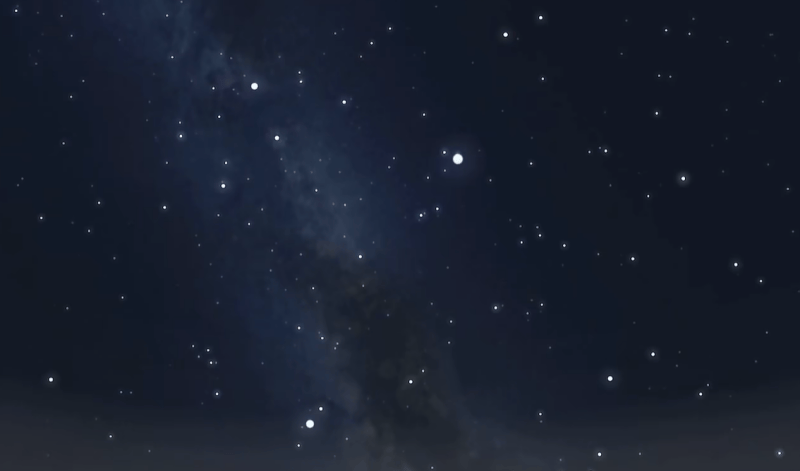
Why does the night sky look different at different latitudes?
The reason the night sky looks different at different latitudes on Earth is because the Earth is a sphere. The position of the stars in the sky changes with latitude. The closer to higher latitudes, the more prominent the northern stars become; conversely, the closer to the higher latitudes of the Southern Hemisphere, the more prominent the southern stars become.
For example, in the northern United States, people can usually see the Big Dipper hanging in the sky for a long time, while the southern constellations are rarely seen. As the location gets closer to the equator, this gradually changes. By the time you reach the equator, you can see almost all the constellations in the sky within a year. At the North Pole, only the northern constellations are visible, and vice versa at the South Pole.
At the North Pole, Polaris (the North Star) appears directly overhead.
If you stand at the North Pole, you'll find Polaris almost directly overhead.
This is because:
North Pole latitude = 90° North
Celestial Pole altitude = Observer latitude
At the North Pole, the North Celestial Pole is at approximately 90° overhead, and Polaris is near the North Celestial Pole, thus appearing to be in the center of the sky.
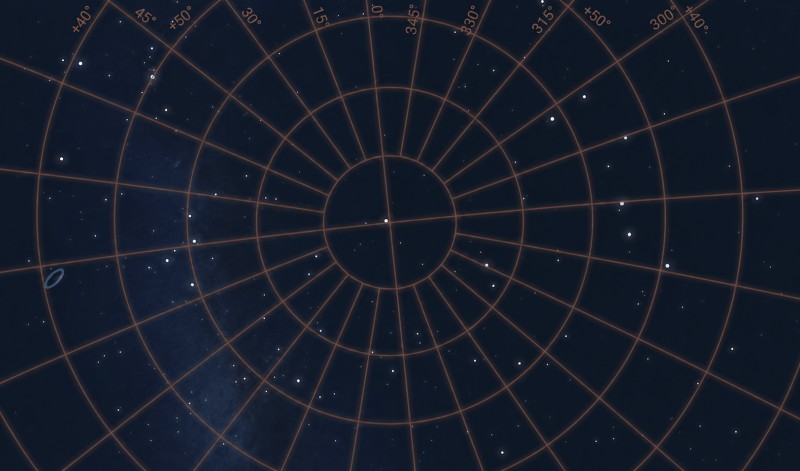
Why don't the stars at the North Pole rise in the east and set in the west?
In most parts of the Earth, due to the Earth's rotation, we see stars rise in the east and set in the west. However, at the North Pole, this is completely different.
Because the Earth's axis is almost directly aligned with Polaris during its rotation, the entire night sky revolves around the North Celestial Pole. Therefore, the stars we see form a circle in the sky, without crossing the horizon.
In other words:
Stars "circle"
But they don't "rise" or "set"
This phenomenon is called "diurnal apparent motion," but the diurnal motion at the North Pole is the most unique.
What would the night sky look like from the South Pole?
After understanding the question, "What does the night sky look like from the North Pole?", the situation at the South Pole is easy to deduce.
The North and South Poles are almost perfectly symmetrical:
Only the southern sky is visible from the South Pole
The northern sky is not visible
All stars also revolve in circles
Polar days and polar nights also occur.
Therefore, although the sky at the Earth's poles faces opposite directions, the astronomical laws are essentially the same.
Why can people near the equator see more stars?
Compared to the North and South Poles, the equatorial region is actually the place where "the most stars can be seen."
Because at the equator:
The celestial equator passes overhead
The northern and southern celestial regions appear alternately
Therefore, people living near the equator have almost the entire year's worth of opportunities to see all the major constellations. This is why many famous astronomical observation sites are located near low latitudes.