
When we look up at the night sky, do we feel as if the countless twinkling stars cover the entire universe? In reality, the night sky we see is only a tiny fraction of the infinite universe, and most stars visible to the naked eye do not originate from deep space, but rather from a small region within our Milky Way galaxy.
Almost all stars visible to the naked eye originate from the Milky Way galaxy.
According to current astronomical research, under ideal conditions, the human eye can see approximately 6,000 stars (globally), and almost all of these stars belong to the Milky Way galaxy.
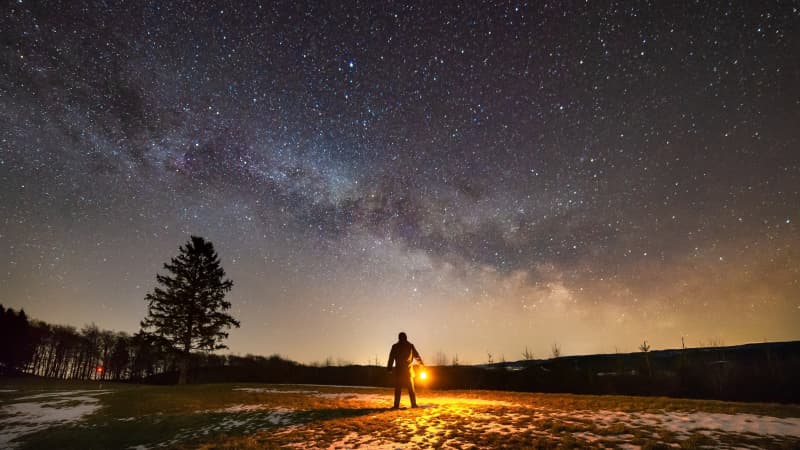
More specifically, most of the stars visible to the naked eye are located within a range of several hundred to a thousand light-years from Earth. Considering the Milky Way's diameter is approximately 100,000 light-years, these stars are essentially our "local neighbors" within the Milky Way.
There are very few exceptions, such as SN 1987A, which erupted in the Large Magellanic Cloud in 1987 and briefly reached naked-eye brightness at its peak. However, such transient astronomical events are extremely rare and do not represent the norm.
Can we see celestial objects outside the Milky Way with the naked eye?
While it's practically impossible to see individual stars outside the Milky Way with the naked eye, we can still see some entire celestial objects, such as the Andromeda Galaxy, which, under favorable conditions, can be seen directly as a blurry patch of light.
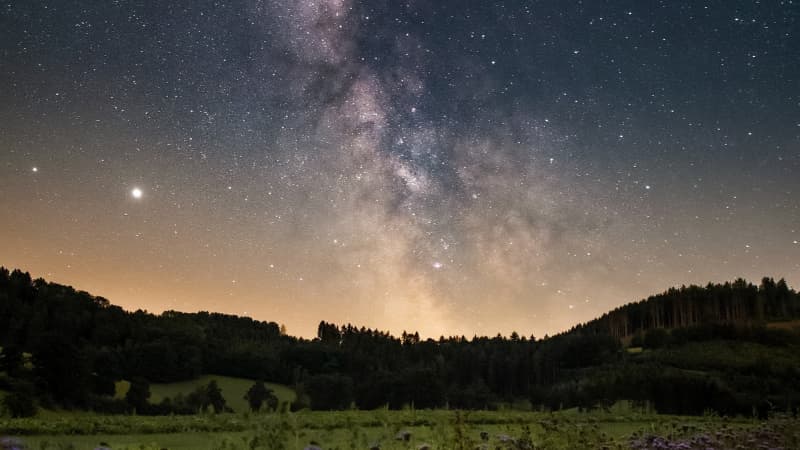
Furthermore, people in the Southern Hemisphere can see the Large and Small Magellanic Clouds. However, it's important to note that what we see is the entire galaxy, not just a single star within it. In simpler terms: the naked eye can see "other galaxies," but not "the stars within those galaxies."
Do all the stars in the night sky have names?
This is a very interesting topic. Since the number of stars visible to the naked eye is extremely limited, could we give each star a name?
Throughout human history, different civilizations have named the bright stars in the night sky. For example, the ancient Chinese star system, compiled over successive dynasties, has recorded the names of thousands of stars. Even in Western tradition, there are star naming systems based on Arabic and Latin.
In fact, from the perspective of modern astronomy, stars with official names actually constitute only a small fraction. The vast majority of stars, or the faintest stars, are simply numbers in star catalogs.
When we connect all the preceding information, we arrive at a complete picture: the night sky we see is actually only a very limited part of the Milky Way galaxy, and only a few stars within it have traditional names, but each has a specific scientific code in astronomy.