
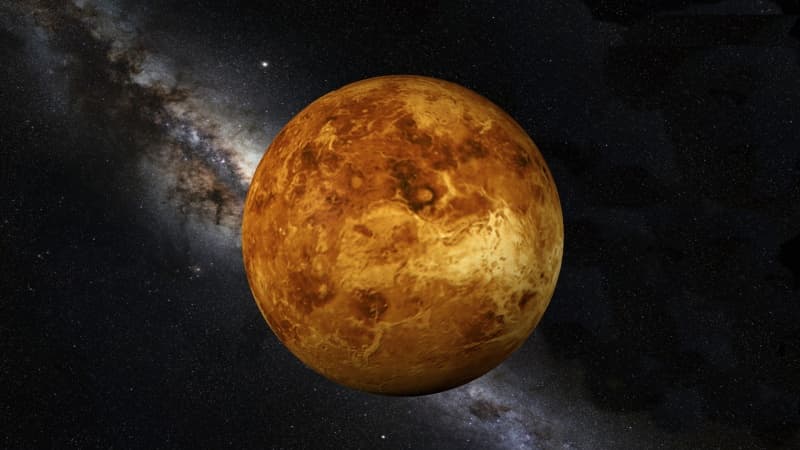
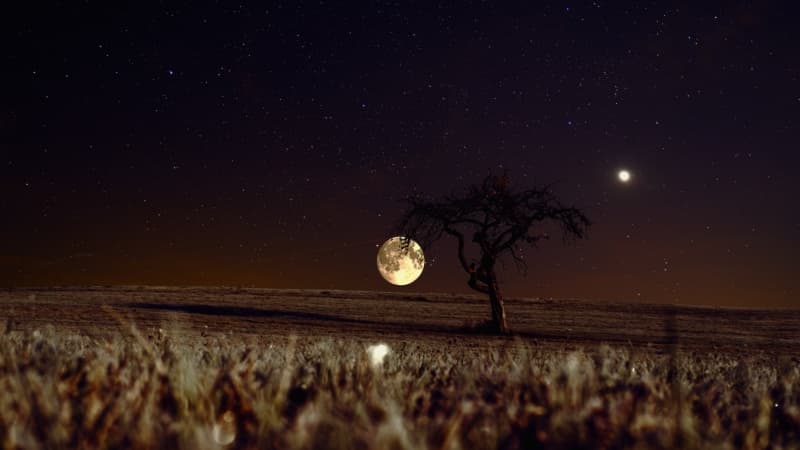
In the night sky, there is an exceptionally bright star that usually appears shortly after sunset in the western sky or low in the eastern sky before sunrise. Its brightness far surpasses that of surrounding stars, and it is clearly visible even in the light-polluted night sky of cities. This star is none other than Venus—the brightest planet in the night sky.
Even compared to Sirius, the brightest star, Venus's brightness is several times greater. Sirius's apparent magnitude is approximately -1.46, while Venus's magnitude can reach approximately -4.9. Therefore, from an observational perspective, Venus can be considered the second brightest celestial body in the night sky after the Moon.
When is Venus at its brightest?
Common sense dictates that Venus is brightest when it is in its "full phase" (completely illuminated like a full moon), but the reality is quite the opposite: Venus is not brightest when it is at its fullest fullness; rather, its brightness peaks when it appears in a "crescent shape." To understand this, we need to understand the two core factors affecting Venus's brightness: its visible area (apparent diameter) and the proportion of light illuminated portion (phase). Venus's brightness is the result of the combined effect of these two factors.
Like the moon, Venus also experiences phase changes, a phenomenon known in astronomy as "phase variation." This is because Venus is located inside Earth's orbit, making it a typical "inner planet." Like Earth, Venus revolves around the sun, and the "phase variation" of Venus as seen from Earth is the continuous change in the portion of Venus illuminated by the sun.
This "phase change" of Venus was first observed and recorded by Galileo using a telescope in the 17th century, and it was one of the important pieces of evidence supporting the heliocentric theory at the time. The phase changes of Venus are indistinguishable to the naked eye, but through an astronomical telescope, one can clearly see its entire process from "full phase" to "crescent moon," and then to "slim crescent moon."
How does Venus's brightness change?
First, a key point: Venus's brightness depends not only on the proportion of its illuminated surface but also on how large the object appears.
(1) Why is "full phase Venus" not bright?
When Venus is on the opposite side of the Sun, its visible surface on Earth is fully illuminated, equivalent to a "full moon" state. However, at this time, Venus is farthest from Earth, so its apparent diameter in the sky is very small. Therefore, even in the "full phase" state, its brightness is not at its peak.
(2) Why is "Crescent Venus" Brightest?
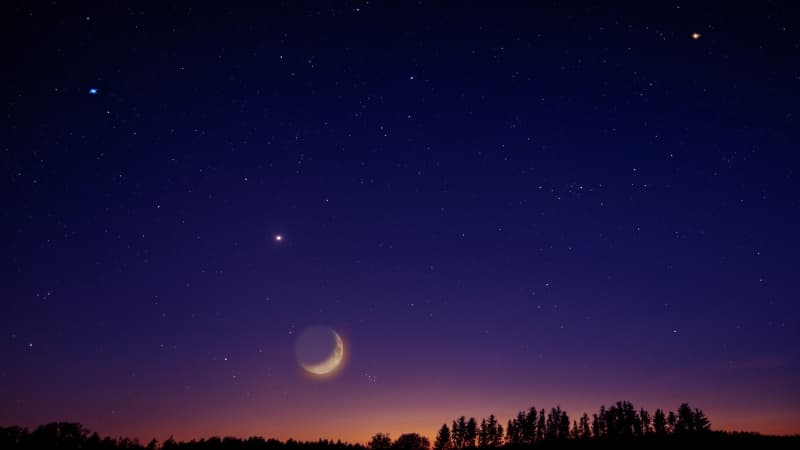
As Venus moves closer to Earth along its orbit, its apparent diameter gradually increases, making it appear "larger." Simultaneously, its phase changes from full phase to crescent, and then to full phase again. Although the proportion of Venus illuminated decreases, its overall brightness actually increases because Venus is closer to Earth in the solar system.
When Venus's phase is approximately 20% to 30%, its brightness reaches its peak. During this phase, Venus exhibits a distinct crescent shape. However, due to its moderate distance from Earth, the combined effect of its illuminated area × apparent diameter is maximized. This is why observers perceive Venus as brightest during its "below crescent" phase.
(3) Why is Venus not at its brightest during the "New Moon" phase?
If Venus continues to approach Earth, its apparent diameter will increase further. However, at this time, Venus's phase will become very thin, similar to a "new moon" state. In extreme cases, it may even appear as a "ring-like" structure (due to light scattering in its atmosphere).
Although Venus appears very large at this time, its brightness actually decreases because its visible bright side is at its smallest. Therefore, Venus is always brightest during the phase of approaching but not yet reaching inferior conjunction, not near perigee.
What is the periodic variation in Venus's brightness? Venus orbits the Sun approximately every 224.7 days, and its synodic period relative to Earth is about 584 days. During this period, Venus's brightness undergoes the following changes:
Superior conjunction (farthest point, full phase) → Lower brightness
First quarter phase → Gradually increasing brightness
Crescent phase → Reaching its brightest point
Approaching inferior conjunction → Brightness decreases again
Therefore, Venus experiences a period of peak brightness approximately every 1.6 years, which is the best time for amateur astronomers to observe and photograph it.
Why are Venus's brightness variations not noticeable to the naked eye?
Astronomical data shows that Venus's brightness varies greatly, ranging from approximately -2.9 to -4.9 in one cycle. However, the human eye's perception of brightness is logarithmic, so the actual visual perception is not as dramatic as the astronomical data suggests. Furthermore, Venus itself is very bright, so in most cases, people only perceive it as consistently bright without actually observing the specific variations in its brightness.
Observation Tips: When is Venus Brightest to See?
In actual observation, Venus is usually brightest at:
Shortly after sunset (as the "evening star")
Before sunrise (as the "morning star," also known as the "morning star") The best time to observe Venus is usually when the sun has just set or is about to rise, when the sky is relatively dark but Venus is still high in the sky, providing the best viewing experience.