
Many people are curious about our Milky Way galaxy, and beginner astronomers often ask the same question during their first astronomical observation: How can I observe the Milky Way? Why can other astronomers find it so quickly, while I can't?
Actually, the Milky Way isn't "invisible," but rather it requires the right time, location, and environmental conditions to be clearly seen. If the method is incorrect, even if you look up all night, you'll only see scattered stars.
In this article, I will explain in detail the best time, location, and techniques for observing the Milky Way, helping novice astronomers quickly get started with stargazing and gradually master the correct techniques for observing the Milky Way.

First, what is the Milky Way, and why is it usually difficult for us to see it?
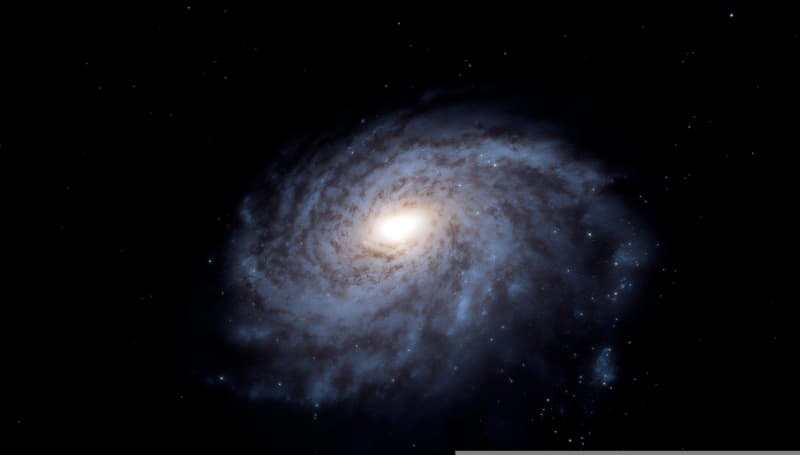
Before learning how to observe the Milky Way, we first need to understand what the Milky Way is: The Milky Way we see is actually our own galaxy. From Earth's perspective, it is a pale white band of light stretching across the night sky. This band is actually composed of billions of stars, but due to its extreme distance, we can only see a hazy, bright band as a whole.
Many people cannot see the Milky Way in the night sky, not primarily because they "can't find it," but because environmental conditions are unfavorable. Light pollution is particularly severe in modern cities; even without cloud cover, few stars are visible in urban areas at night, let alone the Milky Way. Moonlight is also a significant interfering factor. On nights with a full moon or near a full moon, sky brightness increases significantly, reducing the visibility of the Milky Way and further increasing the difficulty of observation.
Therefore, if novice astronomers want to observe the Milky Way, they must first accept the reality that it cannot be seen at any time or in any place. They must actively seek out and create suitable observation conditions.
The Best Time to Observe the Milky Way
Of all the factors affecting Milky Way observation, time is the most easily overlooked yet most crucial. Knowing the optimal time for observation can significantly increase the success rate.
The Milky Way cannot be observed year-round. If you are in the Northern Hemisphere, the Milky Way observation season is from March to October, with June to August being the best time. During this period, the core region of the Milky Way is brighter and easier to see with the naked eye.
From a 24-hour perspective, the Milky Way typically rises gradually several hours after sunset, reaching its optimal observation position late at night, particularly between 10 PM and 2 AM, when the sky is darkest and interference is minimal—the prime time for Milky Way observation.
Additionally, it's crucial to consider the influence of the lunar phase, especially during the peak observation season. If the chosen observation day coincides with a full moon, the Milky Way will become difficult to discern due to its intense moonlight. Therefore, it's advisable to check the lunar phase information beforehand and prioritize clear days around the new moon to obtain a more ideal dark environment.
Therefore, to increase the success rate of observation, the following conditions must be met simultaneously: correct season + midnight + no moon or weak moonlight + cloudless weather.

How to Choose the Best Location for Observing the Milky Way
Equally important as the observation time is choosing the location, especially in modern times. Light pollution is the biggest obstacle to observing the night sky because city lights brighten the background, obscuring the Milky Way, a distant and relatively faint band of light. Therefore, if you choose an observation location in a city, you are almost certain to miss seeing the brilliant Milky Way. The truly suitable location for Milky Way observation must be far from light pollution.
Ideal choices are mainly mountainous areas, beaches, grasslands, and rural areas far from cities. These places have very little light pollution and a darker environment, which significantly improves the contrast of the Milky Way at night, making it much clearer.
Besides avoiding light pollution, you should also choose a location with a wide field of view, avoiding obstructions from mountains, buildings, and trees to obtain a more complete view of the Milky Way. Before deciding to go for observation, you can use light pollution maps and navigation software to filter your destination and find more suitable observation areas.
In preparing for Milky Way observation, location selection is far more important than equipment. A suitable dark environment is far more valuable than purchasing expensive gear.
How to Observe the Milky Way: Essential Skills for Beginners
After determining the appropriate time and location, the next step is to develop a specific observation method. For a beginner, mastering some basic skills is essential to improving the efficiency of successful Milky Way observation.
First, once at the chosen observation point, allow your eyes sufficient time to adapt to the darkness. The human eye takes approximately 15-20 minutes to adjust, gradually increasing its sensitivity to low light. During this adaptation process, avoid using mobile phones or looking directly at strong light sources, as this will significantly hinder your eyes' adaptation to darkness.
Second, don't try to find a single star. Instead, look for the band of light across the entire sky. The Milky Way is not just a point, but a blurry bright band spanning the night sky, appearing like a faint cloud. Given sufficient darkness, the band of light reflected from the Milky Way is relatively easy to identify.
Another method is to locate it by constellations. The Milky Way usually passes through some obvious constellation regions, such as Cygnus, Aquila, and Sagittarius. Identifying these constellations can roughly determine the Milky Way's location. However, this method is not very beginner-friendly, as beginners often struggle to recognize all the constellations in the sky initially.
If the above observation methods are still difficult, you can use stargazing tools, such as mobile star chart apps or star maps. These tools can display the Milky Way's position in real time and are very user-friendly for beginners.
Frequently Asked Questions: Why can't I see the Milky Way even after following the above methods?
If you have followed the above tutorial and still cannot see the Milky Way, you should check the following factors: First, light pollution. If the observation location is still affected by city lights, the Milky Way may be completely invisible. Second, weather conditions, such as clouds, fog, and poor air quality, also greatly affect the observation results. Third, the timing of the observation may be inappropriate.
Furthermore, beginners often lack patience, not giving their eyes enough time to adjust to the sky, and not taking the time to search patiently. The Milky Way is not something that can be seen at a glance; it requires a gradual process of adaptation and observation.
Mastering the right method is more important than any equipment.
Now, to answer the initial question: how can one observe the Milky Way? The answer is actually quite simple. It's not about needing complicated equipment, but about using the right method. As long as you choose the right time, find a location far from light pollution, and master certain observation techniques, you have a great chance of seeing the Milky Way with your own eyes.
For beginners, the first successful observation of the Milky Way is often awe-inspiring, leaving them understanding why so many people are captivated by the starry sky.