
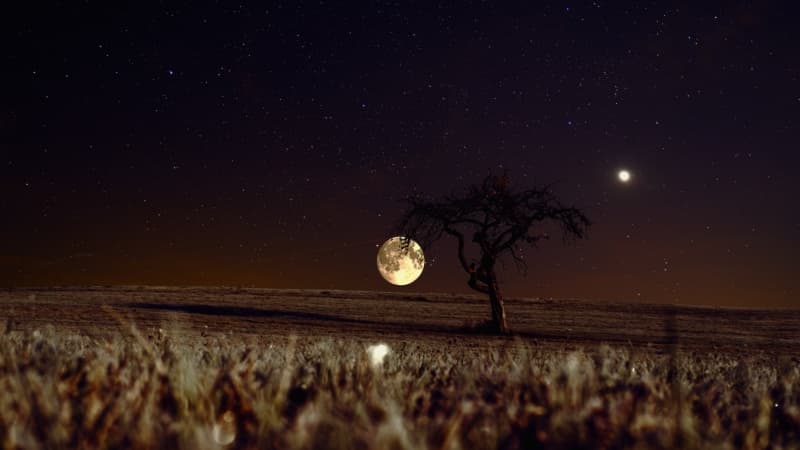
The night sky offers a spectacular array of sights from late June through early July. This week features the annual "Strawberry Moon," and Mercury will enter retrograde at the end of the month, while brilliant Venus continues to shine in the western sky. Additionally, the center of the Milky Way is rising to its optimal position for viewing; for stargazers in North America, this is an observation window not to be missed.
Let’s take a look at the most noteworthy celestial events for each day this week.
June 26: Hunting for the Wild Duck Cluster (M11)
This week’s stargazing can begin with the famous **Wild Duck Cluster (M11)**. Although moonlight from the waxing gibbous moon may affect deep-sky observations, this open cluster in the constellation Scutum remains visible through binoculars or a small telescope.
Located approximately 6,000 light-years from Earth, M11 is composed of a vast number of young stars. It derives its name from its overall shape, which resembles a flock of wild ducks in flight, and it is one of the easiest clusters to observe in the summer Milky Way.
If the night sky is clear, try observing the cluster at different magnifications; you will discover a remarkably dense concentration of stars at its center, creating a truly spectacular visual effect.
June 27: A Close Encounter Between Mars and the Pleiades
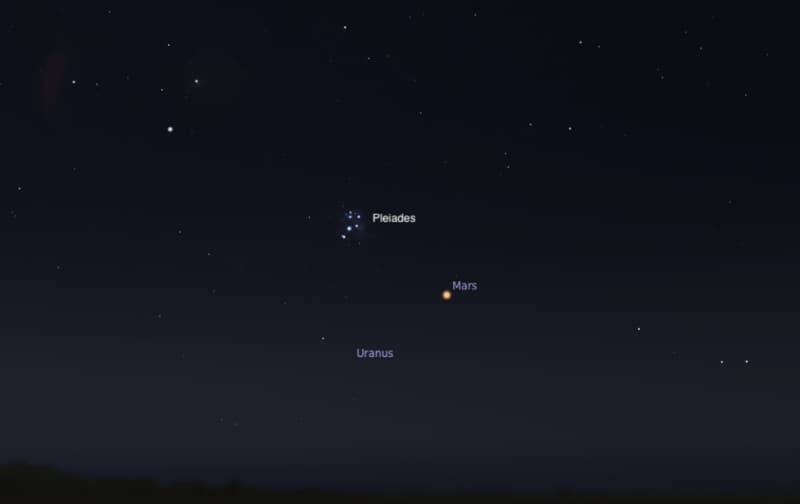
An exquisite celestial meeting will grace the eastern sky in the early morning.
Mars has moved into the vicinity of the constellation Taurus, positioning itself less than 5 degrees away from the famous **Pleiades star cluster (M45)**. Although Mars has a magnitude of only about 1.3, its vivid orange-red hue remains striking, creating a sharp contrast with the Pleiades, which resemble a glittering cluster of blue-white diamonds.
For the best viewing experience, start observing about 90 minutes before sunrise from a location with an unobstructed view of the eastern horizon.
June 28: Mercury Ends Direct Motion and Prepares to Go Retrograde
The most notable planetary event of the week occurs on June 28.
On this day, Mercury will reach a "stationary" point before beginning its retrograde motion. This marks a change in its apparent direction of movement relative to the background stars; it is not actually moving backward, but rather exhibiting a visual phenomenon caused by the differing orbital speeds of Earth and Mercury.
Shortly after sunset, provided the western horizon is sufficiently clear, there is a chance to spot Mercury low in the sky. Jupiter and Venus are also visible nearby, adding highlights to the evening sky.
Given Mercury's low altitude, it is recommended to wait until the sun has fully set before observing with binoculars to ensure safety.
June 29: June's "Strawberry Moon" Illuminates the Night Sky
The highlight of this week's astronomical events is undoubtedly the "Strawberry Moon."
The name "Strawberry Moon" does not imply that the moon actually appears pink; rather, it stems from a traditional Native American name for the June full moon, marking the season when strawberries ripen.
The full moon will rise shortly after sunset and remain visible throughout the night near the constellation Sagittarius. While the bright moonlight may hinder observations of the Milky Way and deep-sky objects, it offers an excellent opportunity to view lunar features such as the maria (dark plains), impact craters, and the prominent ray system surrounding the Tycho crater.
With a telescope of moderate magnification, one can also observe in detail the interplay of light and shadow across different regions of the lunar surface.
June 30: A Challenge to Observe Neptune
In the early hours of the day, Neptune rises higher in the sky, offering a challenging opportunity for experienced observers.
Located near the constellation Pisces, Neptune has a magnitude fainter than 8; it is invisible to the naked eye and requires binoculars or an astronomical telescope for viewing. To locate it, one can first find the brighter planet Saturn and then gradually shift the view toward the area where Neptune is situated.
Because Neptune has an extremely small apparent diameter, it typically appears through a telescope as nothing more than a tiny dot with a pale blue hue. Nevertheless, for deep-sky enthusiasts, successfully identifying this distant ice giant remains a highly rewarding experience.
July 1: Venus Remains the Brightest Planet in the Night Sky
As July begins, Venus continues to be the most dazzling celestial object in the evening sky.
About an hour after sunset, Venus hangs high in the western sky, gradually drawing closer to Regulus, the brightest star in the constellation Leo. The gap between the two will narrow further over the coming days, offering an excellent opportunity for photography enthusiasts.
Viewed through a telescope, Venus reveals distinct phases—appearing not merely as a bright point of light, but showing a clear crescent or gibbous shape.
July 2–3: The Galactic Center Enters Its Prime Viewing Season
The latter half of this week marks the peak time for observing the summer Milky Way.
Around midnight, the Milky Way stretches across the southern sky, with its core—the center of our galaxy—positioned near the constellation Sagittarius. Away from urban light pollution, the naked eye can discern a milky-white band of light spanning the heavens.
Slowly scanning the Milky Way with binoculars reveals a wealth of nebulae, star clusters, and dark nebulae. The region near Sagittarius, in particular, is rich in deep-sky objects, making it one of the most rewarding areas to explore during the summer.
For those planning to photograph the Milky Way, it is best to choose a moonless night—or one where the moon rises late—and travel to a location with a Bortle Class 4 (or darker) sky to achieve the best results.
Stargazing Recommendations for the Week
Overall, this week features significant celestial events—such as the "Strawberry Moon" and Mercury in retrograde—alongside spectacular sights like Mars appearing alongside the Pleiades, Venus approaching Regulus, and the Galactic Center entering its prime viewing period.
For casual stargazers, the full moon, Mars, and Venus offer the easiest viewing opportunities; meanwhile, astronomy enthusiasts with telescopes can take on the challenge of observing the M11 Wild Duck Cluster, Neptune, and the rich array of deep-sky objects within the summer Milky Way.
We recommend checking the local weather forecast in advance, avoiding areas with cloud cover or light pollution, and having binoculars or a telescope ready. The night sky this week promises a rich and memorable viewing experience.