
This week's night sky is something astronomy enthusiasts can look forward to. From Venus and Jupiter in the western sky at dusk to Saturn and Mars rising before dawn, there are celestial events to observe almost every day. Meanwhile, the slender crescent moon will gradually return to the night sky this week, forming a spectacular "planetary conjunction" with Venus and Jupiter. For those who enjoy stargazing, photography, or planetary observation with telescopes, this week is undoubtedly one of the most exciting observation windows in May.
In addition to the bright planets, this week will also feature a moonless night ideal for deep-sky observation. Although the Milky Way is not yet at its peak, zodiacal light, the Beehive Cluster, the Whale Galaxy, and transits of Jupiter's moons are all worth paying close attention to. If you are new to astronomy, this week is also an excellent opportunity to learn about the spring night sky and the ecliptic plane.
Below, we will provide a detailed summary of the most noteworthy stargazing and planetary observation events of the week, organized by date.
May 15th: Discovering Crater in the Spring Sky
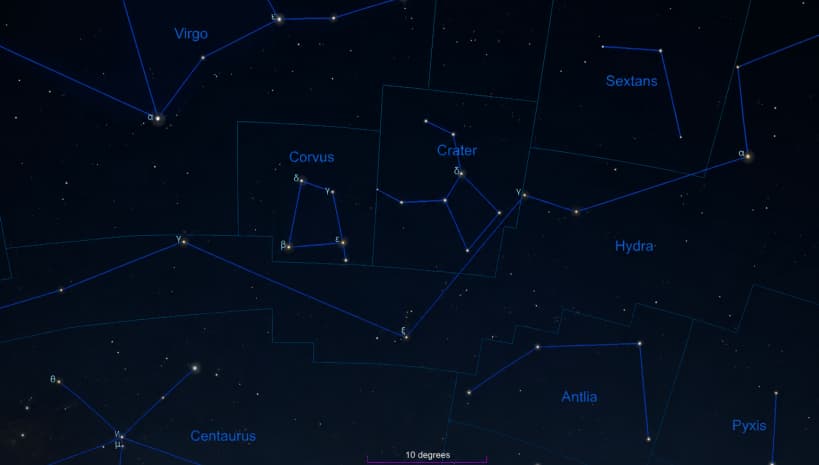
This week's observations can begin with a constellation unfamiliar to many—Cradle. While not small, its overall brightness is low, making it easily overlooked in the light pollution of North American cities. However, on clear, moonless nights, it remains one of the most representative southern constellations in the spring sky.
About an hour after sunset, Crater will appear at an altitude of approximately 30° in the southern sky. It lies below Virgo and near the tail of Corvus and Leo. Since this region lacks particularly bright stars, it's recommended to first locate the more easily identifiable Leo and then gradually move south.
The most famous star in Crater is Alkes (α Crater), but the truly brighter one is Delta Crater. When observed with binoculars, you'll find that although not dazzling, its distinctive "cup" shape is still quite noticeable in the absence of city lights.
For those just beginning to learn about the night sky, spring is an excellent time to practice constellation location. Compared to the dense and complex stellar distribution in the Milky Way during winter, the spring night sky is much simpler, making the relationships between many constellations easier to discern.
May 16th: New Moon Arrives, Optimal Window for Deep-Sky Observation
One of the most important changes in observation conditions this week is the arrival of the new moon.
Because moonlight significantly reduces the brightness of the night sky background, the period around each new moon is a golden time for deep-sky object observation. For those who enjoy observing galaxies, nebulae, and star clusters, this weekend presents a highly worthwhile deep-sky window in May.
One of the recommended deep-sky targets this week is the Whale Galaxy NGC 4631 in the constellation Canes Venatici. This is a typical side-spiral galaxy, approximately 25 million light-years from Earth. Because we observe it almost from the side, it appears elongated and slightly curved, resembling a whale floating in space.
With telescopes larger than 8 inches, its darker internal dust lanes can be faintly seen. Under favorable observation conditions, its nearby companion galaxy, NGC 4627, can also come into view at the same time.
For observers in North America, visibility will be generally good late this week. If you are in a clear area away from urban light pollution, the galactic core, while not yet fully elevated, is already ideal for observation in the spring galactic region.
May 17: Zodiacal Lights Offer Their Last Observation Opportunity in May
As spring draws to a close, this week is also one of the important windows for observing zodiacal light in the Northern Hemisphere.
Zodiacal light is a very special astronomical phenomenon. It is neither the Milky Way nor the aurora, but rather a soft glow formed by sunlight being scattered by dust from the inner solar system. This dust mostly originates from cometary activity and asteroid collisions and has accumulated near the ecliptic plane for a long time.
About an hour after sunset, if you are in an area with low light pollution, try looking for a faint, cone-shaped band of light on the western horizon. This light usually extends upwards along the ecliptic, and Venus and Jupiter are located near the ecliptic this week, so they can actually help you locate the zodiacal light more easily.
Many people who see zodiacal light for the first time mistake it for city lights or reflections from thin clouds. However, in truly dark skies, zodiacal light appears as a very soft and uniform bright white glow.
As May ends, zodiacal light gradually becomes increasingly difficult to observe, and the next better viewing season will be in the pre-dawn skies of late summer and early autumn.
May 18-20: The Moon, Venus, and Jupiter in a Consecutive "Planetary Conjunction with the Moon"
The most suitable celestial event for casual stargazers this week is undoubtedly the consecutive conjunctions of the Moon with Venus and Jupiter.
On the evening of May 18, a very slender crescent moon will appear low in the western sky, approaching Venus, the brightest planet in the night sky. Because Venus's brightness is close to magnitude -4, it will remain extremely conspicuous even in urban environments.
This day is ideal for photography. The slender crescent moon and bright Venus hanging simultaneously in the twilight sky is a classic example of an "easy-to-observe, high-visibility" celestial event.
On May 19 and 20, the Moon will continue its eastward movement, gradually approaching Jupiter. At that time, the Moon, Venus, and Jupiter will together outline the ecliptic plane.
This is actually a great observation opportunity for those just beginning to learn about the structure of the solar system because:
Venus
Jupiter
The Moon
They are almost all located near the main plane of the solar system, so they will align along the ecliptic.
Using binoculars, you can also try to find the open cluster M35 near Venus, and the Beehive Cluster M44 in Cancer. These targets can be observed beautifully even with small telescopes.
May 21: Saturn Begins to Dominate the Pre-Dawn Sky
If you're willing to get up early, the pre-dawn sky in the latter half of this week is equally spectacular.
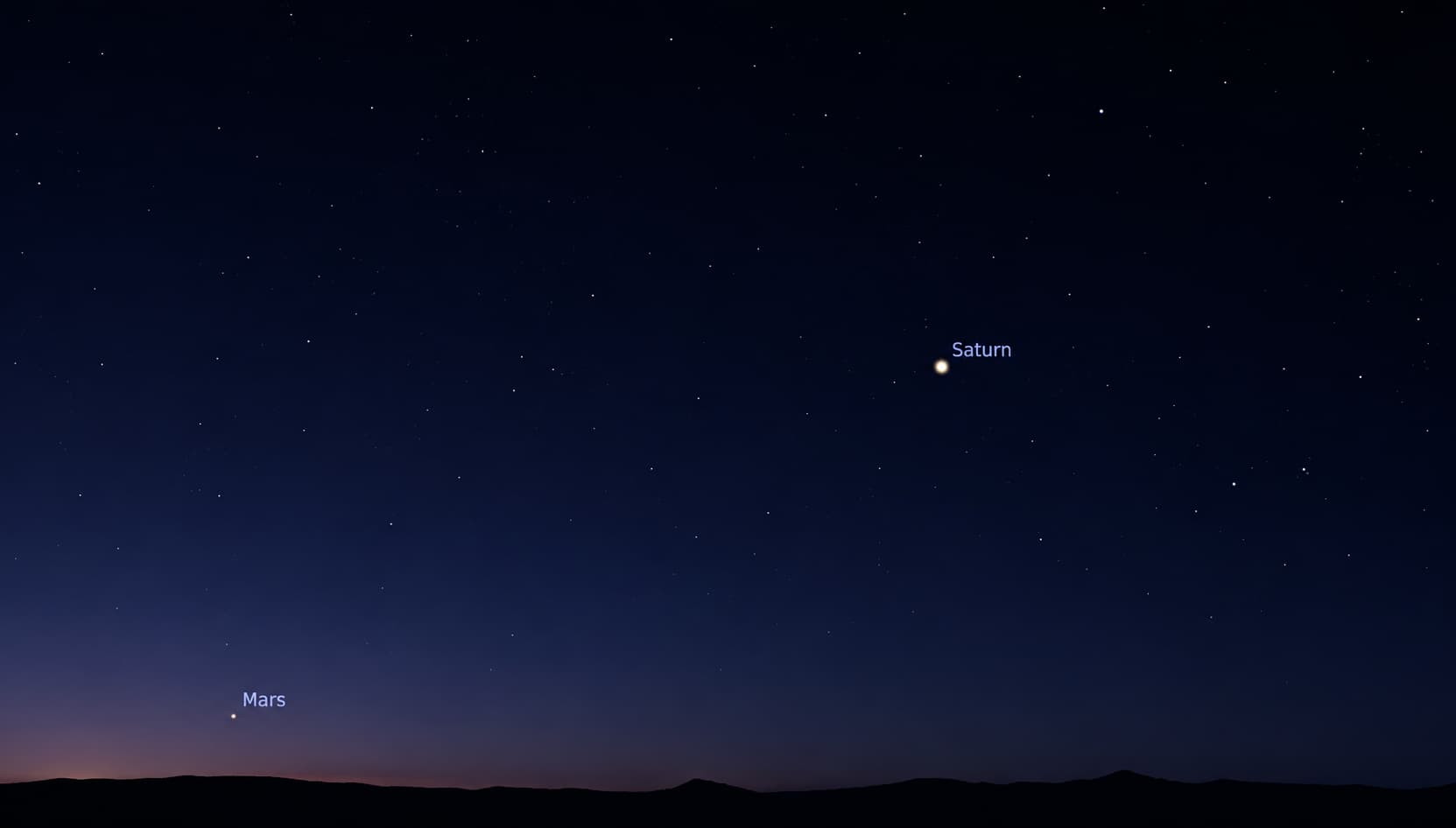
Saturn is now gradually entering a better observation position. After 4 a.m., it will appear low in the eastern sky and become one of the brightest objects in that region.
Compared to Jupiter and Venus, Saturn's greatest charm still comes from its spectacular ring system. Even with an entry-level telescope, the ring structure surrounding Saturn can be clearly seen. Meanwhile, Mars is gradually returning to the morning sky. However, due to its current distance from Earth, its apparent diameter remains small, and observational details are limited.
For observers in North America, late May marks the beginning of the summer Milky Way's rising phase. If the weather is stable and atmospheric transparency is high, observing the Milky Way and Saturn simultaneously in the early morning would be a truly worthwhile experience.
May 22: Jupiter's Moon Transit Reaches Weekly Climax
The most "telescopically valuable" event of the week will occur on the evening of May 22nd.
One of Jupiter's greatest charms is its four easily observable Galilean moons:
Io
Europa
Ganymede
Callisto
This week, two of these moons will transit Jupiter's surface consecutively.
A "transit" occurs when a moon passes in front of Jupiter and casts a shadow on the surface of Jupiter's clouds. With a medium-sized telescope, you can even see these small, dark shadows moving slowly.
This observational experience is truly breathtaking for many astronomy enthusiasts. You'll realize you're observing a "solar eclipse" on another planet in real time.
For observers on the west coast of North America and in Hawaii, the viewing conditions for this double transit of moons are particularly excellent.
This Week's Stargazing Summary: One of the Most Worthwhile Weeks to Observe in May
Overall, this week almost simultaneously offers:
Planetary Observation
Deep Sky Observation
Zodiacal Light Observation
Planetary conjunction with the Moon
Transit of Jupiter's Moons
and many other important observation themes.
Whether you're a beginner stargazing or an experienced enthusiast with a telescope, this week is well worth taking the time to carefully observe the night sky.
Especially:
Venus and the Moon in the same frame
Transit of Jupiter's Moons
Zodiacal Light
Saturn Dawn Observation
These phenomena all offer excellent viewing conditions in late May.
For many, their true love for astronomy often begins with a single, extraordinary sight in the night sky. This week's skies provide just such an opportunity.