
It is now September; if you look toward the eastern or southeastern sky before dawn in the Northern Hemisphere, you will encounter a bustling celestial scene. Orion has returned to the morning sky, and the stars Castor and Pollux in Gemini stand out prominently. The orange-red planet Mars is passing near Gemini, while lower down, Jupiter shines far more brightly than ordinary stars.
At the same time, the Winter Triangle—formed by Sirius, Procyon, and Betelgeuse—has already appeared, and the famous M44 Beehive Cluster can be spotted in the direction of Cancer. This September pre-dawn sky is unique because, while summer has not yet fully ended, constellations characteristic of winter have already made an early appearance before sunrise, offering an excellent opportunity for beginners to learn about seasonal constellations, planetary motion, and open star clusters.
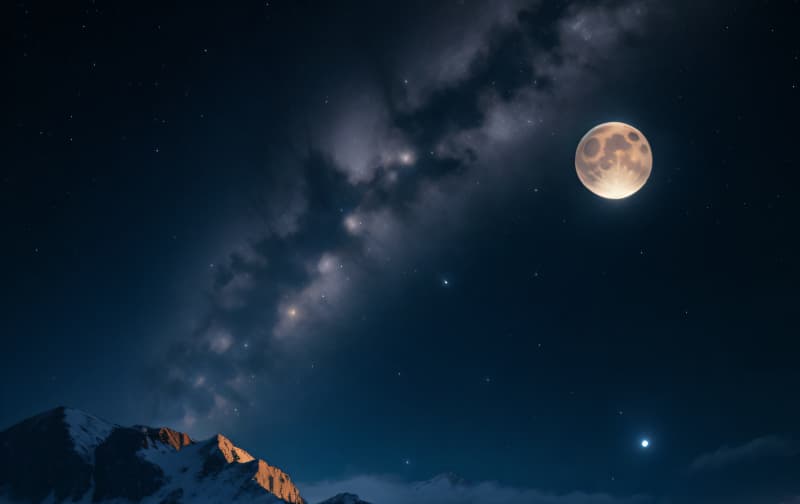
Why is Orion already visible in the early mornings of September?
Orion is a famous winter constellation in the Northern Hemisphere, so many novice stargazers often wonder why it can already be seen in September. The reason is actually quite simple: due to Earth's orbit around the Sun, any given star rises approximately four minutes earlier each day than it did the day before. By late summer and early autumn, winter constellations begin to rise after midnight, though at this stage, they appear primarily during the late-night hours and before dawn.
By September, Orion rises to a higher position in the eastern sky; the most easily recognizable feature remains the three stars of Orion's Belt, which form a nearly straight line. These three stars serve as one of the most reliable guideposts for navigating the winter sky, as tracing a line outward from them leads to other bright celestial objects, such as Betelgeuse, Sirius, and the constellation Taurus.
Why does Mars appear near the constellation Gemini?
In the autumn sky, Mars is visible in the morning near Gemini, forming a striking grouping with the stars Castor and Pollux. Unlike fixed stars, which remain stationary within a constellation, Mars moves continuously along a path near the ecliptic as it orbits the Sun alongside Earth. From our perspective on Earth, Mars slowly shifts its position relative to the background stars.
Around September 25–26, Mars, Pollux, and Castor will align in a nearly straight line before dawn, and all three will be visible to the naked eye. With apparent magnitudes of approximately 1.2 for Mars, 1.1 for Pollux, and 1.6 for Castor, their brightness levels are quite similar; however, Mars typically displays a distinct orange-red hue. This color difference serves as a helpful visual aid for beginners to grasp the observational concept that planets move while the background stars remain essentially stationary.
Why is Jupiter more conspicuous than Sirius?
In the dawn sky, Jupiter stands out even more than Mars. Around mid-September each year, Jupiter shines brightly as a morning star with a magnitude of approximately −2; consequently, it appears brighter than Sirius—the brightest star in the entire sky—even when the latter is nearby.
Jupiter’s brightness comes from reflected sunlight; thanks to its immense size and brilliant cloud layers, it remains one of the most prominent objects in the night sky, despite being much farther from Earth.
What is the Winter Triangle?
As dawn approaches, the Winter Triangle—formed by Sirius, Procyon, and Betelgeuse—can still be identified in the eastern and southeastern sky. It is not an official constellation but rather a large asterism spanning three constellations: Canis Major, Canis Minor, and Orion.
Betelgeuse, distinctively orange-red, is located at Orion's shoulder; Procyon is the brightest star in Canis Minor; and Sirius, situated in Canis Major, is the brightest star in the night sky. Together, these three bright stars form a massive triangle that serves as an excellent reference point for navigating the winter night sky.
The reason it is visible only during the latter half of the night in September is that the Winter Triangle has not yet appeared in the evening sky. As autumn progresses, this trio of stars rises earlier each day, eventually becoming one of the most prominent features of the night sky during winter.
Why does the M44 Beehive Cluster look like a patch of mist?
Located in the constellation Cancer, the M44 Beehive Cluster—also known as Praesepe—is another excellent target for observation with binoculars. It is an open cluster containing approximately 1,000 stars and lies about 600 light-years from Earth. Under sufficiently dark skies, M44 appears to the naked eye merely as a fuzzy, wispy patch of light.
When viewed through binoculars, however, this "mist" quickly resolves into a multitude of tiny stars—a striking visual contrast. Ancient Chinese astronomers referred to this hazy celestial object as *Jishiqi* (Exhalation of Piled Corpses), and it is situated within the "Ghost Mansion" (Gui) lunar mansion. In mid-September 2026, M44 remains an early-morning target; as the months progress, it will rise earlier, making it increasingly easier to observe during the autumn and winter seasons.
How can you use these targets to get to know the dawn sky in September?
If you are observing the eastern sky at dawn in September for the first time, there is no need to try to identify every constellation right away. The most practical approach is to start by locating Orion's Belt, as the three neatly aligned bright stars are very easy to spot; then, look for the nearby orange-red star Betelgeuse, and trace a line downwards to find the brilliant Sirius. Next, turn your attention to Gemini; use Castor and Pollux to identify the area where Mars is located, and then look for the even brighter Jupiter. Finally, if the sky is dark enough, you can use binoculars to search for the Beehive Cluster (M44) in Cancer. This route connects Orion, Gemini, Mars, Jupiter, the Winter Triangle, and M44, making it much easier to develop a spatial sense of the entire sky than simply memorizing the coordinates of individual stars.