
For North American astronomy enthusiasts, the night skies from late May to early June 2026 are exceptionally valuable for observation. This week not only features a rare "Blue Moon," but also Mercury's best viewing window of the year, Jupiter's close alignment with Gemini, Mars and Saturn appearing together in the same frame at dawn, and numerous deep-sky targets ideal for binoculars and telescopes.
If you're looking for "what stars to observe this week," a "June 2026 star guide," or "the best time for stargazing in North America," then this week's night skies are definitely worth paying close attention to. Whether you're a beginner to astronomy or a seasoned deep-sky photographer with an equatorial mount and a large-aperture telescope, you'll find targets to record in this week's night skies.
May 29: Optimal Observation Window for the Cancer Binary System
On the evening of May 29th, the constellation Cancer will still be visible in the western sky, offering one of the last opportunities to observe this spring constellation before it completely fades from view.
To the upper left of Gemini, a distinct inverted Y-shaped star cluster can be found, the most noteworthy of which is the binary system—Iota Cancri. This is a classic color-contrast double star, ideal for beginners in North America using small refracting telescopes.
Its most distinctive feature is the clearly different colors of its two member stars: one is golden yellow, while the other has a pale blue tint. This color contrast is even more pronounced with telescopes of 80mm or larger.
With a distance of approximately 30 arcseconds between the two stars, they are easily separated even at low to medium magnification. For those new to binary star observation, this is a highly representative introductory target in the spring night sky.
Tonight's keywords:
Cancer observation
Binary star system
North American spring night sky
Telescope target for beginners
Iota Cancri
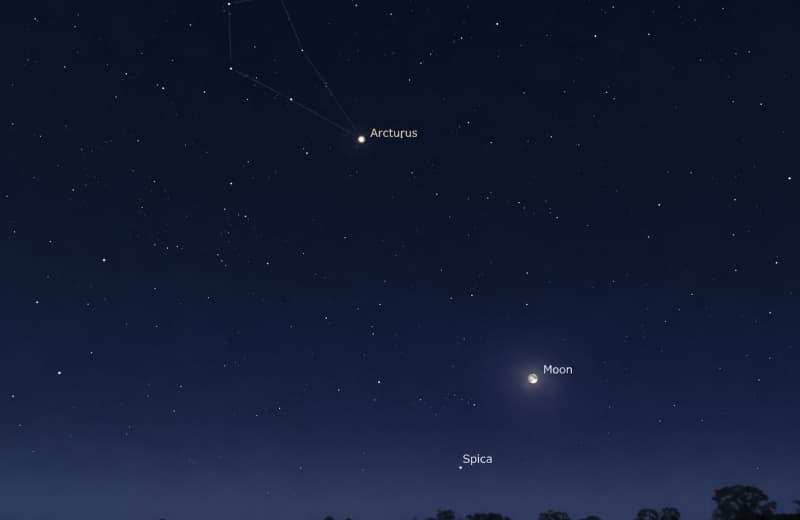
May 30: Searching for the "Kite Asterism" in Boötes
As May draws to a close, the constellation Boötes begins to dominate the eastern night sky.
About an hour after sunset, the bright Arcturus becomes quite prominent. This orange-red giant star, with a magnitude of -0.1, is one of the brightest stars in the northern sky and one of the easiest navigational stars to spot during the spring-summer transition.
The stars surrounding Arcturus form the famous "Kite Asterism." This large constellation is ideal for naked-eye observation and introductory astronomy lessons.
In the low-light-pollution environment of rural North America, the outline of a kite can be clearly seen with the naked eye. Using binoculars, a large number of background stars and the edge of the Milky Way can also be observed.
For beginners wanting to learn constellation navigation, Boötes is an important transitional constellation before the summer Milky Way observation season.
Recommended observation equipment:
8×42 binoculars
70mm refracting telescope
Naked-eye stargazing
May 31: First Blue Moon of 2026
The most important astronomical event of the week will occur on May 31st.
This day will see the first "Blue Moon" of 2026. A Blue Moon doesn't mean the moon actually turns blue, but rather that it's the second full moon within the same calendar month.
Due to the full moon's extreme brightness, deep-sky observation conditions will be poor tonight, but it's ideal for lunar photography and capturing lunar landscapes.
Even more noteworthy is the fact that the full moon will be very close to Antares in Scorpius. Antares is a famous red supergiant star, its orange-red color still visible against the moonlight.
For users in southern North America, the moon and Antares will be visible simultaneously in the southwestern sky in the early morning, creating a visually striking combination.
At the same time, Mars will rise low in the eastern sky. Because Mars also has a reddish hue, this week also presents the best time to distinguish between Mars and Antares.
Key observation targets tonight:
Blue Moon
Antares
Scorpio
Mars rising
Moon photography
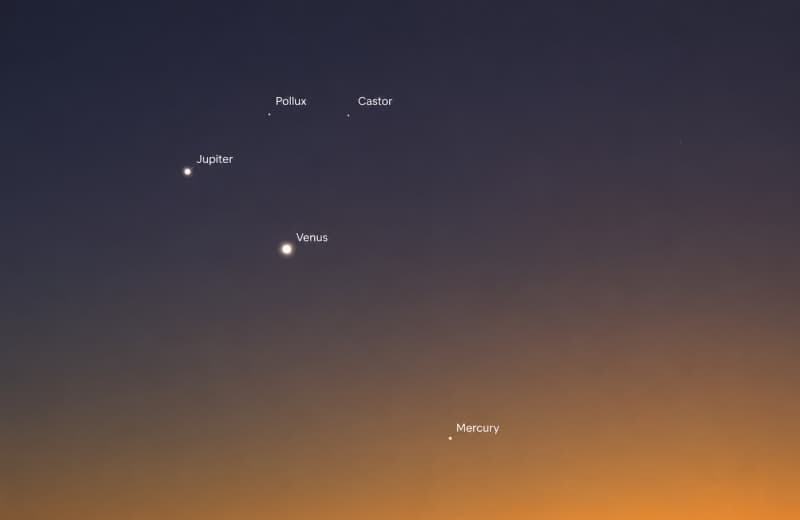
June 1st: Mercury Enters its Best Observation Season
For many North American stargazers, Mercury has always been one of the most difficult planets to observe.
But with the arrival of June, Mercury finally enters its best evening observation window of 2026.
About 30 minutes after sunset, Mercury will be low in the western sky, aligned near the ecliptic with Venus and Jupiter. This "tri-planet alignment" is extremely spectacular.
Due to the significant differences in the brightness of the three planets, it is ideal for:
Planetary brightness comparison
Studying ecliptic trajectories
Planetary photography
Observing planetary phases
With a small telescope, Mercury's gibbous phase can be clearly seen.
For beginners who have long struggled to find Mercury, this week is the most worthwhile time of year to try.
June 2nd: Saturn and Titan Enter Optimal Early Morning View
In the early morning, Saturn begins its early summer observation season.
Currently, Saturn's ring tilt is approximately 8°, meaning observers can clearly see its ring structure and southern hemisphere.
More notably, Titan will be approaching Saturn's vicinity this week. This second-largest moon in our solar system has a brightness of approximately magnitude 8, making it easily identifiable with medium-sized telescopes.
Using telescopes with apertures of 100mm or larger, some observers may even be able to search for:
Rhea
Dione
Enceladus
For planetary observers, "Saturn season" has officially begun.
Recommended Equipment:
Refractor of 90mm or larger
6-inch reflector
Planetary photography CMOS camera
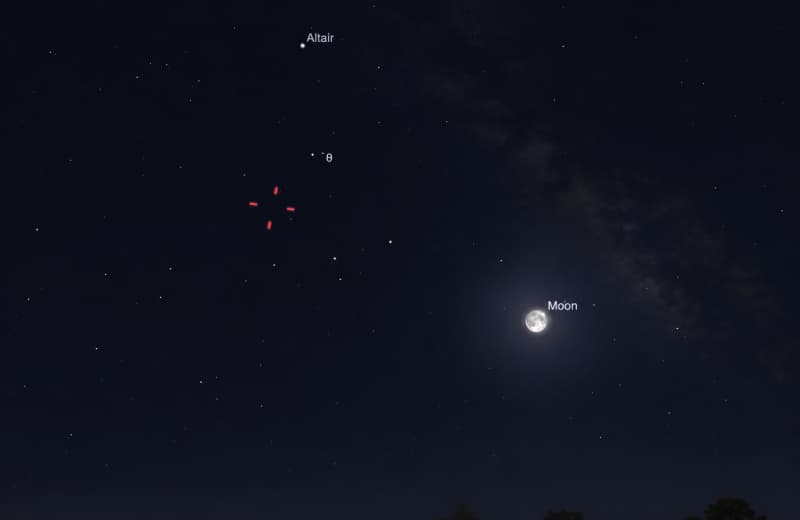
June 3: Asteroid Juno Enters Annual Observation Window
On June 3, asteroid Juno (3 Juno) will enter its stationary phase near the constellation Aquila.
This is an important time for asteroid observation, as it signifies Juno's transition from prograde to retrograde motion.
While its magnitude of 10 is too faint for naked-eye observation, this main-belt asteroid can still be located using a medium-sized telescope.
For many experienced amateur astronomers, asteroid tracking is an essential part of deep-sky observation.
If you are learning:
Asteroid location
Equatorial mount star finding
Astronomical coordinate systems
Long exposure tracking photography
Then this week's Juno is a perfect practice target.
June 4th: Jupiter Approaches Pollux, Creating a Summer Zodiacal View
On the evening of June 4th, Jupiter will be near the southern edge of Pollux.
While they won't be so close as to be indistinguishable to the naked eye, they will still create a visually stunning combination of planets and stars in a wide-angle view.
Meanwhile:
Mercury is low in the sky
Venus is in the center
Jupiter is higher up
The three planets are almost in a straight line along the ecliptic.
This type of ecliptic alignment is one of the most popular subjects for many North American astrophotographers.
Using a wide-angle lens with a landscape, such as:
Mountains
Lakes
Forests
Deserts
makes it easy to capture night sky photos with an astronomical magazine-like quality.
June 5th: Mars and Saturn in the Same Frame Before Dawn
The last major celestial event of the week will occur before dawn on June 5th.
Mars and Saturn will both be visible in the eastern sky.
Although Mars' apparent diameter is currently very small, making it difficult to see clear surface details, it remains an important marker planet in the pre-summer night sky.
For users in North America, the biggest challenges for low-altitude observation in the early morning are:
Atmospheric disturbances
Low-altitude haze
Morning light interference
Therefore, it is recommended to choose:
Higher elevation areas
Unobstructed terrain in the east
Dark sky conditions below Bortle magnitude 4
This will significantly improve the quality of planetary observation.
Analysis of North American Stargazing Conditions in June 2026
Overall, early June 2026 is an ideal time for stargazing in North America.
This week features the following characteristics:
High concentration of planets
Excellent ecliptic viewing conditions
Summer Milky Way about to rise
Blue Moon bringing high search volume
Deep-sky photography entering its peak season
This Week's Stargazing Summary
May 29th to June 5th, 2026, is one of the most worthwhile weeks for observation during the spring-summer transition.
From the Blue Moon to the best viewing period for Mercury, from Saturn's rings to Jupiter's ecliptic alignment, there are almost daily targets to record in the night sky this week.
If you are looking for:
This Week's Stargazing Guide
What to Observe Tonight
North American Stargazing Guide
Planetary Observation Times
June 2026 Celestial Events
Then this week is undoubtedly the best time to kick off the summer stargazing season.
As the Milky Way's core gradually rises in mid-June, the true peak season for deep-sky observation is just around the corner.