
After dusk in June during the Northern Hemisphere summer, as night falls, a group of iconic bright stars slowly rises in the eastern sky over the mid-to-high latitudes of North America—the Summer Triangle. This giant geometric shape, composed of Vega, Deneb, and Altair, is the most prominent navigational marker in the Northern Hemisphere summer night sky and the starting point for many astronomy enthusiasts to begin their deep-sky observation journey. For astronomy enthusiasts in the Northern Hemisphere, understanding the physical phenomena, spectral characteristics, and observation strategies behind this group of bright stars can significantly enhance their stargazing experience.

The Spectral Code of the Summer Triangle: Color Temperature and Stellar Classification
The three stars in the Summer Triangle also differ in color, mainly due to the temperature differences on their surfaces. Vega appears bluish-white, with a spectral type of A0V, and its surface temperature is approximately 9600K, making it one of the hotter main-sequence stars. Altair is slightly yellowish-white, with a spectral type of A7V and a surface temperature of about 7500K. Deneb is also white, with a spectral type of A2Ia, but it is a supergiant rather than a main-sequence star.
The three bright stars in the Summer Triangle exhibit different colors, directly reflecting the differences in their surface temperatures. Vega appears bluish-white, with a spectral type of A0V and a surface temperature of approximately 9600K, belonging to the hotter type of main-sequence star. Altair is slightly yellowish-white, with a spectral type of A7V and a surface temperature of approximately 7500K. Deneb is also white, with a spectral type of A2Ia, but it is a supergiant rather than a main-sequence star.
Low in the southeastern sky of North America during summer, there is another very conspicuous red star—Antares (α Scorpii), with a spectral type of M1.5Iab and a surface temperature of only about 3500K, making it a red supergiant with enormous luminosity. By comparing the bluish-white hues of the Summer Triangle with the orange-red luster of Antares, amateur astronomers can intuitively understand the basic relationship between color and temperature in the O-B-A-F-G-K-M sequence of stellar spectral classification.
The True Luminosity Behind Apparent Magnitude: Distance and Absolute Magnitude
Apparent magnitude is the brightness of the night sky as seen by the naked eye, but to measure a star's true luminosity, we need to use the definition of absolute magnitude—the apparent magnitude of stars at a distance of 10 parsecs (approximately 32.6 light-years). Vega has an apparent magnitude of 0.03 and is only 25 light-years away, with an absolute magnitude of about 0.5; Altair has an apparent magnitude of 0.77 and is 17 light-years away, with an absolute magnitude of about 2.2; while Deneb has an apparent magnitude of 1.25, seemingly dimmer, but is actually about 2600 light-years away, with an absolute magnitude as high as -8.4, and a luminosity about 200,000 times that of the Sun.

If these three stars were placed at the same distance from Earth, Deneb would be far brighter than the other two. This difference in brightness reflects the vast physical scale of stars in the universe: Deneb, as a supergiant, has a radius more than 200 times that of the Sun, while Vega and Altair are merely large main-sequence stars. Understanding the difference between apparent magnitude and absolute magnitude is very helpful for astronomy enthusiasts to establish a correct concept of the physical distance of stars, and can also avoid the common misconception of judging the "size" of a star based solely on its brightness with the naked eye.
Observation Strategies for Light Pollution in North America: From Cities to Dark Sky Regions
Light pollution in North America exhibits a clear urban-rural divide. In cities and suburbs with a Bortle scale of 5 to 8, Vega and Altair in the Summer Triangle remain clearly visible due to their high brightness. However, Deneb is more susceptible to background glow near the horizon, resulting in low visibility. More seriously, light pollution can obscure less bright stars, reducing the contrast between the Summer Triangle and surrounding stars, disrupting the overall constellation's outline, and significantly impacting observation. Furthermore, when Antares is low in the southeastern sky, its bright orange-red features fade to a dark yellow due to light pollution, losing its original spectral characteristics. Modern LED streetlights are rich in blue light, which seriously affects the human eye's ability to adapt to darkness. After being affected by streetlights, it usually takes 30 to 40 minutes to readjust to the dark environment. Therefore, it is recommended that astronomers in North America use tools such as Dark Site Finder or Light Pollution Map to find dark-sky locations with a Bortle rating of 3 or lower, such as remote areas of Rocky Mountain National Park or the Appalachian Mountains, to obtain the best summer triangular observation conditions.
Choosing the Right Telescope and Filters for Observing the Summer Triangle
Different types of optical equipment offer different advantages for observing the Summer Triangle and surrounding bright stars. Binoculars offer a wider field of view, suitable for appreciating the overall outline of Cygnus (Northern Cross) and the relative position of the Summer Triangle to the Milky Way; 7×50 or 10×50 binoculars are recommended. Small refracting telescopes (80mm to 100mm aperture) can be used to resolve the famous binary star system near Vega—Epsilon Lyrae, a classic target for testing optical resolution. For extremely bright red supergiants like Antares, neutral density filters can be used to reduce glare and observe the star's orange-red disk more clearly. For CCD or CMOS deep-sky photography, H-alpha narrowband filters are effective for capturing the faint reflection nebulae around Antares. For the Milky Way region where the Summer Triangle is located, a wide-angle lens with a light pollution filter (such as IDAS LPS) is suitable for wide-field photography, suppressing sodium and mercury lamp emissions while preserving the natural colors of the stars.
Excellent Navigation Tools: The Northern Cross and the Southeastern Red Giant
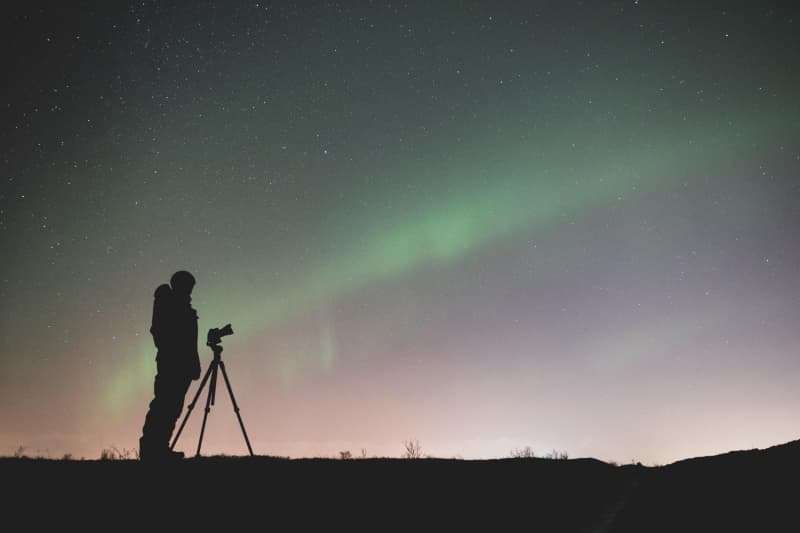
The Summer Triangle itself is an excellent nighttime navigation tool. Deneb is located at the apex of the Northern Cross (Cygnus), with Sadr forming the center of the cross, extending outwards like the wings of a swan. Moving about 15 degrees southeast from Vega will lead you to Altair. Then, turn your gaze northeast, following the Milky Way's band of light to Deneb to complete the triangle. Antares, one of the brightest red giants in the North American summer night sky, is located in the southeast and serves as a natural anchor point for locating Scorpius. The nearby globular cluster M4, faintly visible to the naked eye, is an excellent target for binoculars. In practice, it is recommended to first establish visual lines between the main bright stars using a star marker, then use a mobile star chart app (such as Stellarium Mobile) for calibration, paying particular attention to distinguishing Antares from Jupiter or Saturn slightly to the north (if it happens to be visible during the day) to avoid confusing planets with stars.
The Summer Triangle is a key anchor point for summer observations in the Northern Hemisphere not only because its three bright stars form a massive, visually recognizable geometric framework, but also because they each represent typical samples of different stages and physical scales of stellar evolution—from nearby main-sequence stars to distant supergiants, from bluish-white, hot surfaces to the cool atmospheres of red supergiants. For observers in North America, June to August is the optimal window for tracking this celestial landmark. Whether at a dark-sky camp in the Rocky Mountains or a backyard balcony in the suburbs, mastering spectral knowledge, choosing appropriate optical equipment, and understanding the impact of light pollution can elevate observations of the Summer Triangle from simple "seeing" to a deeper understanding of the fundamental nature of stellar physics.