
When many amateur astronomers first look up at the night sky, they often assume all stars emit the same white light. However, careful observation in environments with less light pollution reveals that the stars in the night sky actually possess a rich variety of colors. Some appear bluish-white, some have a yellowish tint, while others clearly exhibit orange-red or even deep red hues.
So, why are some stars red? What does this color difference signify? For stargazing enthusiasts, understanding the formation principles, temperature characteristics, and observation techniques of red stars not only enhances the stargazing experience but also helps in a deeper understanding of stellar evolution. In fact, stellar color is not simply a visual phenomenon but the result of the combined effects of a star's surface temperature, spectral type, and evolutionary stage.
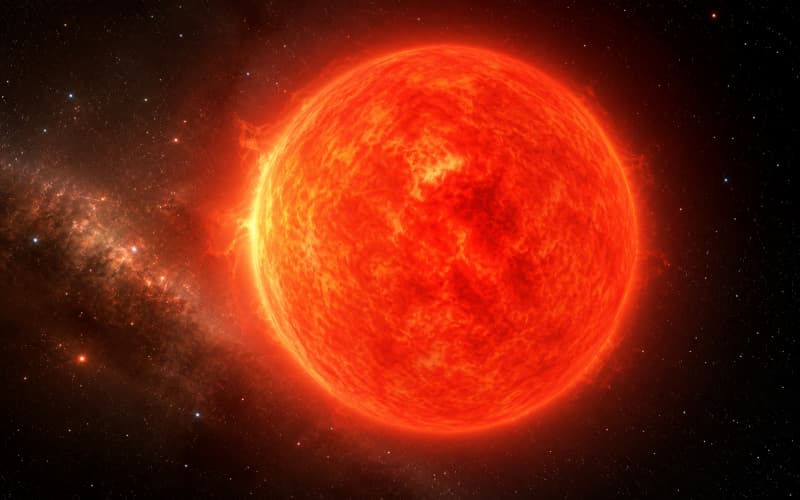
The color of a star is closely related to its surface temperature.
To understand why some stars are red, we first need to understand the relationship between stellar color and temperature. A star is essentially a giant, hot sphere of gas, radiating light according to the laws of blackbody radiation. According to Wien's displacement law in physics, the higher the temperature, the shorter the peak wavelength of the radiation; the lower the temperature, the longer the peak wavelength.
\lambda_{max}=\frac{b}{T}
Hot stars typically have surface temperatures exceeding 10,000 Kelvin, thus appearing bluish-white; while cold stars have surface temperatures of only around 3,000 to 4,000 Kelvin, and their radiation peaks are closer to the red and infrared bands, thus appearing red or orange-red to the human eye. In other words, red stars are actually cooler than the Sun. The Sun's surface temperature is about 5,778 Kelvin, classifying it as a yellowish-white star, while many red stars have surface temperatures only about half that of the Sun.
This color variation is not due to the presence of some red substance on the stellar surface, but rather to the different wavelengths of light produced by different temperatures. This is why astronomers can make preliminary judgments about the temperature range and physical properties of stars based solely on their color.
What spectral types do red stars belong to?
Modern astronomy uses a spectral classification system to categorize stars. The most common stellar spectral sequence is O, B, A, F, G, K, M, with O-type stars being the hottest and M-type stars the coldest.
In this classification system, most distinctly red stars belong to the M-type. M-type stars typically have surface temperatures below 3700 Kelvin, and their spectra show numerous molecular absorption bands, such as the titanium oxide absorption characteristic. These molecular structures can only exist in low-temperature environments, thus becoming an important characteristic of low-temperature red stars.
Besides M-type stars, some K-type stars also exhibit an orange-red hue. For example, the famous red giants in the night sky often belong to late K-type or M-type spectra. Using astronomical telescopes with low-resolution spectrometers, amateur astronomers can even observe these spectral features themselves, thus verifying the relationship between stellar color and temperature.
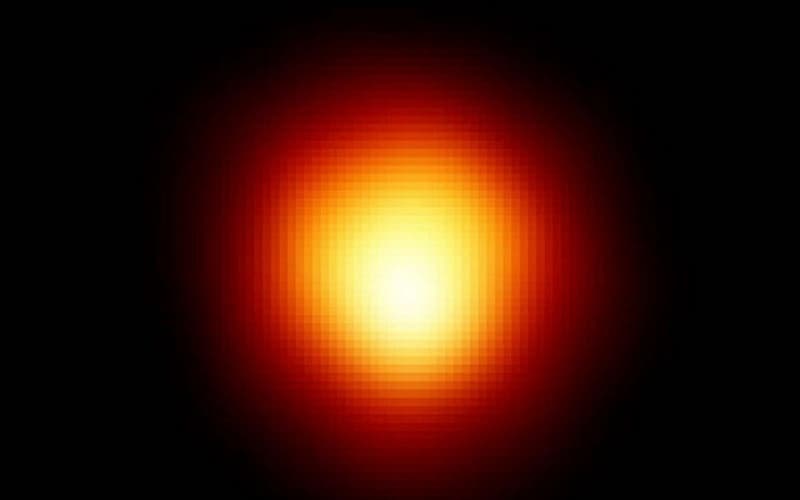
For beginners, understanding spectral classification is crucial because stellar color is actually the most intuitive representation of spectral type. When astronomers see a bright red star, they can often immediately infer that it belongs to a lower-temperature spectral category.
Why Do Red Giants Appear So Red?
Many red stars in the night sky are not simply due to their low temperature, but are closely related to their stellar evolution. During the main sequence phase, stars maintain a stable state through hydrogen fusion. As the core hydrogen fuel gradually depletes, the star's internal structure undergoes significant changes.
As the core contracts, the outer gas expands, and the star's radius rapidly increases by tens or even hundreds of times. Although the total energy output increases, the temperature per unit area decreases due to the dramatic expansion of surface area, causing the star's color to gradually turn red. Stars in this stage are called red giants.
A familiar example of a red star for North American stargazers is Betelgeuse in the winter sky. It is one of the most prominent members of the Orion constellation, with a distinct orange-red hue visible to the naked eye. Another famous red star is Antares, located in the constellation Scorpius, which is extremely prominent in the summer night sky.
These red giants are actually in the late stages of their stellar lives, so studying them helps us understand the Sun's evolutionary fate over the next billions of years.
Red dwarfs are also an important group of red stars.
When discussing why some stars are red, people often only think of massive red giants, but in fact, the most numerous red stars in the universe are red dwarfs.
Red dwarfs are low-mass stars, typically with less than half the mass of the Sun. Due to their smaller mass, their core temperatures are lower, and nuclear fusion is slower, allowing them to burn for billions to trillions of years. Compared to the Sun's lifespan of only about 10 billion years, red dwarfs can almost be called the "longest-lived champions" of the universe.
Proxima Centauri, familiar to North American amateur astronomers, is a typical red dwarf. Although it is the closest to the Sun, it is too dim to be seen directly with the naked eye.
In recent years, much exoplanet research has focused on red dwarfs because of their sheer number and extremely long lifespans. Many potentially habitable planets have also been discovered orbiting red dwarfs. Therefore, red stars are not only objects of observation but also important targets in the search for extraterrestrial life.
Earth's atmosphere also makes stars appear reddish.
Not all red stars are truly red. Sometimes, a star's color is affected by Earth's atmosphere.
As a star approaches the horizon, its light has to pass through a thicker layer of atmosphere. Molecules and particles in the atmosphere preferentially scatter blue light, causing the remaining light to appear reddish. This phenomenon is the same as why the sun appears red at sunrise and sunset.
Therefore, a star that is actually nearly white may appear orange-red or even deep red as it rises or sets. To accurately determine a star's color, it's best to observe it after it has risen to a higher altitude.
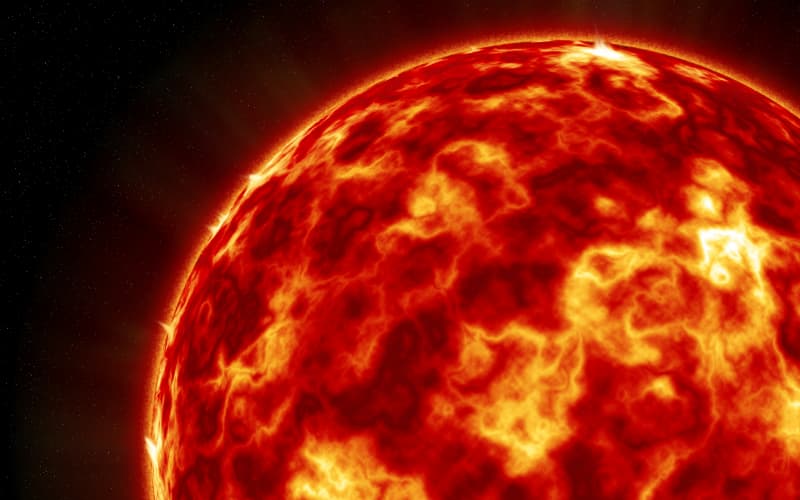
Furthermore, urban light pollution also affects color perception. The large amounts of blue light produced by LED lighting reduce the human eye's sensitivity to stellar colors. Therefore, observing in North American national parks, dark sky reserves, or suburban areas far from cities often makes it easier to discover the true color differences between stars.
How to Observe Red Stars in the Night Sky
For stargazing enthusiasts who wish to observe red stars with their own eyes, binoculars are already quite effective. 7×50 or 10×50 binoculars can enhance brightness, making the stars' colors stand out more.
Using a refracting telescope with an aperture of 80mm or larger, or a reflecting telescope with an aperture of 150mm or larger, allows for a clearer distinction between the colors of red giant stars and surrounding stars. Low-magnification observations are generally easier to perceive stellar colors than high-magnification observations because the light is more concentrated.
In winter, it's recommended to look for Betelgeuse in Orion; in summer, Antares in Scorpius; and in autumn, Aldebaran is a well-known orange-red star. These targets are relatively bright and easily identifiable even in moderate light pollution conditions.
For photography enthusiasts, using an astronomical camera with short exposures and proper white balance correction can more accurately record stellar colors, thus further understanding the relationship between stellar temperature and spectral characteristics.
Red stars reveal the secrets of stellar life.
Why are some stars red? The answer mainly comes from the combined effects of a star's surface temperature, spectral type, and evolutionary stage. Cooler stars emit more long-wavelength light, thus appearing red; many red giants are a natural consequence of stars entering their later stages; while the vast number of red dwarfs represent the most common type of star in the universe. Additionally, atmospheric scattering and observational conditions also influence the color we see.