
In the vast universe's billions of years of history, collisions and mergers between galaxies are not uncommon astronomical events. In fact, modern astronomical observations have proven that most large galaxies have undergone collisions and mergers, a process that is crucial in shaping the structure of the universe.
In the distant universe, approximately 60 million light-years from Earth, astronomers have discovered a pair of astonishingly interacting galaxies—NGC 4567 and NGC 4568. Because their overlapping appearance resembles a butterfly in flight, they are affectionately known as the "Butterfly Galaxy" by astronomers and amateur observers.
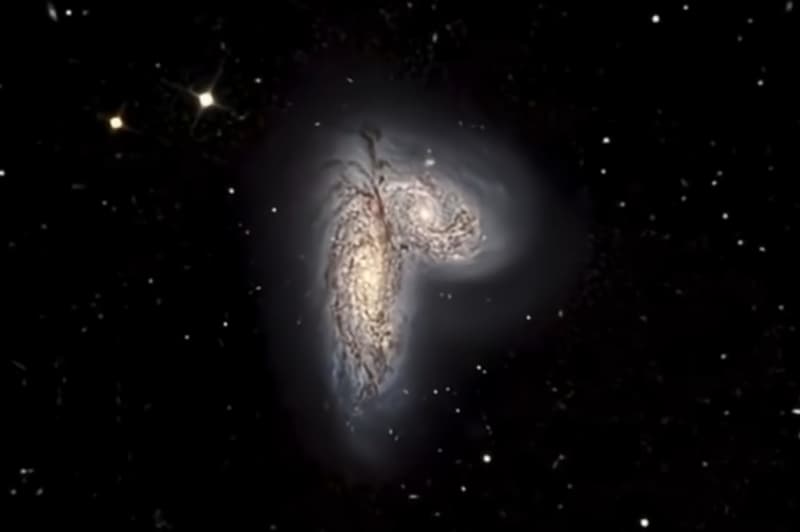
The discovery of this famous butterfly galaxy system not only benefits the astronomical community's study of galaxy collisions but also provides observational samples for star formation and gravitational interactions. For astronomy enthusiasts, the Butterfly Galaxy is a popular target for deep-sky observations in the spring.
What are Butterfly Galaxies?
Butterfly Galaxies are actually composed of two separate spiral galaxies:
NGC 4567
NGC 4568
Both galaxies are located in the constellation Virgo and belong to the famous Virgo Cluster. From Earth, the disks of the two galaxies partially overlap, creating a visual effect resembling butterfly wings, hence the nickname "Butterfly Galaxies."
The similarity between NGC 4567 and NGC 4568 is not a simple visual coincidence. Through spectroscopic analysis and redshift measurements, astronomers have confirmed that these two galaxies have very similar radial velocities and are indeed interacting gravitationally.This phenomenon is called Interacting Galaxies.
What's happening at NGC 4567 and NGC 4568?
Images taken by modern telescopes show that these two galaxies still maintain a relatively intact spiral structure, meaning they are currently in the early stages of a collision. In this stage, the stars within the galaxies don't collide directly because the distances between them are still very vast. However, the gas clouds, dust, and dark matter within the galaxies are primarily disturbed by the gravitational pull of the two galaxies.
As the two galaxies approach each other, the following phenomena will occur:
Increased gas compression
Large amounts of interstellar gas are gravitationally compressed.
Increased star formation rate
New stars begin to form in large numbers, creating so-called Starburst Regions.
The spiral structure twists and turns.
The spiral arms begin to stretch, forming tidal tails.
The cores gradually move closer together.
Ultimately, the two galactic cores will merge.
Currently, NGC 4567 and NGC 4568 are in the early stages of this process, so their spiral arms are still clearly visible.
Will galaxy collisions lead to star collisions?
This is one of the most frequently asked questions by amateur astronomers. The answer is: almost never. While two galaxies may be colliding, the average distance between stars is extremely vast. If the Sun were shrunk to the size of a golf ball, the nearest star would still be hundreds of kilometers away.
Therefore, during galaxy mergers:
Gas clouds collide frequently
Dust interacts
Dark matter halos merge
Stellar orbits are readjusted
However, the probability of actual stellar collisions is extremely low.
This is why many colliding galaxies still retain a large number of surviving stars.
What will the Butterfly Galaxy look like in the future?
According to current dynamical simulations, NGC 4567 and NGC 4568 will continue to approach each other over the next few hundred million years. It is estimated that in about 500 million years: the two separate spiral galaxies will completely merge.
After the two galaxies merge:
Existing spiral arms disappear
The galactic disk structure disintegrates
Stellar orbits become randomized
New elliptical galaxies form
This process is remarkably similar to the impending collision between the Milky Way and the Andromeda Galaxy. In other words, the Butterfly Galaxy actually demonstrates to humanity the possible evolutionary stages the Milky Way may undergo in the future.
How to observe the Butterfly Galaxy in North America?
The Butterfly Galaxy is a challenging deep-space target for amateur astronomers.
The best time to observe is typically: North American Spring Observing Season
March
April
May
Recommended Equipment:
8-inch or larger reflecting telescopes
10-inch Dobsonian telescopes
Equatorial mount system for astrophotography
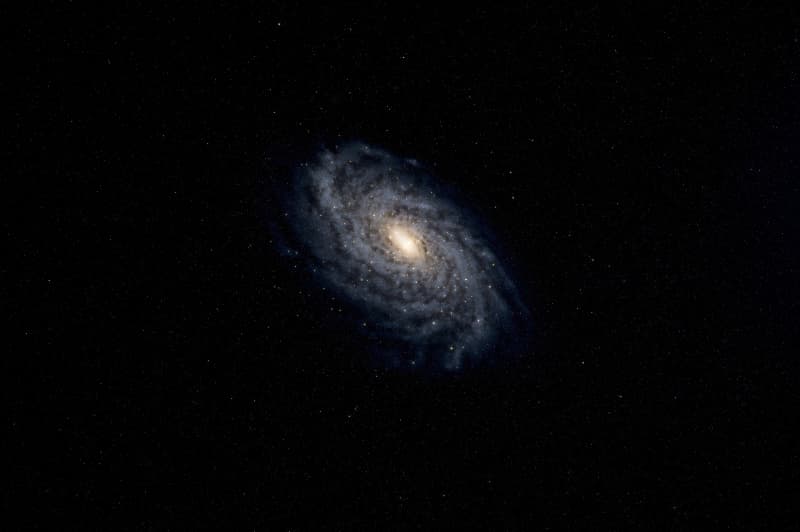
Under dark sky conditions, long exposure photography can clearly record this famous colliding galaxy.
The butterfly galaxies, NGC 4567 and NGC 4568, are among the most classic interacting galaxies in the universe. They not only showcase the magnificent processes of galaxy collisions and mergers but also reveal the physical mechanisms behind star formation, supernova explosions, and galaxy evolution. With the continuous commissioning of large-scale astronomical facilities in the future, scientists will be able to study the evolutionary history of this cosmic "butterfly" in greater depth.
For North American amateur astronomers, the butterfly galaxies are not only star targets in deep-sky photography but also important windows into understanding galaxy collisions, the Virgo Cluster, and the formation of cosmic structures. If you're planning your next spring stargazing trip, consider adding NGC 4567 and NGC 4568 to your observation list and personally witness this cosmic dance that has lasted for hundreds of millions of years.