
For astronomy enthusiasts, Venus has always been one of the most captivating celestial bodies in the night sky. As the second brightest natural object in the night sky after the moon, Venus usually appears in the sky at dusk or dawn. Under certain atmospheric conditions, Venus may also form a rare atmospheric optical phenomenon – Venus columns.
What is a Venus Light Pillar?
A Venus Light Pillar is a special atmospheric optical phenomenon.
When Venus approaches the horizon in the night sky, if there are many horizontally floating hexagonal plate-like ice crystals in the atmosphere, the light emitted by Venus will be reflected by these ice crystals, forming a bright pillar of light extending vertically.
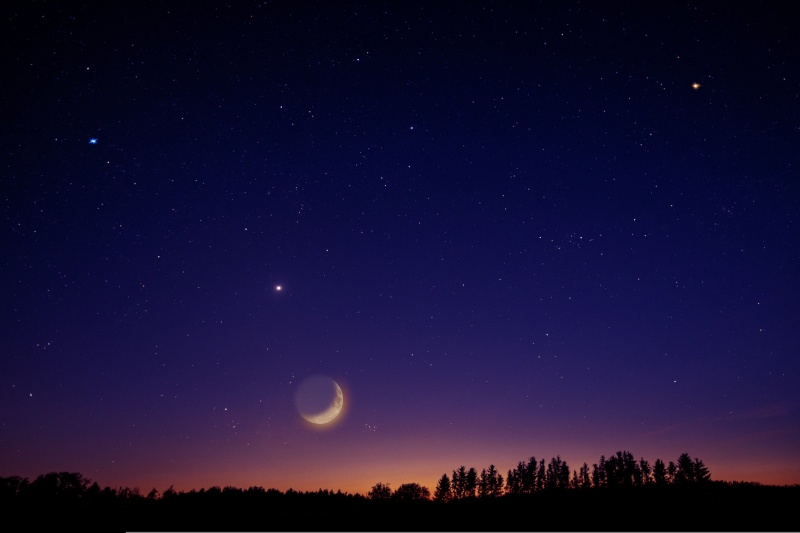
Visually, a Venus Light Pillar appears as a beam of light extending from Venus into the sky, sometimes upwards, sometimes downwards, and sometimes in both directions simultaneously.
This phenomenon is essentially the same optical phenomenon as the more common Sun Pillar and Moon Pillar, except that because Venus is much less bright than the Sun and Moon, the conditions for the formation of a Venus Light Pillar are much more demanding.
For stargazing enthusiasts in North America, being able to witness a clear Venus Light Pillar is often a very lucky experience.
The Scientific Principles of Venus Column Formation
To understand the formation of Venus column, we first need to understand the mechanism of light reflection by ice crystals.
High-altitude cirrostratus clouds or near-surface diamond dust environments often contain numerous tiny ice crystals. These ice crystals are mostly hexagonal plate-like structures.
As these ice crystals slowly fall through the air, they naturally maintain a near-horizontal orientation.
Light emitted from Venus strikes the surface of these horizontally arranged ice crystals, causing specular reflection.
Due to the observer's perspective, the reflected light from ice crystals at different altitudes eventually aligns into a vertical band of light, which we then see as a Venus column.
The formation process mainly includes:
1. Venus provides a strong light source.
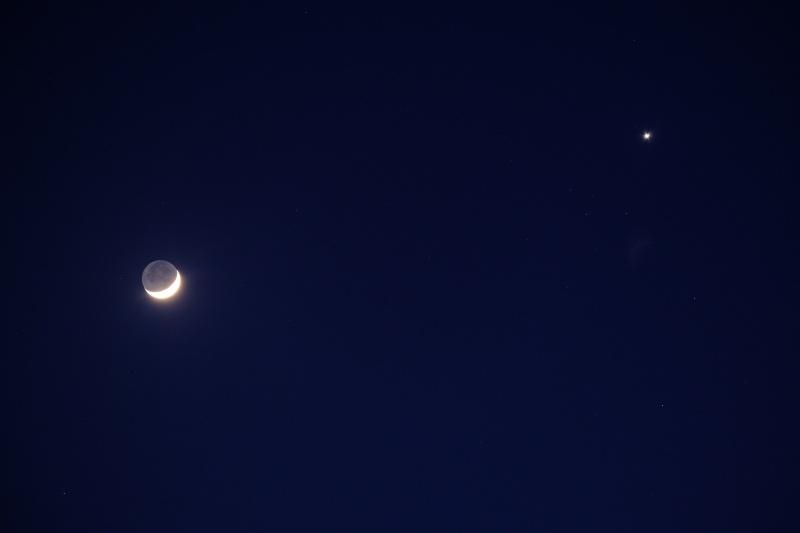
Venus's apparent magnitude can reach up to -4.9.
This brightness is sufficient to produce a noticeable reflection effect in dark environments.
2. Abundant ice crystals in the atmosphere.
The hexagonal, plate-like ice crystals in the atmosphere are key to the formation of light pillars.
Without ice crystals, even if Venus is very bright, light pillars will not appear.
3. Venus has a relatively low altitude.
Venus usually needs to be close to the horizon.
When Venus rises too high, the reflection geometry is no longer suitable for forming noticeable light pillars.
4. Its atmosphere is extremely transparent.
Water vapor, haze, or pollution in the atmosphere will weaken the light pillar effect.
Therefore, Venusian pillars are often more likely to appear in cold winter weather.
What are the differences between Venus pillars, solar pillars, and lunar pillars?
Many people, upon first seeing a photo of a Venus pillar, mistakenly believe it's simply a smaller version of a solar pillar or lunar pillar.
In reality, while they share the same formation mechanism, the difficulty of observation differs significantly.
| Light pillar type | Light source brightness | Frequency of occurrence | Difficulty of observation |
| Sun Pillar | Extremely high | Common | Easy |
| Moon Pillar | Highly high | Occasionally seen | Medium |
| Venus Light Pillar | Relatively low | Extremely rare | Very High |
Because Venus is much dimmer than the Sun and Moon, the pillars of light it produces are usually thinner, dimmer, and more easily obscured by ambient light.
This is why many amateur astronomers may never witness a prominent Venusian pillar in their lifetime.
Are Venus pillars and diffraction spikes the same thing?
The answer is no.
Many photographs show both pillars of light and radiating rays around Venus, which can be confusing.
In fact, they are completely different phenomena.
Venusian columns are a real phenomenon in the atmosphere.
Venusian columns are formed by the reflection of light from ice crystals in the air.
Even different observers viewing them simultaneously will see the same column structure.
It truly exists in the sky.
Starbursts are an optical diffraction phenomenon.
Starbursts (diffraction spikes) originate from a camera lens or the human eye itself.
When light passes through the edges of the lens aperture blades, diffraction occurs.
This creates the effect of rays radiating outwards.
In simple terms:
Venus columns are an atmospheric optical phenomenon;
Starbursts are a diffraction phenomenon produced by optical devices;
Although they may occur simultaneously, they are fundamentally different.
Which regions in North America are best for observing Venus columns?
For stargazing enthusiasts in the United States and Canada, the following regions offer the best opportunities to observe Venus columns:
Alaska
Alaska is cold, dry, and rich in ice crystals.
Winter is one of the best times in the world to observe Venus columns.
Yukon, Canada
Yukon's extremely cold environment often produces diamond dust.
Suitable for photographing solar columns, lunar columns, and Venus columns.
Alberta, Canada
Alberta has high atmospheric transparency in winter.
Photographers frequently capture various atmospheric optical phenomena.
The Great Plains region of the northern United States includes:
North Dakota
Montana
Minnesota.
These regions have cold winters and wide horizons, providing essential conditions for the formation of Venus pillars.
How to increase the probability of seeing the Venus column?
If you wish to observe the Venus column yourself, you can refer to the following strategies:
Choose the time when Venus is brightest.
Focus on the period when Venus reaches its maximum brightness.
This is an important prerequisite for forming a noticeable pillar of light.
Observe Venus when it is near the horizon.
The best time is usually:
30–90 minutes after sunset
30–90 minutes before sunrise
At this time, Venus is at its lowest altitude.
Avoid urban light pollution.
Look for observation locations with low Bortle ratings.
The darker the sky, the easier it is to spot faint beams of light.
Pay attention to the weather forecast.
Key areas to watch:
Upper-level cirrostratus clouds
Diamond dust weather
Extreme cold weather
These conditions often indicate the presence of large amounts of ice crystals.
Bring a telephoto lens.
Recommended photography equipment:
70-200mm
100-400mm
600mm and above super telephoto.
Telephoto lenses make it easier to highlight the slender Venus column structure.
Why are Venus columns so popular in astrophotography?
In deep-sky and planetary photography, Venus columns are considered a phenomenon with both scientific and artistic value.
The reasons for their popularity include:
Extremely low frequency of occurrence
Stringent observation conditions
High difficulty in capturing images
Unique visual effects
Significance for both astronomical and atmospheric optics research
Venus light pillars are a rare atmospheric optical spectacle in the night sky.
A Venus light pillar is a rare optical phenomenon formed by the reflection of Venusian light by atmospheric ice crystals. Although its formation mechanism is the same as that of solar and lunar pillars, its observation is far more difficult than other light pillar phenomena due to the limited brightness of Venus. Successful observation of Venus light pillars requires several conditions to be met simultaneously, including low-lying Venus, a transparent atmosphere, abundant ice crystals, and a wide-open horizon.